





What Is Electrodeposition?
Electrodeposition is the electrochemical process that deposits dissolved ions onto an electrically conductive surface by applying a potential difference. When metal cations gain electrons at an electrode, they are reduced and form a solid layer or discrete particles on that surface. The process is widely used both to build coatings intentionally and to remove or recover dissolved species from liquid streams.
Its basic mass relation follows Faraday’s law, m = ItM / nF, linking deposited mass to current, time, molar mass, electron number, and the Faraday constant. In real systems, deposition quality depends on voltage, current density, ion concentration, fluid flow, pH, and the geometry of the electrode surface. Competing reactions, passivation, or poor transport can limit how much material is captured efficiently.
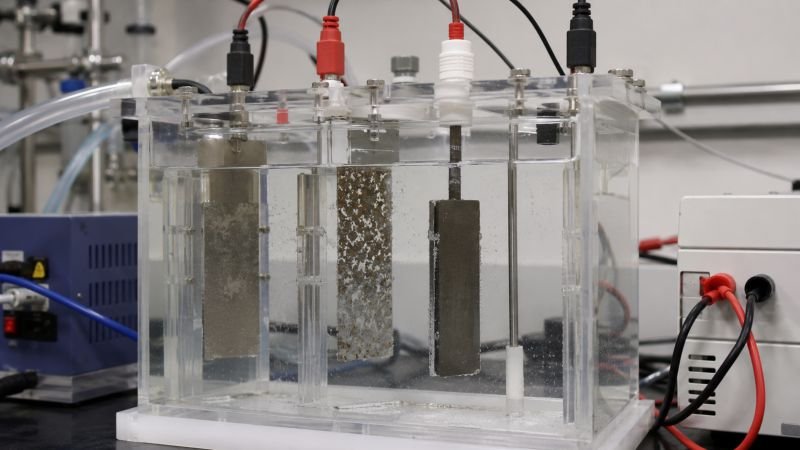
The method matters because it turns dissolved chemical content into a recoverable solid phase that can be measured, removed, or reused. In electrochemical contaminant capture, it offers a direct route for concentrating metal ions from localized polluted water. Used in devices include plating baths, microfabrication tools, corrosion test cells, and treatment modules designed to collect metals on electrode surfaces.
Example:
A treatment cell can plate dissolved copper from industrial rinse water onto a cathode for later recovery.
Related Terms:
- Chelating Ligands
- Catalytic Degradation
- Current Density
NoSuchDevice is a free archive of machines that do not exist yet but already have a shadow in physics. I research and write every entry alone, with no ads. Take a look around the archive, or help keep it free.