





What Is Electron Spin State?
Electron spin state describes the quantized angular momentum orientation of an electron. Spin is not literal rotation of a tiny sphere; it is an intrinsic quantum property that gives the electron a magnetic moment. For a free electron, the spin projection is often represented as m_s = +1/2 or m_s = -1/2 along a chosen measurement axis.
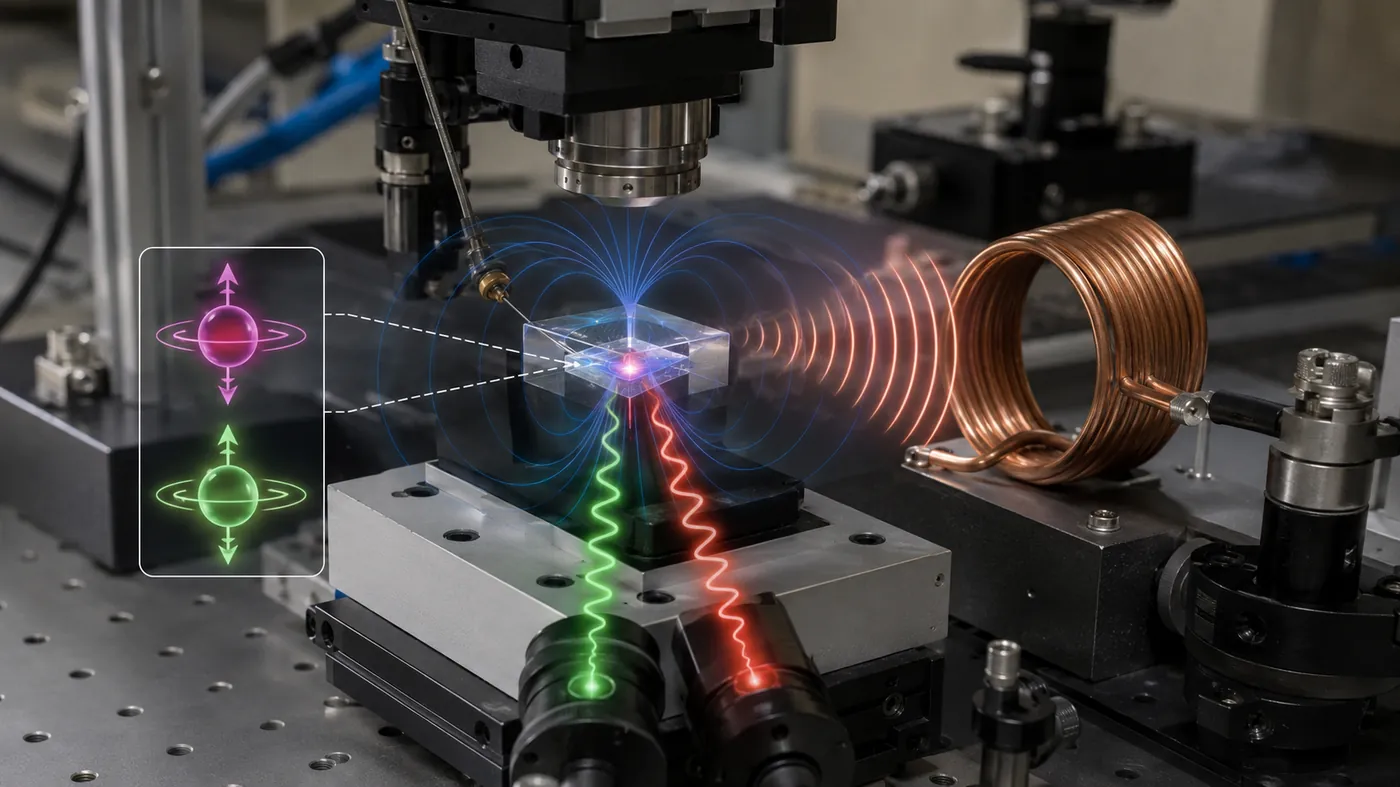
In real materials, spin states interact with magnetic fields, nearby nuclei, crystal defects, and electromagnetic radiation. Those interactions split energy levels, produce resonance signals, and allow controlled transitions between states. The principle appears in solid-state quantum sensing where spin behavior acts as a readable probe of local fields or chemical environments. Used in devices include magnetic resonance spectrometers, electron spin resonance instruments, diamond magnetometers, spintronic memory, and quantum bits.
The concept matters because spin links quantum mechanics to measurable magnetic behavior. Engineers and physicists use electron spin states to store information, sense weak fields, analyze radicals, and study defects in semiconductors. The usefulness of a spin state depends on how long it remains controllable and how clearly it can be read.
Control methods usually combine static magnetic fields with microwave or radio-frequency pulses that drive transitions between allowed states.
Example:
An electron spin resonance experiment can identify a radical species by measuring the field at which its spin state changes.
Related Terms:
- Nitrogen-vacancy Center
- Decoherence
- Magnetic Resonance
NoSuchDevice is a free archive of machines that do not exist yet but already have a shadow in physics. I research and write every entry alone, with no ads. Take a look around the archive, or help keep it free.