




What Is Nitrogen-vacancy Center?
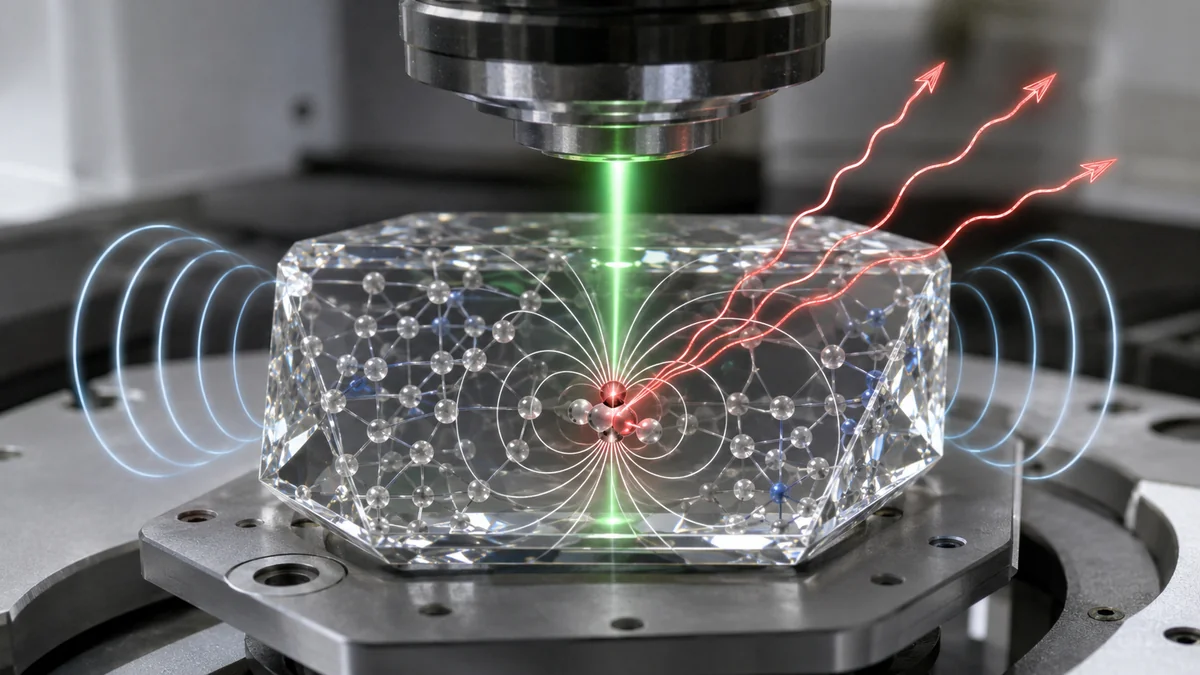
Nitrogen-vacancy center is a point defect in diamond where one carbon atom is replaced by nitrogen and an adjacent carbon site is vacant. The defect traps electronic states whose spin and light emission can be controlled at room temperature. A useful magnetic relation is Delta f = gamma_e B, where magnetic field changes shift the spin resonance frequency.
In real crystals, the center is addressed with green light and microwave fields, then read through changes in red fluorescence. Nearby magnetic fields, electric fields, strain, or temperature alter the spin levels, making the defect valuable in quantum agricultural sensing and other nanoscale measurement domains. Used in devices include diamond magnetometers, scanning probe microscopes, temperature sensors, bioimaging probes, and compact quantum sensing modules.
The concept matters because it connects atomic-scale quantum behavior to practical sensing hardware. Unlike many quantum systems, nitrogen-vacancy centers can operate without cryogenic cooling and can be placed close to samples. That makes them useful for measuring weak local signals in materials science, chemistry, biology, and precision instrumentation.
Performance is usually limited by defect depth, crystal purity, surface chemistry, optical collection efficiency, and spin coherence time.
Example:
A diamond sensor can map tiny magnetic fields from current flow in a microelectronic circuit by reading shifts in nitrogen-vacancy center fluorescence.
Related Terms:
- Electron Spin State
- Decoherence
- Diamond Lattice Defect
NoSuchDevice is a free archive of machines that do not exist yet but already have a shadow in physics. I research and write every entry alone, with no ads. Take a look around the archive, or help keep it free.