




In Maharashtra, in the third week of May 2026, a 12-hectare cotton field is waiting for nitrogen. The farmer managing it received an input cost alert three weeks earlier: urea at $591 per metric ton, up from $380 in December. The cause sits 7,000 kilometers away. The Strait of Hormuz, a 21-mile passage between Iran and Oman, has been effectively closed since early March. According to Rystad Energy’s 2025 trade mapping, roughly 21 percent of globally traded urea and 15 percent of global ammonia move through that corridor in normal times. The UN’s Food and Agriculture Organization estimates that 3 to 4 million tonnes of fertilizer per month are now stranded in a supply chain that has nowhere to move.
This disruption is not the original problem. The original problem is structural, and it predates every geopolitical crisis by decades. The system that delivers nitrogen to crops broadcasts it across entire fields. Between 40 and 70 percent of what it applies never reaches a plant root. It washes into groundwater, volatilizes into the atmosphere, or binds to soil particles in forms the plant cannot access. A shipping lane closure simply makes that underlying inefficiency catastrophic at a moment when there is no reserve.
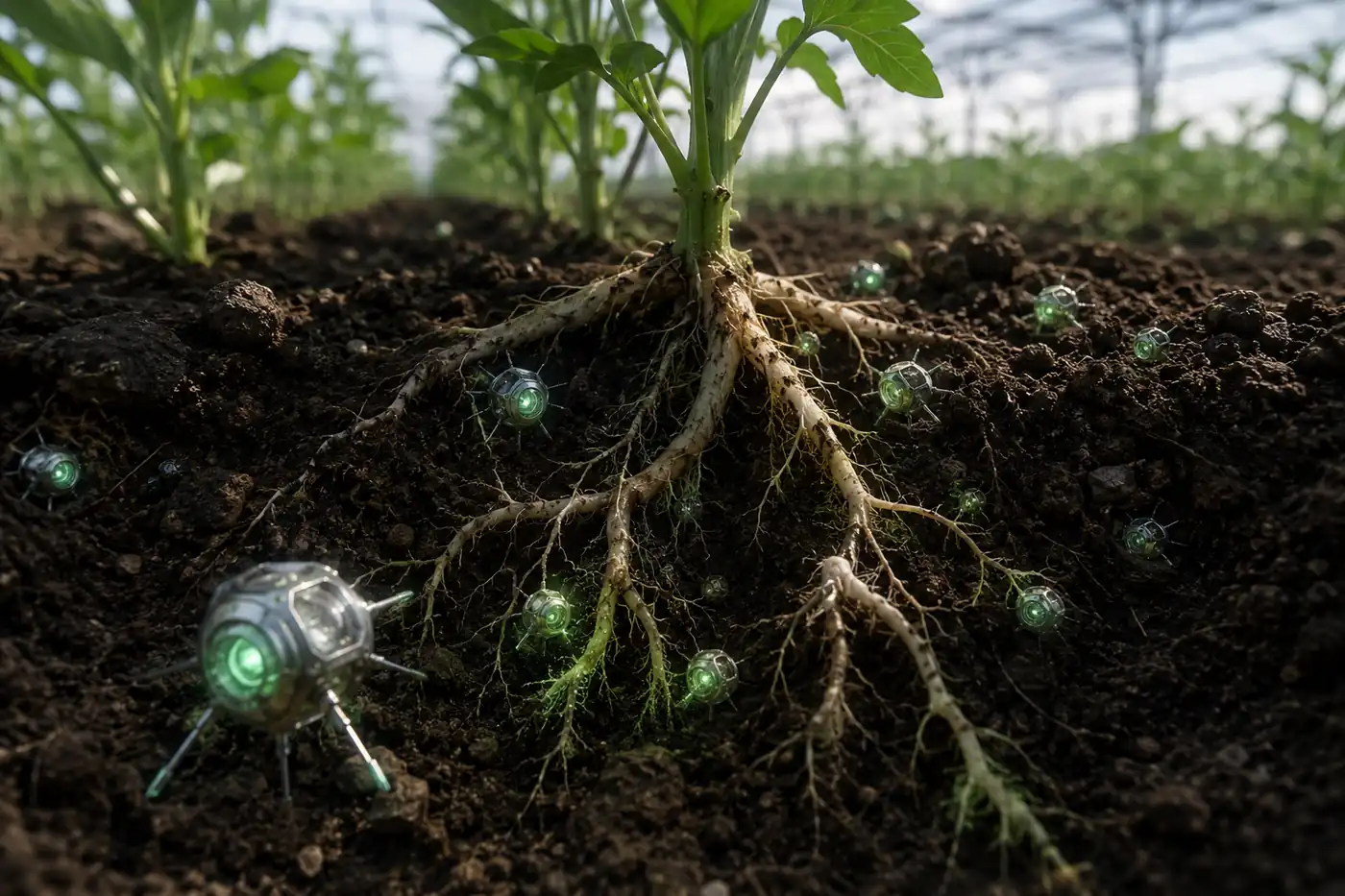
Quantum soil enhancers were designed around a different premise: find the root that needs nitrogen, position the device at its surface, and deliver the nutrient directly to the site of metabolic demand. Everything in between – the volatile supply chain, the broadcast application, the 50-percent loss rate – becomes unnecessary.
The short version: Quantum soil enhancers are nano-scale devices deployed in swarms of 10 billion per hectare. Each agent navigates the soil matrix using electrochemical gradients, reads the metabolic state of individual root hairs using quantum sensing elements, and releases its nitrogen payload only when it detects confirmed nutrient stress. The nitrogen retention rate in a quantum-enhanced field reaches approximately 90 to 95 percent of what is applied. The physics driving the delivery mechanism already operates inside every nitrogen-fixing bacterium on Earth.
Key Takeaways
- The quantum tunneling mechanism that drives nitrogen delivery in these devices has been running inside soil bacteria for 2.7 billion years. Evolution installed it. The quantum soil enhancer replicates it deliberately.
- Conventional broadcast fertilization loses between 40 and 70 percent of applied nitrogen before any root absorbs it. A quantum enhancer swarm reduces that loss to roughly 5 percent.
- Each agent is smaller than a bacterium and lighter than a grain of pollen. A full hectare deployment fits in a standard irrigation tank.
- The device does not respond to low nitrogen in the surrounding soil. It responds to a root hair showing confirmed metabolic distress – a biological signal that bulk soil chemistry cannot produce on its own.
- At continental scale, a coordinated network of quantum enhancer swarms starts to function as a live metabolic sensing layer for the planet’s food-producing surface.
Table of Contents
The Fertilizer System Quantum Soil Enhancers Were Built to Replace
The nitrogen economy of modern agriculture rests on a reaction Fritz Haber first achieved in 1909. His synthesis of ammonia from atmospheric nitrogen and hydrogen gas, scaled industrially by Carl Bosch, solved a hard geochemical problem: nitrogen makes up 78 percent of the atmosphere but sits locked in a triple bond that most living organisms cannot break. The Haber-Bosch process breaks it. Every year, approximately 150 million tonnes of ammonia leave those plants, mostly destined for the urea, ammonium nitrate, and other nitrogen fertilizers that the global food system depends on.

The delivery end of that system has not kept pace with the production end. Urea dissolves in soil water and converts through hydrolysis into ammonium. Ammonium can oxidize further into nitrate, and nitrate moves freely with water through the soil pore network. Rainfall, irrigation, and the physical structure of the soil carry it out of the root zone before the plant can capture it. A nitrogen application efficiency of 35 to 50 percent is considered an acceptable outcome under conventional practice. In light tropical soils with high rainfall, it drops below 30 percent.
The Hormuz disruption has put a sharp number on what that inefficiency costs under supply pressure. Urea prices rose more than 28 percent within three weeks of the closure, crossing $600 per metric ton by mid-March 2026. Countries including India, Brazil, Bangladesh, Thailand, and Australia face direct exposure. One ton of urea now costs US farmers the equivalent of 126 bushels of corn, up from 75 bushels in December 2025. Historical data from the 2022 Russia-Ukraine fertilizer disruption suggests prices often continue rising for several months after the initial shock.
Quantum soil enhancers do not make that supply chain more resilient. They make it matter less, by capturing 90 to 95 percent of what enters the field rather than 35 to 50 percent.
What Quantum Soil Enhancers Actually Do
A quantum soil enhancer is not a fertilizer carrier in the conventional sense, and calling it a sensor misses the function entirely. The device holds both roles simultaneously, at a scale where the distinction between sensing a signal and acting on it collapses to femtoseconds.
Each device is a structured nano-assembly approximately 200 to 400 nanometers in diameter – smaller than most soil bacteria, roughly the scale of a large virus. Its casing is a biodegradable polymer matrix embedding three functional components: a quantum sensing array that reads local ion chemistry and magnetic signatures from root cell metabolism; an electrochemically active surface that drives passive navigation through soil pore networks; and a sealed nutrient payload chamber holding nitrogen precursors in encapsulated form. The chamber opens only when two independent quantum sensing signals agree that a target root hair is in confirmed nutrient deficit. Agreement from one signal alone is not sufficient to trigger release.
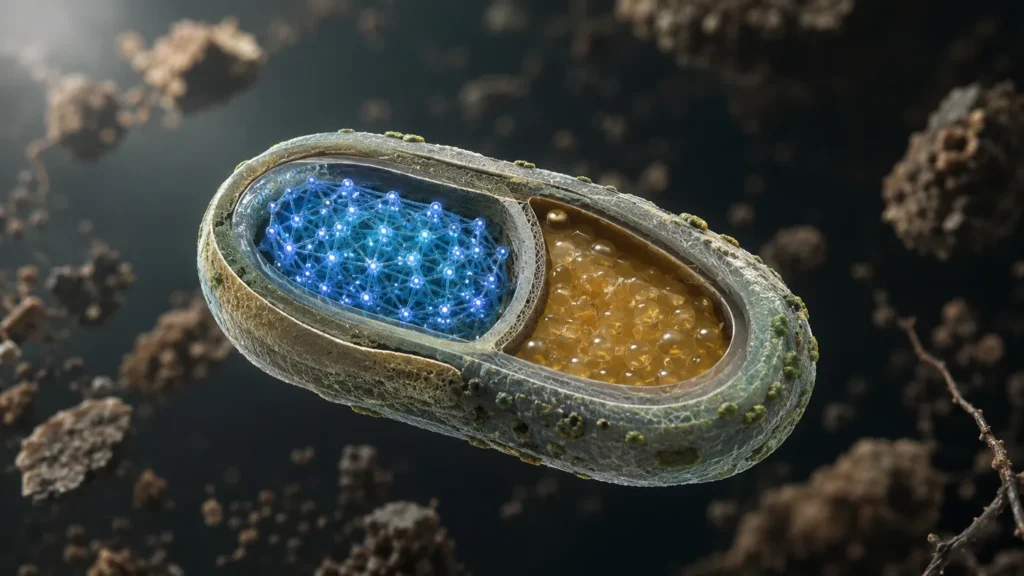
The swarm that does the actual agricultural work contains approximately 10 billion such agents per hectare, applied in aqueous suspension through standard drip or flood irrigation infrastructure. Over 24 to 48 hours after application, the swarm distributes itself through the soil pore network, drawn toward root surfaces by the same electrochemical gradients that guide bacterial chemotaxis. Each agent acts independently. No central control allocates deployments across the field. The collective behavior – dense agent concentrations near high-demand roots, sparse distribution in low-activity zones – emerges from 10 billion individual responses to local chemistry.
What results is a form of nitrogen delivery the soil microbiome experiences as a supplementary source. Bacterial nitrogen-fixers continue working. Mycorrhizal networks continue mediating phosphorus exchange. The quantum soil enhancer fills the gap between what biology provides and what the crop demands at peak growth rate.
How a Quantum Soil Enhancer Navigates the Ground
The soil beneath a crop field is not a passive medium. It is a matrix of mineral particles, organic fragments, fungal hyphae, bacterial colonies, and a continuous film of water across solid surfaces that carries dissolved ions, organic acids, and metabolic byproducts in concentrations that shift over distances of millimeters. Any device released into this environment needs a navigation mechanism that functions without external signals and draws no onboard power for movement.
Passive Navigation Using Root Exudate Gradients
Plant roots release chemical signals into the surrounding soil continuously. Organic acids, root exudates, and metabolic byproducts alter the local pH and oxidation-reduction potential of the soil water film in patterns that intensify toward the root surface. A quantum soil enhancer carries a surface charge configuration tuned to the electrochemical signature of these gradients. As exudate concentration increases, the device experiences a net directional force through charge interactions with the soil water film, moving passively toward the signal source with no propulsion mechanism.
In sandy soils with open pore networks, passive migration covers several millimeters per hour. Clay-rich soils slow movement but increase retention time near root zones, because higher surface charge on clay particles holds agents in proximity to root surfaces where sensing signals are strongest.
Positioning at the Root Surface
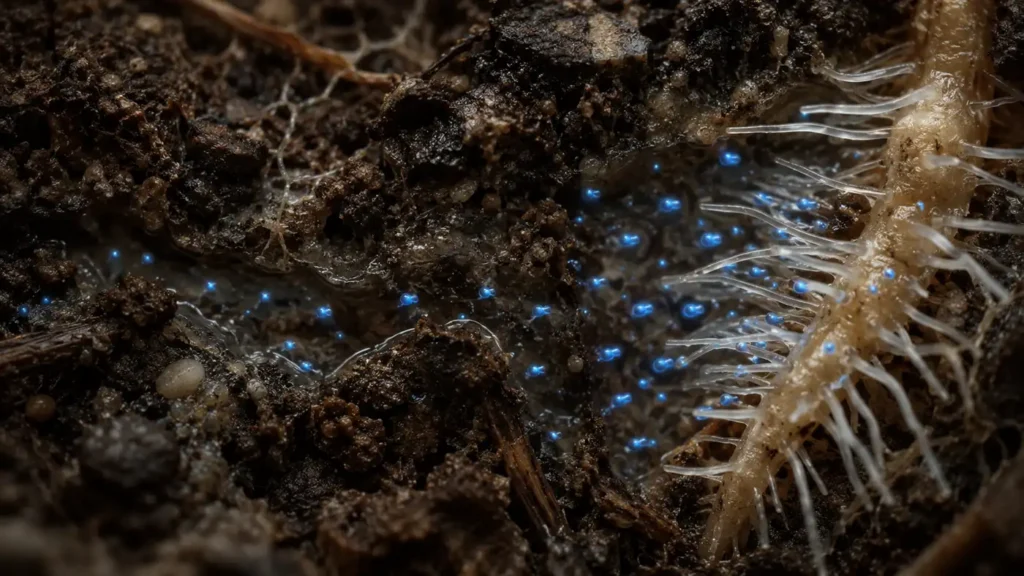
At approximately 2 to 5 micrometers from an active root hair – within sensing range but outside direct physical contact – the device stabilizes. The surface charges that drove it toward the root now hold it in a stable proximity position against the soil water film. At this distance, the quantum sensing elements engage. The physical navigation phase is complete. What follows is a sensing and decision process occurring entirely within the device’s quantum measurement architecture, completing before any payload release.
The Physics a Quantum Soil Enhancer Runs On: Tunneling and Nitrogenase
The nitrogen delivery mechanism in a quantum soil enhancer does not propose new physics. It replicates a process that nature solved roughly 2.7 billion years ago in the nitrogenase enzyme of nitrogen-fixing bacteria. Nitrogenase converts atmospheric nitrogen gas into ammonium by moving electrons through a chain of iron-sulfur protein clusters toward the bound N₂ molecule. At each step in that chain, the electron does not travel over the energy barrier separating one cluster from the next. It tunnels through it.
Quantum tunneling allows a particle to cross an energy barrier it does not classically have enough energy to surmount. For electrons in a biological protein, the barrier is the gap between electron donor and acceptor sites. At nanometer scales, that gap is narrow enough that quantum wavefunctions extend across it, and the electron appears on the other side without having traveled through the intervening space. The process is not a metaphor or an approximation. It is the measured physical mechanism of biological electron transfer.
The Tunneling Probability at Work
The probability that an electron successfully tunnels across a potential barrier is:
T ≈ e^(-2κd)
where d is the barrier width and κ is the decay constant, defined as:
κ = √(2m(V – E)) / ħ
Each symbol in plain terms:
- m is electron mass: 9.11 × 10⁻³¹ kg
- V – E is the effective barrier height above the electron’s energy: in the nitrogenase iron-sulfur chain, approximately 0.3 eV, equal to 4.806 × 10⁻²⁰ J
- ħ is the reduced Planck constant: 1.055 × 10⁻³⁴ J·s
- d is the distance between adjacent iron-sulfur clusters: approximately 0.7 nanometers
Calculating κ:
κ = √(2 × 9.11×10⁻³¹ × 4.806×10⁻²⁰) / 1.055×10⁻³⁴ = 2.80 × 10⁹ m⁻¹
Then:
2κd = 2 × 2.80×10⁹ × 0.7×10⁻⁹ = 3.92
T ≈ e⁻³·⁹² ≈ 0.020
Two percent probability per crossing attempt. In physiological conditions, nitrogenase processes millions of attempts per active site per second. The throughput is sufficient to fix nitrogen at rates that support plant growth across billions of root systems simultaneously. A quantum soil enhancer’s delivery scaffold replicates this iron-sulfur cluster geometry in a synthetic lattice, running at the same two-percent-per-attempt tunneling probability with a substrate concentration that triggers release into the root zone water film on demand.
The biological precedent is the essential point. Quantum tunneling already works in warm, wet soil chemistry at root-zone temperatures. Nature has been running that experiment without interruption for 2.7 billion years.
Everything here is free. Readers are the reason it stays that way.
I make all of it alone, with no ads. If it is worth a coffee a month to you, that keeps the next one coming.
Keep it alive →How Quantum Soil Enhancers Read What a Plant Actually Needs
Delivering nitrogen is not the hard problem in quantum soil enhancer design. Discrimination is. The device must distinguish a root hair in genuine nitrogen deficit from one that is adequately supplied, inside a chemical environment where both states produce broadly similar bulk ion concentrations. A wrong reading in either direction constitutes failure – delivering to a satisfied root wastes payload; missing a root in crisis defeats the device’s purpose.

Two independent quantum sensing modalities must both confirm nutrient deficiency before any payload releases.
Quantum Dot Ion Profiling
Embedded in the device casing, an array of quantum dots – semiconductor nanocrystals between 3 and 8 nanometers in diameter – emits fluorescent light at wavelengths that shift predictably with the local concentration of specific ions. Ammonium (NH₄⁺), nitrate (NO₃⁻), and local pH together define a three-dimensional ion signature that the array resolves at sub-nanomolar precision. Classical electrochemical sensors of comparable size produce noisy readings in ion-rich soil water and require external power. The quantum dot array requires neither, responding optically through passive quantum confinement effects – a consequence of size-dependent orbital quantization in nanocrystals small enough that electrons behave as confined particles.
Molecular Spin as a Metabolic Fingerprint
Below the ion-concentration level, nitrogen-vacancy (NV) defect centers in a synthetic diamond lattice embedded in the casing detect something the quantum dots cannot see. Under nitrogen stress, root cell metabolism shifts electron-carrying molecules in the root wall into a specific spin state configuration that produces a characteristic magnetic field pattern with a measurable relaxation time. A root sitting in low-nitrogen soil but not actively metabolizing does not generate this signature. A root in confirmed metabolic distress does. The quantum soil enhancer requires both the quantum dot ion profile and the NV magnetic fingerprint to align – because the soil can produce conditions that satisfy one check independently of the other.
| Parameter | Broadcast Fertilization | Quantum Soil Enhancer |
|---|---|---|
| Delivery precision | Field-scale broadcast | Individual root hair, 2-5 micrometer range |
| Delivery trigger | Scheduled application timing | Dual quantum sensing confirmation |
| Nitrogen retained by plant | 30-60% of applied volume | 90-95% of applied volume |
| Sensing resolution | None | Sub-nanomolar, quantum spin-assisted |
| Power requirement | External spreading machinery | Passive electrochemical gradient harvesting |
How Quantum Soil Enhancers Coordinate Across a Field
Ten billion independent agents distributed through one hectare of topsoil is not a system that benefits from centralized management – and the architecture reflects that. The swarm does not communicate. No wireless protocol runs between devices. No scheduler allocates delivery events across the field. Each agent responds to its immediate local environment, and the aggregate behavior across all 10 billion emerges from those individual responses.
Dense root zones with high metabolic activity draw agents through stronger exudate gradients, producing higher local agent concentrations precisely where crop demand is greatest. Low-activity zones generate weaker gradients and receive fewer agents. The distribution of the swarm across a field self-organizes around actual root demand without any external instruction.
Power for sensing and signal-threshold computation comes from the redox chemistry naturally occurring in the soil water film. Each device harvests milliwatts from oxidation-reduction reactions in its immediate environment – sufficient to run its quantum sensing elements and trigger payload release. No battery. No external power source. The chemistry of the soil the device navigates also powers the decisions it makes.
At the end of the growing season, approximately 15 percent of deployed agents migrate upward with capillary water and can be recovered at field margin drainage collection points. Each carries a passive record of its sensing history: the local ion profiles, NV magnetic signatures, and delivery events it encountered across the season. Aggregated from millions of recovered agents, this record becomes a high-resolution spatial-temporal map of root-zone nutrient demand across the field. Processed through the AI soil analysis platforms described in The Role of Artificial Intelligence in Eco Tech, that seasonal dataset calibrates the payload composition and deployment density for the following year’s application.
What Quantum Soil Enhancers Become at Planetary Scale
Quantum effects in biological systems are not a theoretical conjecture. The light-harvesting complex in photosynthesis uses quantum coherence to route absorbed photon energy to the reaction center with near-perfect efficiency – a result that classical energy transfer cannot replicate. As covered in Quantum Mechanics in Eco-Tech, these biological precedents establish that quantum effects operate reliably in warm, wet biological environments at the timescales biology requires. Nitrogenase runs the same principle for electron transfer. What quantum soil enhancers do is extract those blueprints from organisms that evolved them over billions of years and instantiate them in a synthetic chassis built for agricultural precision.

The physical constraint deserves a direct statement: quantum coherence above approximately 310 Kelvin is unstable. Thermal noise destroys superposition states faster than most engineered systems can exploit them. The quantum soil enhancer handles this the same way nitrogenase does – by relying on quantum events that complete in femtoseconds, roughly a thousand times faster than thermal decoherence can act at root-zone temperatures. The race ends before the noise arrives.
The evolutionary arc of the technology progresses through three identifiable stages. A first-generation quantum soil enhancer handles a single crop cycle in a single field, operating without external data. A mature form integrates with satellite-scale soil monitoring: the continental-resolution nutrient demand maps described in Environmental Monitoring with Remote Sensing feed directly into pre-deployment payload calibration, informing the swarm about field conditions before it enters the ground. At the third stage, a coordinated network of satellite data, AI demand modeling, and continent-wide quantum enhancer deployments transitions from precision agriculture into something qualitatively different: an active nutrient management system operating across the planet’s food-producing surface.
The difference between a swarm in Maharashtra in 2026 and that third stage is not a difference in kind. It is one in scale, in coordination, and in the number of growing seasons it takes to move a device from a single field to infrastructure.
The View From NoSuchDevice
What makes me uncomfortable about quantum soil enhancers is not the physics. The physics is solid. Quantum tunneling in nitrogenase is measured and published. NV center magnetometry at sub-nanometer resolution has been demonstrated in laboratory conditions. Quantum dot ion sensing at sub-nanomolar precision is operational in research settings. The device assembles validated mechanisms at every component level.
The discomfort is in the distance between component validity and deployment reality. Manufacturing 10 billion precisely structured nano-assemblies per hectare, at a cost that makes agricultural sense for a farmer currently paying $600 per ton for urea, is a supply chain problem of semiconductor-industry difficulty. Individual components can exist in a lab. Making them exist in billion-unit production batches at commodity prices is a different category of work entirely.
That said, I think quantum soil enhancers sit firmly in Zone 2 of what this archive covers. The physics is real. The engineering path is coherent. The scale challenge is enormous but not categorically different from what the semiconductor industry solved for integrated circuits across 50 years of cost reduction. The trajectory is clear, even if the timeline is not.
Where I land honestly: this technology becomes more economically attractive the more expensive conventional fertilizer gets. The Hormuz closure is driving urea above $600 per ton, and analysts suggest prices could continue climbing for months. Every disruption to the nitrogen supply chain makes a device that captures 90 percent of what enters the field – rather than 40 percent – look less like a luxury and more like arithmetic. If the input volume drops proportionally to efficiency gains, the device does not need to be cheap to compete. It needs to be cheap enough relative to the input volume it eliminates.
The civilizational implication at infrastructure scale is one I find genuinely uncertain. A real-time metabolic sensing layer across global agricultural land – combining satellite monitoring, AI demand modeling, and the passive sensing records from billions of recovered agents each season – produces a feedback loop humanity has never had: not a model of what soil health probably is, but a continuous measurement of what it actually is, at root-hair resolution, across entire growing regions. Whether that constitutes a meaningful step toward food security or simply a more sophisticated form of engineered dependency is not a question the device answers. It is the question that comes after.
You read the whole thing.
That is rarer than it should be, and it is the exact kind of attention I built this archive for. I make every piece alone, with no ads and no investor deciding what gets written. If you want the next machine taken apart like this one, you can help me make it.
A coffee a month is enough to keep it free for everyone.
Prefer crypto or a one time gift? Other ways to give →