



What Is Decoherence?
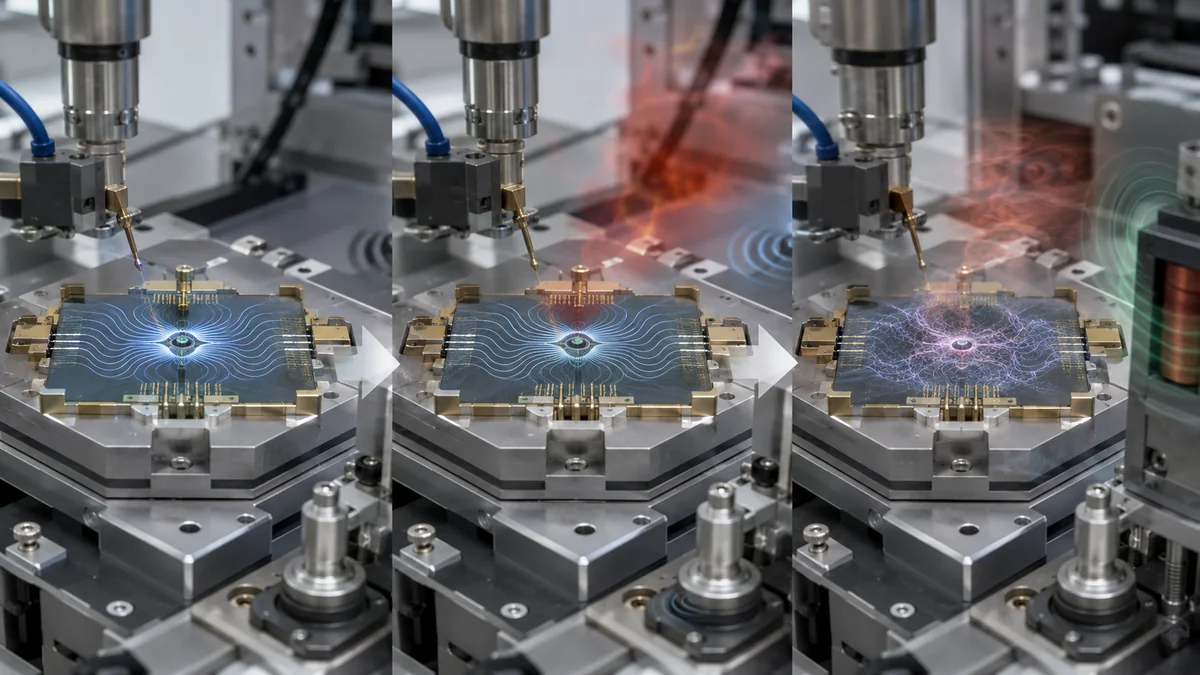
Decoherence is the loss of usable quantum phase relationships when a quantum system becomes coupled to its surrounding environment. A superposition can still exist in the larger combined system, but local interference becomes unavailable to measurement. A common decay model is C(t) = C0 exp(-t/T2), where T2 is a coherence time for phase-sensitive behavior.
In real systems, decoherence is caused by magnetic noise, thermal motion, charge fluctuations, collisions, imperfect control pulses, and unwanted coupling to nearby degrees of freedom. It limits quantum biosensing methods because the signal must be measured before environmental noise erases readable phase information. Used in devices include quantum computers, atomic clocks, diamond sensors, superconducting circuits, trapped-ion systems, and magnetic resonance instruments.
The concept matters because it sets the practical boundary between a controllable quantum state and an ordinary noisy signal. Long coherence times allow finer sensing, deeper computation, and more precise timing. Short coherence times force faster measurement, better isolation, error correction, or signal-averaging strategies.
Engineers reduce decoherence with shielding, cooling, pulse sequences, cleaner materials, and designs that isolate the useful state while preserving access for control and readout.
Example:
A diamond magnetometer loses sensitivity when nearby fluctuating spins shorten the coherence time of its sensing defect.
Related Terms:
NoSuchDevice is a free archive of machines that do not exist yet but already have a shadow in physics. I research and write every entry alone, with no ads. Take a look around the archive, or help keep it free.