






What Is Farad?
The farad is the SI unit of capacitance. One farad means a device stores one coulomb of charge when the applied voltage changes by one volt, written as 1 F = 1 C / V. Because a full farad is very large for ordinary electronics, most components are specified in microfarads, nanofarads, or picofarads, while high-capacitance storage devices may be rated in whole farads or far beyond.
In practice, the farad provides a common scale for comparing how strongly different systems store charge. In electrical capacitance measurement, a higher farad value usually means less voltage change for a given added charge, although usable energy also depends on operating voltage and losses. Used in devices include filters, oscillators, camera flashes, medical defibrillators, and supercapacitors.
The unit matters because it connects abstract field theory to real design choices. Engineers use farad values to size timing networks, smooth ripple, shape transient response, and compare storage components across very different technologies. A capacitance number alone is not the whole story, but without it there is no consistent way to discuss charge storage quantitatively.
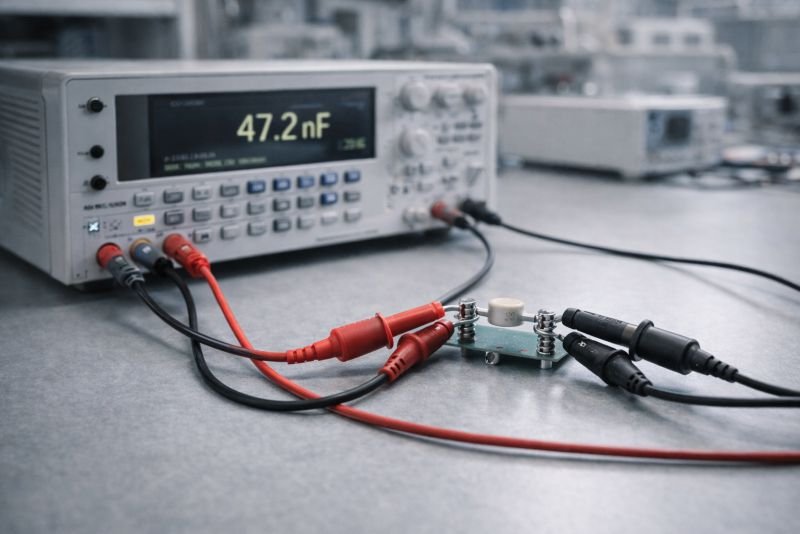
Measurements in farads come from AC bridge methods, impedance analyzers, or controlled current-voltage tests. Those methods must account for leakage, equivalent series resistance, frequency, and temperature, since real components do not behave like perfect ideal capacitors under all conditions.
Example:
A 3000-farad supercapacitor module can absorb or release large bursts of charge with only a moderate change in terminal voltage.
Related Terms:
- Capacitance
- Pseudocapacitance
- Coulomb
NoSuchDevice is a free archive of machines that do not exist yet but already have a shadow in physics. I research and write every entry alone, with no ads. Take a look around the archive, or help keep it free.