


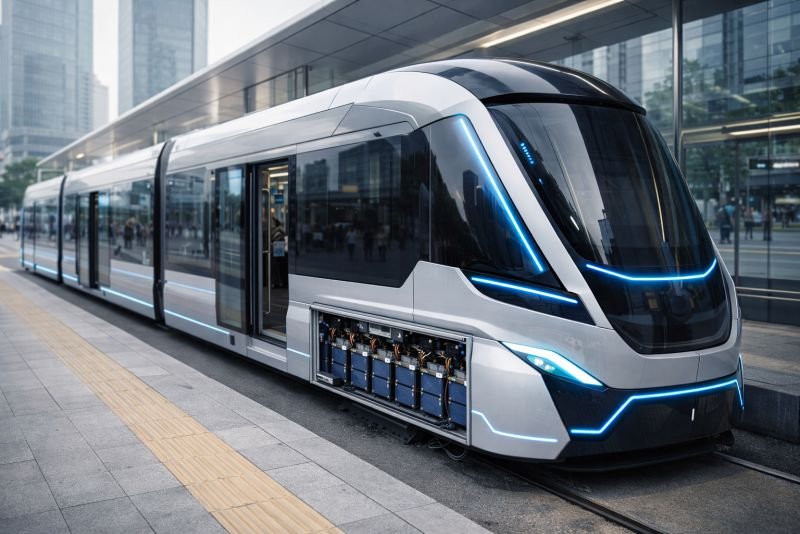
In Zhuzhou, Hunan Province, China, a tram sits at a station for about thirty seconds. Passengers board. Doors close. The tram pulls away down a track that carries no overhead cables, no third rail, nothing supplying power from the surrounding infrastructure. At the next stop, two minutes later, it pauses again for thirty seconds. Then it leaves. The cycle repeats at every stop along the route.
The energy for each segment comes from a bank of supercapacitors that charge completely in the time it takes to load passengers. The CRRC system, deployed commercially from 2013 onward, is not a demonstration project. It runs daily service. What it demonstrates, quietly, is that a capacitor charged in seconds can move a forty-tonne vehicle for nearly two kilometers, and can do this millions of times without the device degrading in any meaningful way.
Most people think of capacitors as small components that smooth voltage in circuit boards. A supercapacitor is a different class of device entirely. Understanding why requires going down to the molecular level of the electrode surface, where the real physics happens.
The short version: Supercapacitors store energy as an electrostatic field at the electrode surface, not through a chemical reaction. This allows them to charge in seconds, survive over one million cycles, and deliver power at rates no battery can match. The tradeoff is energy density: a supercapacitor holds roughly 5 to 15 Wh per kilogram, compared to 150 to 250 Wh/kg for a lithium-ion battery. For applications requiring fast bursts of power rather than long-duration storage, nothing currently outperforms them.
Table of Contents
How Supercapacitors Store Charge at the Molecular Interface
A conventional capacitor stores charge between two conducting plates separated by an insulating layer. Apply a voltage, charge builds on the plates, energy is stored in the electric field between them. The capacitance, measured in farads, depends on the area of the plates and the distance between them. Ordinary capacitors have small plates and a measurable gap, so their capacitance is typically measured in microfarads or picofarads.
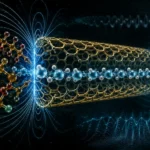
Supercapacitors use a fundamentally different mechanism. The separator is not a solid insulator but a liquid electrolyte, a solution of ions that can move freely through the device. When voltage is applied, ions from the electrolyte migrate toward the electrode surface and arrange themselves in an extremely thin layer, separated from the electrode by a distance measured in fractions of a nanometer. This arrangement is called the electric double layer.
The double layer is not a physical barrier. It is an electrochemical interface where charge on the electrode is balanced by the alignment of oppositely charged ions from the solution. No electrons cross from electrode to electrolyte. No chemical bonds form. No chemical bonds break. The charge sits at the surface, held by electrostatic attraction, and releases just as quickly when the voltage is removed.
This is precisely why supercapacitors charge so fast. The energy does not need to drive a chemical transformation through a series of reaction steps. It simply needs to pull ions to a surface, a process that happens at the speed of ion diffusion in solution, measurable in milliseconds to seconds depending on device geometry and temperature.
The Electrode Surface Area That Makes Supercapacitors Possible
Capacitance scales directly with electrode surface area. The relationship is captured in the parallel plate capacitance equation:
C = εA / d
C is capacitance in farads, ε (epsilon) is the permittivity of the material between the plates, A is the surface area of the electrode, and d is the separation distance between the charged surfaces. In the electric double layer, d is roughly 0.3 to 0.5 nanometers, the distance from the electrode surface to the center of the first layer of adsorbed ions. This is extraordinarily small. The permittivity of the electrolyte at that scale is also relatively high. Both factors push capacitance upward.
The variable that engineers maximize aggressively is A. Activated carbon, the standard electrode material for commercial supercapacitors, achieves surface areas between 1,000 and 3,000 square meters per gram. One gram of activated carbon contains more accessible surface area than a basketball court. The porous structure is a labyrinth of channels ranging from a few nanometers to a few micrometers in diameter, all accessible to electrolyte ions under applied voltage.
To put that surface area figure in physical terms: one kilogram of activated carbon electrode material can provide up to 3,000,000 square meters of surface. That is roughly the footprint of Manhattan, concentrated into a volume you could hold in both hands. This extreme surface area, combined with the nanoscale ion-to-electrode separation, produces capacitance values in the hundreds to thousands of farads range for a practical commercial device. Supercapacitors are sold with capacitances of 1,000 F, 3,000 F, and higher. The largest conventional capacitor in a typical power supply circuit measures a few farads at most.
The Energy Equation and What the Numbers Reveal About Supercapacitor Limits
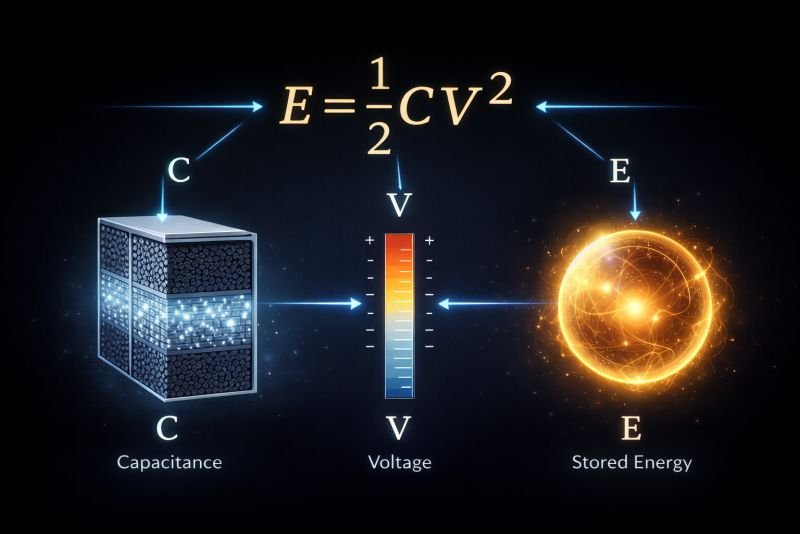
The energy stored in a supercapacitor follows a well-established relationship:
E = ½CV²
E is the stored energy in joules, C is the capacitance in farads, and V is the voltage across the device. Working through a real example makes the physical consequence of this equation immediately apparent.
A commercial supercapacitor module with 3,000 farads of capacitance and a maximum operating voltage of 2.7 volts stores:
E = 0.5 × 3000 × (2.7)² = 0.5 × 3000 × 7.29 = 10,935 joules
That is roughly 3 watt-hours of energy. For a module that might weigh 500 grams, this works out to approximately 6 Wh/kg. A lithium-ion battery cell of the same mass holds 100 to 150 Wh/kg. The supercapacitor stores roughly twenty times less energy per kilogram. The number is not wrong. It is what the physics produces.
The formula also reveals the only practical path to improvement. Capacitance is difficult to increase further without adding more electrode mass. Voltage appears squared in the equation, which means doubling the maximum operating voltage increases stored energy by a factor of four. This is why materials research for next-generation supercapacitors focuses heavily on electrolytes that tolerate higher voltages. Aqueous electrolytes decompose above about 1.2 volts. Organic solvents allow voltages up to 2.7 to 3.0 volts, which is why most commercial supercapacitors use them. Ionic liquid electrolytes can tolerate 4 volts or higher, which would quadruple the energy density relative to today’s devices. The engineering has not caught up to the thermodynamics yet, but the target is clear.
Everything here is free. Readers are the reason it stays that way.
I make all of it alone, with no ads. If it is worth a coffee a month to you, that keeps the next one coming.
Keep it alive →Supercapacitors vs Batteries: What the Power-Energy Tradeoff Actually Means
The fundamental difference between supercapacitors and batteries is not a matter of which one is superior. It is about what kind of energy storage each one was built for by physics, before any engineer made a single design decision.
| Property | Supercapacitor | Lithium-Ion Battery |
|---|---|---|
| Energy density (Wh/kg) | 5-15 | 150-250 |
| Power density (W/kg) | 5,000-20,000 | 300-1,500 |
| Charge time | Seconds | 30 minutes to hours |
| Cycle life | 500,000 to 1,000,000+ | 500 to 2,000 |
| Operating temperature | -40°C to +65°C | 0°C to 45°C |
The power density figure is where supercapacitors become something no battery can approach. At 10,000 W/kg, a supercapacitor can discharge its entire stored energy in under a second. A battery attempting the same rate would be destroyed by the internal heat generated. This is a physical constraint on electrochemical storage, not an engineering deficiency awaiting a clever solution. The chemical reactions that drive battery discharge produce heat as a byproduct, and at extreme discharge rates that heat accumulates faster than it can dissipate.
The cycle life comparison is equally decisive. Each battery charge cycle causes microscopic damage to the electrode structure and the electrolyte interface. After 1,000 to 2,000 cycles, a lithium-ion battery typically retains only 80 percent of its original capacity. A supercapacitor charging and discharging a million times looks essentially the same at the end as at the beginning. The electrostatic mechanism leaves no chemical residue, no structural degradation, nothing that accumulates with repetition.
The Energy Density Ceiling That Physics Imposes on Supercapacitors
At 6 to 15 Wh/kg, a supercapacitor holds enough energy to run a 100-watt light bulb for roughly three to nine minutes per kilogram of device mass. A lithium-ion battery of the same mass would run it for ninety minutes or more. The gap is not small.
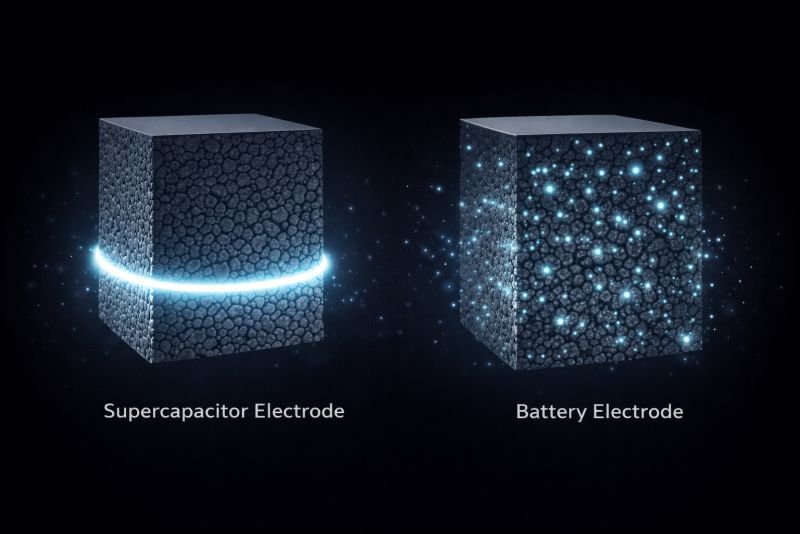
Why does this ceiling exist? In a battery, energy is stored throughout the volume of the electrode material, in every atom and molecule that participates in the electrochemical reaction. In a supercapacitor, energy is stored only at the surface, in the two-dimensional layer where electrode meets electrolyte. No matter how porous the electrode, the surface-to-volume ratio of any three-dimensional material is finite. The interior of each carbon particle contributes mass to the device but contributes nothing to energy storage.
Could this be solved by making the electrode material thinner, essentially all surface? Technically yes. Practically, a material thin enough to be almost entirely surface also becomes too fragile and too electrically resistive to function well at scale. There is a limit to how far this geometry argument can be pushed before other physical constraints take over.
This is the physical argument against supercapacitors replacing batteries in long-duration applications. It is not an argument that can be engineered away with better manufacturing. The only genuine path around it is to introduce a partial chemical contribution to charge storage inside the electrode material, which is exactly what one branch of current research is attempting.
Where Engineers Deploy Supercapacitors in Real Energy Systems
The practical deployment map of supercapacitors follows directly from their properties. Applications where speed, cycle life, and low-temperature reliability matter more than energy density are where supercapacitors consistently prove their value.
Regenerative braking in urban rail is among the largest current uses. When a metro train brakes, it converts kinetic energy back into electrical energy. That energy spike lasts only a few seconds and arrives at high power. Supercapacitors absorb this spike efficiently and release it when the next train on the same section accelerates. The Madrid Metro has installed supercapacitor systems that recover approximately 30 percent of braking energy across the network. A battery system could theoretically do the same job, but the cycle frequency, thousands of braking events per vehicle per day, would exhaust a standard battery in months.
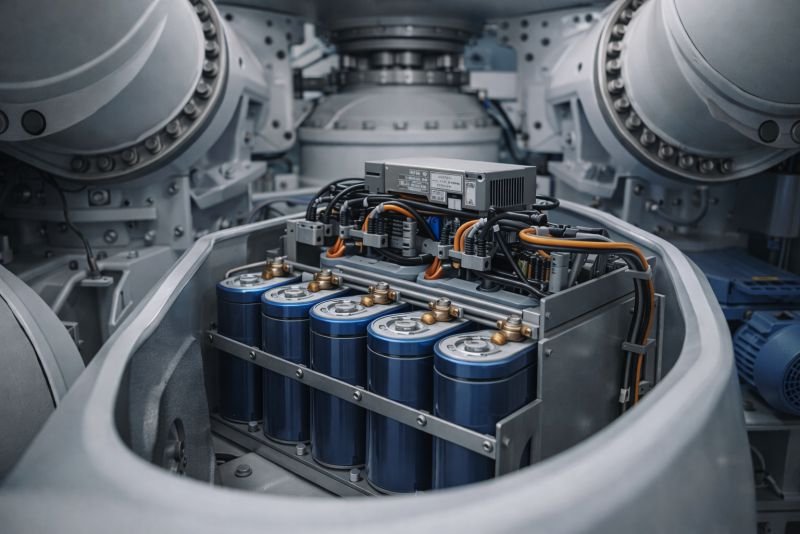
Wind turbine blade pitch control is a less visible but widespread application. Each blade of a large turbine must rotate to a safe position within seconds if the grid connection fails unexpectedly. The backup power for this emergency action comes from supercapacitors mounted inside the blade hub. They rarely discharge in normal operation, but when they do, the action must complete within two to three seconds without exception. Vestas, Siemens Gamesa, and General Electric all rely on supercapacitors for pitch control for this reason. A battery sitting unused in a hub exposed to Arctic temperatures for months, then asked to deliver full power in two seconds: the supercapacitor’s argument over batteries in this context essentially makes itself.
The hybrid architecture is the practical pattern that most energy systems engineers now default to: supercapacitors handle the fast transients, batteries handle sustained delivery. Neither component attempts the job of the other. Both do what physics has specifically qualified them to do.
Pseudocapacitance and the Research Pushing Supercapacitors Toward Higher Energy
Research is actively closing the energy density gap by introducing a partial chemical contribution to charge storage. Certain electrode materials, including ruthenium dioxide, manganese dioxide, and conducting polymers, store charge not only through surface ion adsorption but also through rapid, reversible electrochemical reactions that penetrate slightly into the material itself. This mechanism is called pseudocapacitance, and devices built on it behave like supercapacitors in terms of charge and discharge speed while achieving significantly higher energy storage.
A manganese dioxide pseudocapacitor electrode can reach energy densities of 30 to 50 Wh/kg, three to five times that of a conventional activated carbon device. Ruthenium dioxide achieves even higher values, but at a material cost that makes commercial deployment slow. The mechanism is understood. The economic problem is not yet solved.
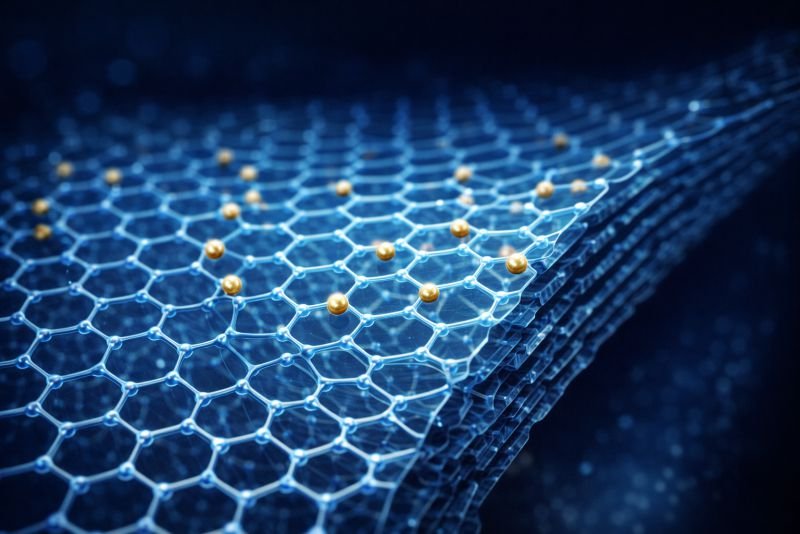
Graphene electrodes represent a parallel research direction. A perfect graphene sheet has a theoretical surface area of around 2,630 square meters per gram, comparable to the best activated carbons. More importantly, graphene’s electrical conductivity is orders of magnitude higher than activated carbon, which reduces internal resistance and improves efficiency at high discharge rates. The practical challenge is producing graphene electrode films where the sheets remain separated. Graphene layers that stack against each other collapse their surface area back toward zero, eliminating the performance advantage. Laboratory results for graphene supercapacitors are promising. Commercial-scale production of graphene electrodes that maintain their structure under real conditions has not yet been demonstrated at meaningful volume.
The trajectory of supercapacitor research points toward devices that will sit between today’s supercapacitors and batteries on the energy density scale, while preserving the fast charge, long cycle life, and wide temperature tolerance that make current supercapacitors irreplaceable in their target applications. The physics already permits this. The materials science is catching up.
You read the whole thing.
That is rarer than it should be, and it is the exact kind of attention I built this archive for. I make every piece alone, with no ads and no investor deciding what gets written. If you want the next machine taken apart like this one, you can help me make it.
A coffee a month is enough to keep it free for everyone.
Prefer crypto or a one time gift? Other ways to give →
Technologies Related to This Concept
| Technology | Concept |
|---|---|
| Revolutionizing Public Transportation with Graphene Energy Storage | Concept: Incorporating graphene supercapacitors into buses and trains for efficient energy use. |
| Graphene Supercapacitors in Renewable Energy Storage | Concept: Using graphene supercapacitors to store energy from solar and wind sources efficiently. |
| Graphene Supercapacitors in Smart Grid Technology | Concept: Enhancing smart grids with graphene-based energy storage for peak load management. |
| Graphene Supercapacitors – Revolutionizing Electric Vehicle Charging | Concept: Exploring how graphene-based supercapacitors can drastically reduce EV charging times. |
| Portable Power Banks Featuring Graphene Supercapacitors | Concept: Developing ultra-fast charging power banks using graphene technology. |