





What Is FMO complex?
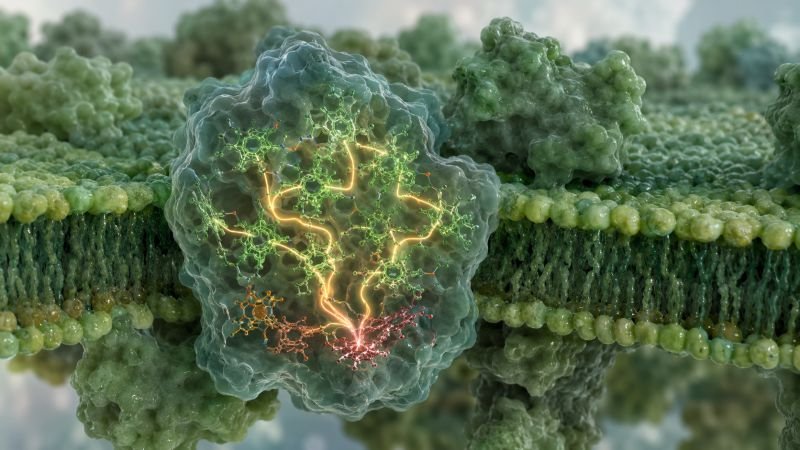
The FMO complex, short for Fenna-Matthews-Olson complex, is a pigment-protein structure in green sulfur bacteria that transfers captured light energy toward a photosynthetic reaction center. It contains bacteriochlorophyll molecules held in precise positions by a protein scaffold. That arrangement lets electronic excitation move through the structure with unusually high efficiency after light has been absorbed by antenna complexes.
A simplified efficiency relation is eta = E_out / E_in, comparing energy delivered onward with energy initially captured. In the FMO complex, pigment spacing and electronic coupling allow the excitation to sample multiple pathways before energy is lost as heat. Real behavior depends on molecular geometry, vibrational coupling, temperature, and the surrounding protein environment, which together shape how coherence and relaxation guide transport.
The system matters because it is a biological example of efficient energy routing in a warm, noisy molecular environment. In bioinspired energy transfer, the FMO complex suggests how nanoscale structure can guide weak energy signals with minimal loss. Used in devices include artificial photosynthesis prototypes, excitonic circuit models, quantum biology experiments, and biomimetic materials that study controlled energy migration.
Example:
In a green sulfur bacterium, the FMO complex channels absorbed excitation from light-harvesting pigments toward the reaction center.
Related Terms:
- Exciton
- Quantum Coherence
- Photosynthetic Reaction Center
NoSuchDevice is a free archive of machines that do not exist yet but already have a shadow in physics. I research and write every entry alone, with no ads. Take a look around the archive, or help keep it free.