





What Is Galactic dark matter halo?
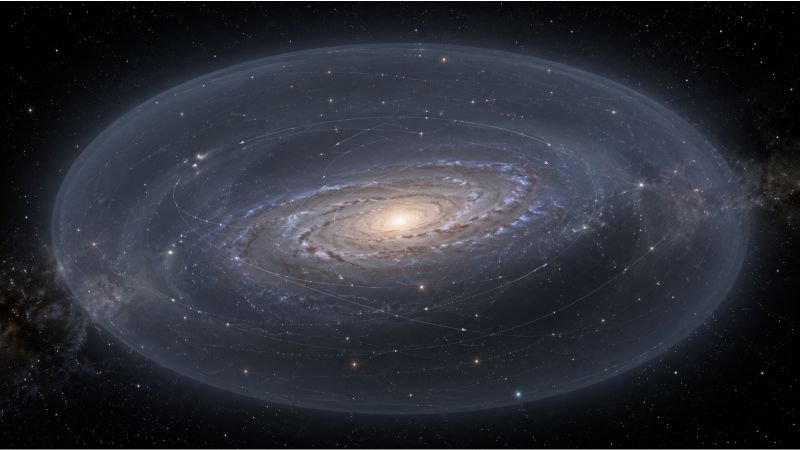
Galactic dark matter halo is the extended, nonluminous mass distribution surrounding a galaxy and dominating much of its outer gravitational field. It is inferred from motion and lensing rather than direct light emission. The halo sets the radial mass profile M(r), and gravity follows g = GM(r) / r^2, so unseen mass can strongly affect stars and gas far beyond the bright stellar disk.
In observations and simulations, halos shape the motion of stars, satellite galaxies, and diffuse gas at large radii, while also influencing gravitational lensing and structure formation. It is a recurring framework in dark matter propulsion models because local dark matter availability depends on being embedded within the Milky Way halo. Used in devices include cryogenic particle detectors, rotation-curve spectrographs, gravitational-lensing cameras, and numerical galaxy-modeling systems.
The concept matters because it explains why visible matter alone underestimates galactic mass and why spiral galaxies remain gravitationally bound at large distances from their centers. Halo properties are also central to estimating local dark matter density, comparing cold-dark-matter models with data, and testing whether alternative gravity theories can reproduce the same large-scale behavior.
Example:
Stars in a spiral galaxy can keep orbiting at high outer-disk speeds because the galactic dark matter halo adds gravitational pull beyond the visible disk.
Related Terms:
- WIMP
- Galactic Rotation Curve
- Gravitational Lensing
NoSuchDevice is a free archive of machines that do not exist yet but already have a shadow in physics. I research and write every entry alone, with no ads. Take a look around the archive, or help keep it free.