




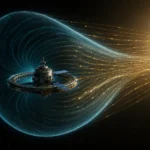
Right now, something is moving through this page. Through the screen, through the table it rests on, through the floor beneath that, and through the ground below the building. Dark matter, the invisible gravitationally active mass that holds galaxies together, streams through ordinary matter at roughly 220 kilometers per second relative to the galactic center, almost entirely unimpeded. A car parked on a street is no exception. A ship crossing the Atlantic is no exception.
The question a dark matter propulsion system answers is a precise one: if that mass is already moving through the vehicle, what does it take to make it push?
The short version: A dark matter propulsion system extracts directional thrust from weakly interacting massive particles, WIMPs, which permeate the galaxy at a density of roughly 0.3 GeV per cubic centimeter near Earth. An engineered interaction lattice inside the drive converts WIMP momentum into net force on the vehicle. The fuel supply is the galactic dark matter halo, which extends uniformly across every ocean, continent, and airspace on the planet. The vehicle carries no fuel. Nothing combusts. Nothing accumulates in the atmosphere.
Key Takeaways
- Dark matter constitutes 27% of the universe’s mass-energy content and flows through all matter at galactic velocities, available everywhere without extraction, storage, or supply chains
- WIMPs transfer momentum through weak-force scattering; an engineered interaction lattice captures that momentum directionally and converts it into vehicle thrust
- No fuel is stored onboard; the drive draws from the galactic dark matter halo, distributed uniformly across every ocean, continent, and airspace on Earth
- A container ship running this drive eliminates not just CO₂ but the sulfur oxide and nitrogen oxide output that makes ocean shipping one of the most damaging transport sectors per unit of cargo moved
- If this drive reaches maritime scale, ocean shipping as a source of atmospheric pollution ceases to exist as a concept; the galactic halo becomes, in a meaningful sense, the fuel infrastructure of global transport
Table of Contents
The Invisible Fuel Already Moving Through Everything
Six and a half billion WIMPs (Weakly Interacting Massive Particle) pass through the frontal profile of a moving truck every second. Through the cab, through the cargo, through the driver. They do this continuously, in every direction, at a density that does not change meaningfully whether the vehicle is in Oslo or in the Sahara. The galactic dark matter halo is not a distant resource needing to be transported to the vehicle. It is already there, and it has been there for the entire operational history of every vehicle ever built.
The Gravitational Case Nobody Argues With
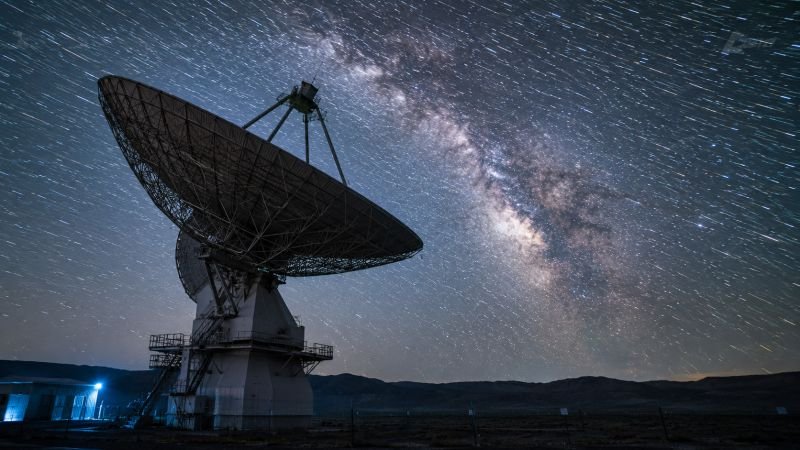
The evidence for dark matter accumulated across decades and across different measurement methods. Galactic rotation curves show that the outer arms of spiral galaxies orbit too fast for their visible mass to explain; without an extended dark matter halo providing additional gravitational pull, the arms would fly apart. Gravitational lensing maps show mass concentrations exactly where dark matter models predict them, in regions where no luminous matter is visible. The quantum mechanics underpinning these large-scale gravitational interactions is now understood well enough to constrain where the dark matter particle can and cannot hide in the theoretical landscape. The particle’s identity remains an open problem. The existence and approximate distribution of the mass it represents is not.
How the Dark Matter Drive Could Operate
Underground physics laboratories have already built the conceptual ancestor of what a dark matter drive requires at its core: cryogenic xenon chambers that detect individual WIMP-nucleus recoil events at precision below a single kiloelectronvolt. The drive takes that detection architecture and scales it from measurement to propulsion. When a WIMP encounters an atomic nucleus, momentum transfers through the weak nuclear force and the nucleus recoils. Individually, each event carries kiloelectronvolt-scale energy. Across billions of interactions per second inside a purpose-built material lattice, that momentum adds up in a direction determined by the geometry of the device.
The Interaction Lattice
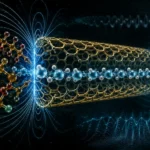
At the core of the drive sits an interaction lattice: a crystalline matrix assembled from heavy nuclei chosen for their WIMP scattering properties. Xenon and tungsten isotopes are the primary candidates, selected because their nuclear spin configurations and neutron counts maximize the probability of both spin-dependent and spin-independent WIMP interactions. The lattice operates below 10 kelvin, eliminating the thermal noise that would otherwise obscure the momentum signal from individual scattering events. At that temperature, the lattice produces approximately 10⁸ registered interaction events per second per cubic meter of active material, a rate sufficient to generate the continuous force gradient the drive requires.
From WIMP Collision to Directional Thrust
An isotropic lattice produces scattering in all directions, which yields no net thrust. The directional element is an asymmetric shielding array mounted on the forward face of the lattice assembly. Heavy-element absorber plates on the forward side preferentially intercept low-angle forward-scattered WIMPs before they exit the assembly, while the rearward face remains open. More WIMP momentum transfers in the forward-to-rearward direction than in the reverse. The lattice experiences a net rearward force. The vehicle, attached to the lattice assembly, moves forward. The physics is classical momentum conservation applied to a non-classical fuel source; the same principle governs a photon sail catching solar radiation, with dark matter playing the role of light.
The Momentum Conversion Chain
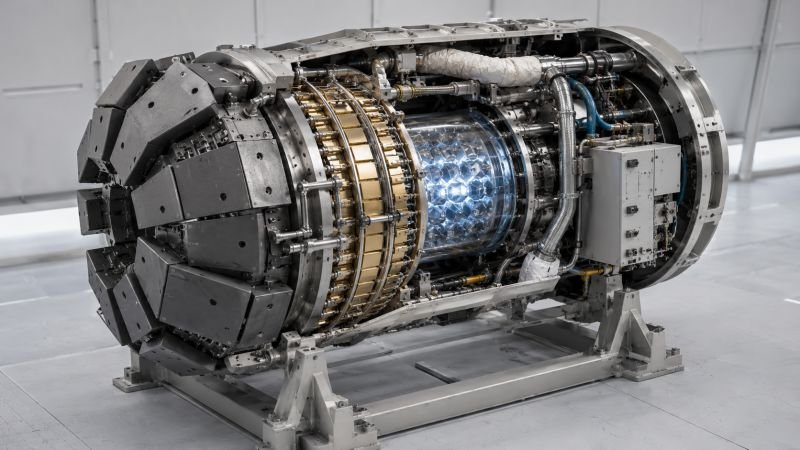
The recoil energy deposited in the lattice by each scattering event appears as heat. A thermoelectric conversion layer wrapped around the lattice assembly captures that temperature differential and converts it to electrical power. That power feeds back into the cryogenic cooling system that maintains the lattice below 10 K and into the drive’s onboard electronics. An external power source handles initial cooldown. Once at operating temperature, the WIMP-generated thermal load sustains the system. On maritime and ground vehicles, the thermoelectric output extends to supplement or replace a separate generator, simplifying the overall power architecture of the vessel.
The Density Equation: What 0.3 GeV per Cubic Centimeter Means in Practice
The dark matter drive is engineered around a specific fuel supply, and the numbers describing that supply are worth looking at directly. Near Earth, the local dark matter density sits at approximately 0.3 GeV per cubic centimeter. Run that through vehicle geometry and the picture becomes concrete.
Consider a heavy freight truck with a frontal cross-section of 10 square meters, or 100,000 square centimeters. Assuming WIMPs with a mass of 100 GeV moving at 220 km/s relative to the galactic center:
WIMP number density: n = ρ / m = 0.3 GeV/cm³ / 100 GeV/c² = 0.003 WIMPs/cm³
WIMP flux through the truck: Φ = n × v × A = 0.003 × 22,000,000 cm/s × 100,000 cm² = 6.6 × 10⁹ WIMPs/s
Six point six billion WIMPs per second cross the truck’s frontal area. The interaction lattice in a truck-class drive is sized to engage that flux across a one-meter active volume, producing the 10⁸ registered scattering events per second the momentum conversion chain requires. Scaling to a maritime vessel, where the hull cross-section runs into hundreds of square meters, the available flux increases in proportion.
| Parameter | Value |
|---|---|
| Local dark matter density near Earth | ~0.3 GeV/cm³ |
| Assumed WIMP mass | ~100 GeV/c² |
| WIMP number density | ~0.003 WIMPs/cm³ |
| WIMP flux through 10 m² vehicle per second | ~6.6 × 10⁹ |
| Target interaction events per second (truck-class lattice) | ~10⁸ |
| Lattice operating temperature | below 10 K |
| Drive thermal output per event | ~few keV |
One property of this fuel supply stands apart from every combustible or nuclear alternative: it does not vary by location. A truck in a tunnel, a ship in the middle of the Pacific, an aircraft at 35,000 feet: the dark matter density variation across Earth’s surface and lower atmosphere falls below measurement precision. The fuel is uniform in a way that petroleum, wind, and sunlight are not.
Everything here is free. Readers are the reason it stays that way.
I make all of it alone, with no ads. If it is worth a coffee a month to you, that keeps the next one coming.
Keep it alive →Where This Drive Changes Transportation: Land, Sea, Air
Each transport mode carries a different fraction of the atmospheric and public health problem that combustion propulsion creates. The principles of sustainable transportation frame the challenge as a design problem; a dark matter drive removes the fuel constraint at the source and restructures the solution space for all three domains.
Surface Transport
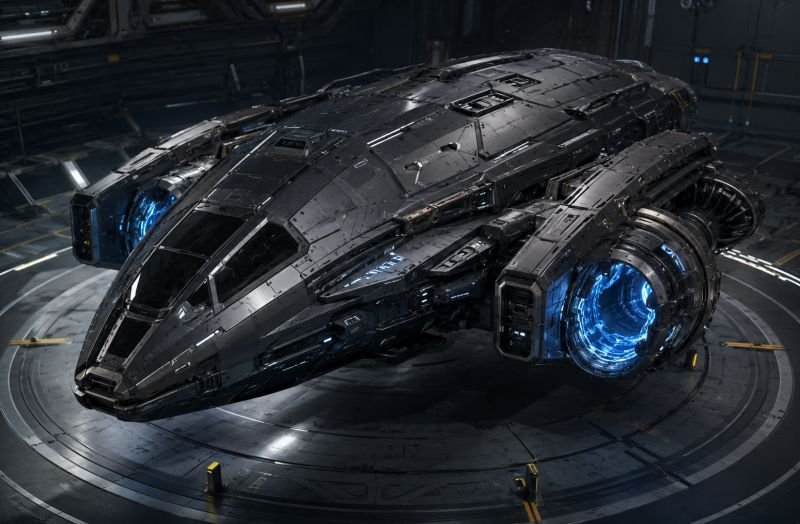
A land vehicle fitted with a dark matter drive removes the fuel tank, the exhaust system, the catalytic converter, and the engine block from its architecture. The drive unit occupies the engine bay. Climate systems and onboard electronics run from the drive’s thermoelectric output supplemented by a modest battery for startup. On road transport, the operational case is simple: zero tailpipe output, no refueling stops, no dependence on fuel distribution infrastructure. The dark matter flux is identical in a city center and on an empty highway at the same latitude.
Maritime: The Most Compelling Case
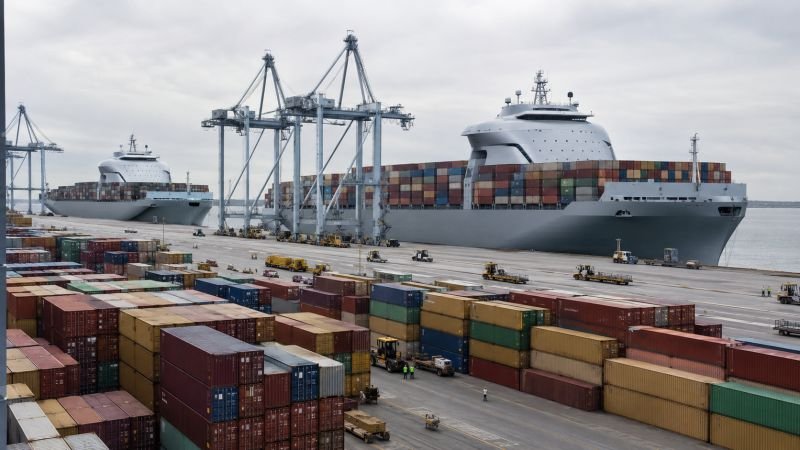
Ocean shipping moves approximately 90% of global trade by volume. A large container ship burns roughly 150 tonnes of heavy fuel oil per day, a fuel type that produces CO₂, sulfur dioxide, nitrogen oxides, and fine particulates at quantities that make maritime transport one of the most damaging sectors per unit of cargo moved. A dark matter drive at maritime scale eliminates the entire combustion profile. Ships operate for weeks without port contact; a drive requiring no fuel resupply fits that pattern precisely. At hull scale, the available WIMP flux scales with cross-section, delivering proportionally larger scattering rates than any land vehicle achieves.
Aviation Without Tanks
Aircraft on long-haul routes carry fuel representing 25 to 40 percent of total takeoff weight. A dark matter drive removes that weight budget entirely, restructuring aircraft design at a fundamental level. The vehicle carries a heavier interaction assembly but loses wing tanks, fuel lines, fuel pumps, and the fire suppression systems built around them. Range becomes a function of drive capacity and onboard electrical reserves. A transatlantic flight no longer has a hard fuel limit in the sense that current aircraft engineering defines one.
Zero Emissions, but What Comes Out Instead?
Calling a propulsion system zero-emissions without specifying what it does produce is a sentence from a marketing brief. A dark matter drive produces byproducts. They are not atmospheric pollutants.
WIMP-nucleus scattering deposits kinetic energy into the recoiling nucleus as heat. The thermoelectric layer captures that heat. A fraction of interactions produce secondary particles: low-energy gamma photons at energies that standard shielding within the device casing absorbs entirely, and neutrinos, which pass through the drive, the vehicle, and the Earth itself without depositing meaningful energy in biological tissue. Nothing exits the drive casing that would not also exit a computer under full processing load.
Nuclear fission drives produce radioactive waste requiring long-term containment. Antimatter propulsion generates 511 keV gamma radiation from electron-positron annihilation at intensities that demand significant shielding mass and careful geometric management throughout the vehicle. A dark matter drive involves no annihilation. The WIMP exits the lattice with slightly less momentum than it entered with; the recoiling nucleus carries the difference. No particle destruction, no high-energy radiation spike, no decay chain requiring management.
Ongoing research into the biological effects of proximity to a high-rate WIMP-scattering assembly runs alongside the engineering development. Underground physics experiments have already characterized the radiation environment around dark matter detectors in considerable detail. Scaling those measurements to a drive-class installation is the starting point for safety assessment, not a blank page. What remains unknown is whether any interaction pathway exists between high-rate scattering environments and biological systems that current models do not yet account for.
From Underground Detector to Global Propulsion Network
The trajectory of this technology runs from a detection problem to an engineering problem to an infrastructure problem, each phase building on the previous one without requiring new physics at any step.
First Generation: The Proof-of-Concept Drive
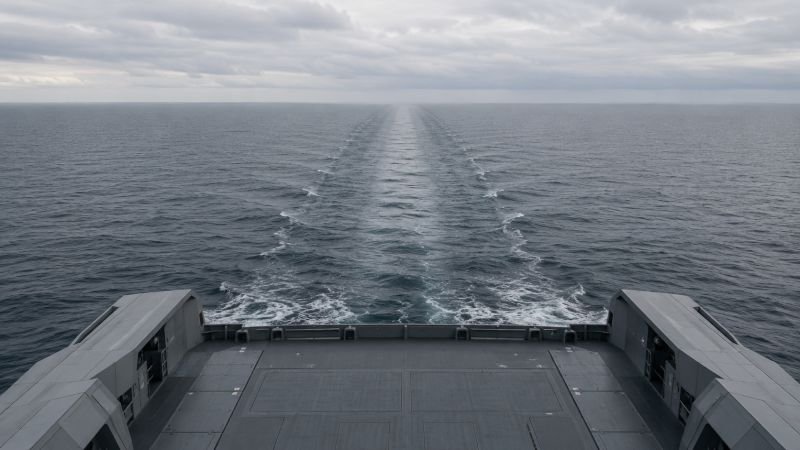
The first dark matter drives are cryogenic assemblies operating at vehicle scale in controlled conditions: heavy freight vehicles and small maritime vessels in short-distance operational tests. The interaction lattice uses xenon-based materials already characterized in underground detector programs. Thrust output is modest. The engineering purpose at this stage is not propulsion efficiency but data collection: establishing the interaction rate at drive scale, validating the thermoelectric recovery loop, and mapping the radiation environment around an operating lattice outside laboratory conditions. The vehicle moves. The fuel cost is zero. Everything else is calibration.
The Mature Drive System
At engineering maturity, the interaction lattice uses materials developed specifically for drive applications rather than adapted from detection experiments. Higher neutron-count isotopes, precision-engineered crystal structures, and active feedback systems that adjust the asymmetric shielding geometry in real time to optimize directional momentum transfer replace the first-generation static assembly. A mature maritime drive at full hull scale delivers thrust comparable to current diesel engines, with no stored fuel, no exhaust, and thermoelectric output sufficient to power all onboard electrical systems. The vessel itself changes: hull geometry is no longer constrained by engine room placement or fuel tank distribution.
Dark Matter Propulsion as Infrastructure
At civilizational scale, the dark matter drive becomes what the combustion engine became: the background assumption of how things move. Shipping lanes no longer depend on proximity to bunkering ports. Aviation range limits disappear from the design equation. Ground transport stops requiring a fuel distribution network stretching to every populated area on Earth. The dark matter halo, uniformly present across every surface and ocean and airspace, becomes the universal fuel infrastructure of global transport. The extraction infrastructure for petroleum, the pipelines, the tanker fleets, the refinery networks, exist because motion requires a stored resource. When motion no longer requires that, a substantial fraction of the industrial world reorganizes around a different premise.
The View From NoSuchDevice
I will say directly where this device sits on the plausibility spectrum, because the answer is not simple. The fuel is real. The interaction mechanism is real. The momentum transfer math is correct. The engineering distance between a working dark matter detector and a working dark matter drive is large, but the physics does not forbid it. That is a meaningful distinction. There is a category of concept that fails because the physics fails. Dark matter propulsion does not sit in that category.
What I find genuinely interesting is that the maritime application is so obviously the right entry point and so underexamined in discussions of clean transport. A container ship running on dark matter interaction eliminates not just the carbon but the sulfur and nitrogen chemistry that makes shipping particularly damaging near coastlines and in ocean ecosystems. The drive requires no refueling infrastructure at sea. The fuel supply is uniform across every ocean. The economics of eliminating 150 tonnes of heavy fuel oil per day per vessel are compelling enough that adoption would not need regulatory mandates to proceed once a working prototype exists at ship scale.
My honest read on the horizon is that this device sits firmly in the long-horizon class. The interaction lattice engineering, building a crystalline assembly that achieves 10⁸ productive scattering events per second from a flux of billions of particles, is not an incremental improvement on existing technology. But it is a plausible engineering goal given continued progress in materials science and cryogenic systems. The underground detector programs running right now are, in a precise sense, the first-generation version of what eventually becomes the interaction lattice. They detect. The drive propels. The physics between those two functions is the same physics.
You read the whole thing.
That is rarer than it should be, and it is the exact kind of attention I built this archive for. I make every piece alone, with no ads and no investor deciding what gets written. If you want the next machine taken apart like this one, you can help me make it.
A coffee a month is enough to keep it free for everyone.
Prefer crypto or a one time gift? Other ways to give →