




What Is WIMP?
WIMP stands for Weakly Interacting Massive Particle, a hypothetical particle candidate for dark matter with substantial mass and extremely weak coupling to ordinary matter. In many models, the local number density follows n = rho / mχ, so heavier particles imply fewer particles for the same mass density. Because they interact mainly through gravity and possibly the weak force, they can shape cosmic structure while remaining very difficult to detect directly.
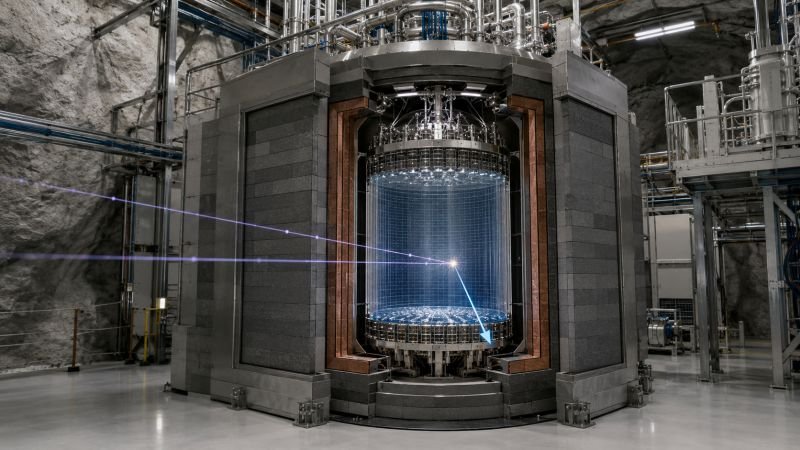
In experiments, researchers look for nuclear recoils, ionization, or scintillation produced when a WIMP transfers momentum to a target atom inside cryogenic or noble-liquid detectors. The same interaction logic appears in dark matter propulsion concepts that imagine turning tiny scattering events into directional force. Used in devices include xenon time-projection chambers, cryogenic bolometers, shielding assemblies, and low-background readout electronics.
The concept matters because WIMPs connect cosmology, particle physics, and detector engineering in one testable framework. If confirmed, they would explain missing gravitational mass in galaxies and clusters while constraining theories beyond the Standard Model. Even null results remain valuable, because every non-detection narrows the allowed mass range and interaction cross-section space for dark matter candidates.
Example:
A xenon detector may record a rare recoil event that is analyzed as a possible WIMP interaction against a very low background rate.
Related Terms:
- Galactic Dark Matter Halo
- Galactic Rotation Curve
- Nuclear Recoil
NoSuchDevice is a free archive of machines that do not exist yet but already have a shadow in physics. I research and write every entry alone, with no ads. Take a look around the archive, or help keep it free.