



What Is Galactic rotation curve?
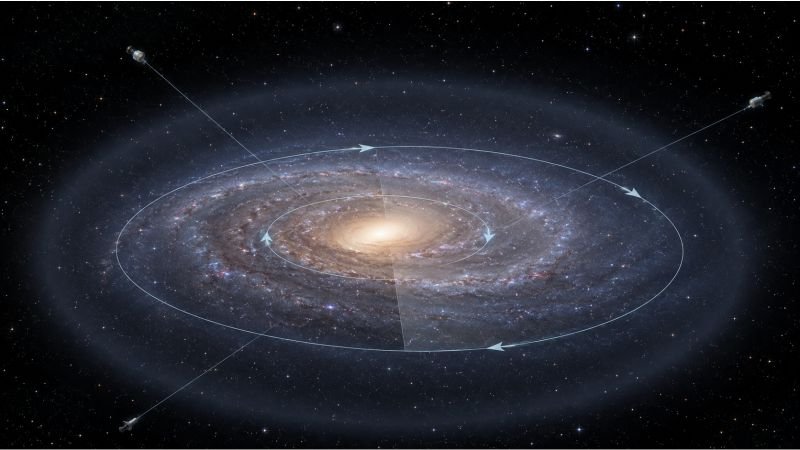
Galactic rotation curve is a plot of orbital speed versus distance from a galaxy’s center for stars, gas, or other tracers. A common relation is v(r) = sqrt(GM(r) / r), which links circular speed to the mass enclosed within radius r. If only visible matter were present, outer speeds would usually fall with distance, but many observed galaxies show flatter profiles than that expectation.
In practice, astronomers build rotation curves from Doppler-shift measurements of atomic gas, molecular gas, or starlight across a galaxy. It is a key observable in dark matter propulsion concepts because the same measurements imply a surrounding halo that sets local dark matter density. Used in devices include radio telescopes, optical spectrographs, integral-field units, and data-reduction pipelines that convert line shifts into velocity maps.
The concept matters because rotation curves provided some of the strongest evidence that galaxies contain more mass than can be seen directly. They remain central for comparing baryonic matter models with halo models, testing modified-gravity alternatives, and estimating how mass is distributed from the inner disk to the galactic outskirts across different galaxy types.
Example:
Neutral hydrogen observed far from a spiral galaxy’s center can still move at nearly the same speed as inner disk material, producing a flat outer rotation curve.
Related Terms:
NoSuchDevice is a free archive of machines that do not exist yet but already have a shadow in physics. I research and write every entry alone, with no ads. Take a look around the archive, or help keep it free.