






What Is Gibbs mixing entropy?
Gibbs mixing entropy is the increase in entropy that occurs when distinguishable substances mix and the number of accessible microscopic arrangements rises. It helps quantify why mixed systems are thermodynamically favored. A standard relation is DeltaS_mix = -R sum x_i ln x_i, where composition determines the entropy gain from mixing.
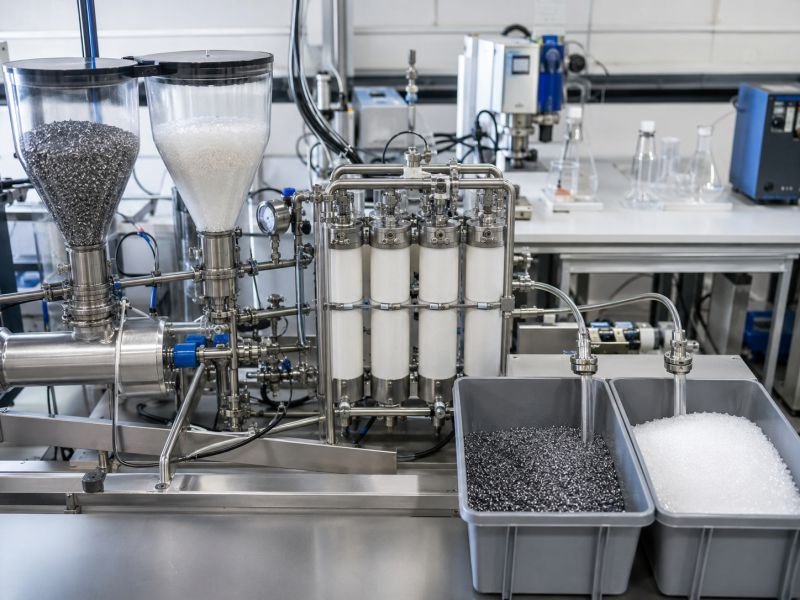
In real separation problems, this term sets the reversible minimum work needed to unmix materials, even before friction, heat loss, or imperfect sorting are counted. More components and more even compositions usually make separation harder. Used in devices include alloy refining systems, membrane separators, gas mixers, and battery recycling lines where mixed streams must be sorted into purer fractions.
The concept matters because it connects microscopic disorder to macroscopic process cost. It is directly relevant to thermodynamic separation analysis, where engineers need to know why closed-loop recovery always demands input energy even when the target material still exists in the waste stream.
Actual industrial energy demand sits well above the theoretical limit, because shredding, pumping, melting, and chemical purification add irreversibilities that raise the practical cost of recovering a clean material stream. Temperature also changes the separation penalty.
Example:
Separating copper and plastic from shredded cable scrap requires more work than handling the same materials before they were physically mixed.
Related Terms:
- Energy Intensity
- Embodied Energy
- Chemical Potential
NoSuchDevice is a free archive of machines that do not exist yet but already have a shadow in physics. I research and write every entry alone, with no ads. Take a look around the archive, or help keep it free.