





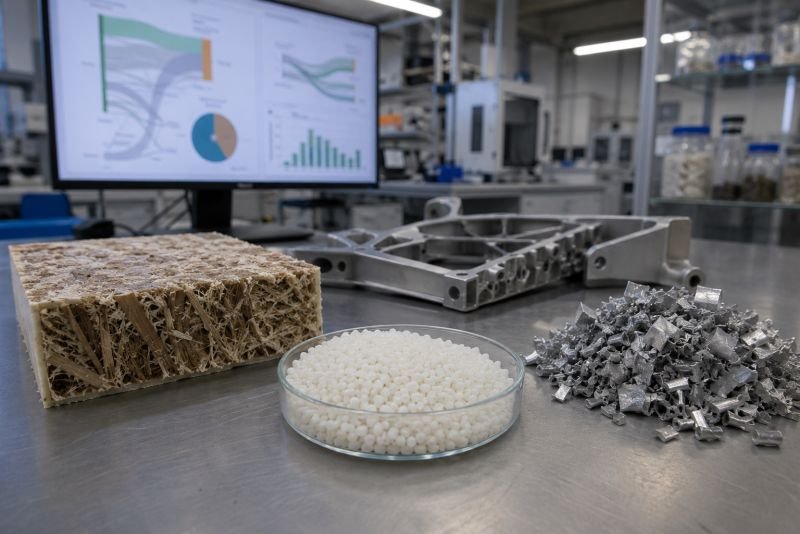
In the autumn of 2022, a procurement team at a Tier 1 automotive supplier in Stuttgart spent three weeks trying to replace a single part. The component was a structural bracket inside a door panel. It weighed 340 grams and was currently made from glass-fiber-reinforced polypropylene. The team had been asked to find a bio-based substitute that could pass the same crash-load specifications. They found four candidates. One failed the mechanical test. One cost 2.4 times as much. One degraded under the same humidity conditions the part would actually face in service. The fourth passed everything. Its embodied carbon was 38% lower than the original.
That bracket is not famous. It never made a press release. It is the actual shape of what sustainable manufacturing in materials science looks like at the engineering level: specific, slow, and constrained by properties that do not care about procurement schedules.
The short version: Sustainable manufacturing is not a production method. It is a set of material decisions made before anything is built. The energy cost locked into a kilogram of primary aluminum (around 155 MJ) is roughly 13 times higher than the cost locked into recycled aluminum (around 11.5 MJ/kg). Bio-based polymers can cut the carbon footprint of a structural component by 30 to 60 percent compared to petroleum-based equivalents, but only if their mechanical properties actually match the application. The physics of entropy mean that recycling is never free and never complete. Understanding these three constraints is the foundation of any serious engagement with sustainable manufacturing.
Table of Contents
Embodied Energy: The Energy Sustainable Manufacturing Spends Before the Factory Starts
Every material carries a hidden energy debt. That debt accumulated during mining, refining, alloying, and processing, and it is called embodied energy. A kilogram of steel produced from virgin ore contains roughly 22 megajoules of embodied energy. A kilogram of primary aluminum contains around 155 megajoules. The difference is not arbitrary. It reflects the electrochemical and thermal work required to break the bonds that hold these elements in their natural mineral states and rearrange them into usable metals.
The calculation that makes this useful for sustainable manufacturing is straightforward.
The total embodied energy of a component is:
E_total = m x e_i
Where E_total is the total embodied energy in megajoules, m is the mass of the material in kilograms, and e_i is the energy intensity for that specific material, also measured in megajoules per kilogram.
Consider a structural frame for a mid-size electric vehicle, requiring approximately 280 kg of material. If that material is primary aluminum:
E_total = 280 x 155 = 43,400 MJ
That figure equals the energy in roughly 1,200 liters of diesel, spent before the vehicle has moved a single meter. Substituting recycled aluminum, where e_i falls to approximately 11.5 MJ/kg, gives:
E_total = 280 x 11.5 = 3,220 MJ
A reduction of more than 92 percent. The car has not changed. Its performance has not changed. The only variable is the origin of the material.
This is why the sourcing question sits at the center of sustainable manufacturing in material science. Design optimization reduces weight. Weight reduction reduces operating energy. But neither change touches the embodied energy calculation until the material itself is reconsidered. A beautifully optimized product built from virgin aluminum still carries a larger energy debt than an unoptimized product built from its recycled equivalent.
The practical constraint is supply. Global recycled aluminum covers less than 35 percent of total aluminum demand. The rest is primary production. Shifting that ratio is an infrastructure problem, a collection problem, and an alloy contamination problem. The physics is already solved. The logistics have not caught up.
Why Recycling in Sustainable Manufacturing Cannot Close the Loop Completely
The second law of thermodynamics does not negotiate. Every time materials are mixed, sorted, melted, and reprocessed, a fraction of their usable quality is lost. This is not a failure of recycling technology. It is a statement about entropy.
When metals are alloyed or contaminated during their first service life, separating them back into pure streams requires energy that always exceeds the theoretical thermodynamic minimum. The minimum energy for separating a mixed system is described by the Gibbs mixing equation, which relates the reversible work of separation to temperature and the composition of the mixture. In real industrial conditions, the actual energy required is much higher. Separation processes involve mechanical shredding, eddy-current sorting, flotation, and chemical leaching, each of which adds heat, loss, and impurity.
Aluminum recycling illustrates this directly. Each cycle introduces small amounts of tramp elements: iron from steel bolts, silicon from coatings, copper from wiring. These accumulate. After three or four cycles, the alloy specification may no longer meet the tolerance required for structural applications. The metal is not destroyed. Its embodied energy is largely recovered. But its quality has been downgraded. What was aircraft-grade aluminum becomes casting alloy.
| Material | Primary Energy Intensity (MJ/kg) | Recycled Energy Intensity (MJ/kg) | Energy Saving from Recycling | Recycling Quality Loss |
|---|---|---|---|---|
| Aluminum | 155 | 11.5 | 93% | Tramp element accumulation; alloy downgrading after 3-4 cycles |
| Steel | 22 | 8.9 | 60% | Minor; steel tolerates impurity better than aluminum |
| Copper | 65 | 4.5 | 93% | Low if single-alloy streams; high in mixed-cable scrap |
| PET plastic | 84 | 35 | 58% | Molecular weight reduction; color mixing limits food-grade reuse |
Sustainable manufacturing must account for this degradation trajectory. A design philosophy that specifies recycled-content materials without considering what generation of recycling that material represents is missing a real variable. The relevant question is not just whether a material can be recycled, but how many times it can cycle before its properties no longer match the application.
Everything here is free. Readers are the reason it stays that way.
I make all of it alone, with no ads. If it is worth a coffee a month to you, that keeps the next one coming.
Keep it alive →Bio-Based Polymers and the Carbon Chemistry Behind Sustainable Manufacturing
Plants do something that petroleum refineries also do, but in reverse. They take carbon dioxide from the air and use solar energy to build long-chain polymer molecules. Cellulose, starch, and lignin are all polymers. They have structural properties. They can be extracted, modified, and processed into materials that compete with synthetic plastics.
The science behind bio-based materials in sustainable manufacturing sits at the intersection of organic chemistry and agricultural biology. Polylactic acid, known as PLA, starts as glucose from corn starch or sugarcane. Bacterial fermentation converts that glucose into lactic acid monomers. A condensation polymerization reaction then links those monomers into long chains, producing a thermoplastic with a tensile strength of around 50 to 70 MPa, depending on molecular weight and crystallinity. For comparison, standard polypropylene sits between 25 and 40 MPa.
PLA is stronger than polypropylene in tension at room temperature. It fails earlier at elevated temperatures. Its glass transition temperature of about 55 to 60 degrees Celsius is a limiting factor for any application that involves heat. Automotive interior components, packaging that ships through hot distribution centers, and anything that might sit in direct sunlight in a closed car are outside PLA’s reliable operating range.
Why Bio-Based Is Not Automatically Better in Sustainable Manufacturing
The carbon footprint argument for bio-based materials rests on the idea that the carbon locked into the polymer was pulled from the atmosphere during plant growth, not extracted from fossil reserves. That logic is sound in theory and complicated in practice.
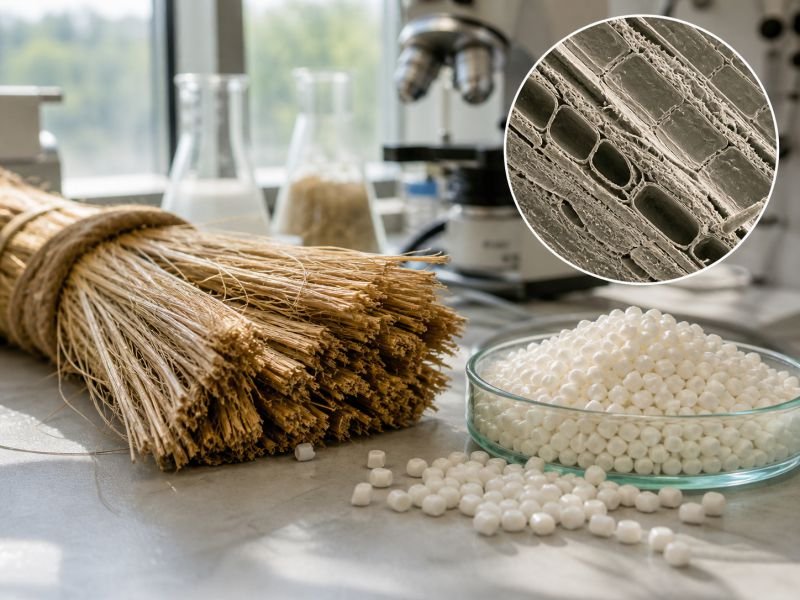
NatureWorks, which operates the world’s largest PLA production facility in Blair, Nebraska, reports a greenhouse gas footprint of approximately 0.5 to 1.0 kg CO2 equivalent per kilogram of PLA, depending on how land-use change and fertilizer production are accounted for. Petroleum-based polypropylene runs at roughly 1.7 to 2.2 kg CO2e per kilogram. The advantage is real. It is not infinite.
Grow the corn on land cleared from carbon-storing grassland, and that advantage reverses entirely. The land-use conversion carbon debt can take 30 to 90 years to pay back through displacement of fossil plastic. Sustainable manufacturing therefore cannot evaluate bio-based materials in isolation from agricultural context. The polymer’s origin matters. So does the origin of the farm that grew its feedstock.
How Life Cycle Assessment Puts Numbers on Sustainable Manufacturing Decisions
A material’s carbon footprint at the factory gate is the start of the accounting, not the end. Life cycle assessment, or LCA, is the methodology sustainable manufacturing uses to track energy use, carbon emissions, water consumption, and end-of-life impacts across the full existence of a material or product.
An LCA traces four stages. Raw material extraction and processing. Manufacturing and assembly. Use phase. End of life, including whether the material is recycled, composted, incinerated, or buried.
The result is not a single number. It is a profile. A material with low production energy might have high end-of-life impact if it cannot be separated from other materials in a product. Carbon fiber composite is a clear example: it is lightweight and strong, reducing fuel consumption over a vehicle’s operating life, but nearly impossible to separate cleanly for recycling at end of life. Current carbon fiber recycling processes recover fiber length fractions that degrade the material’s structural properties substantially. The LCA tells you that carbon fiber pays back its manufacturing energy through mass savings in high-use applications like aircraft, but that the end-of-life stage remains an unsolved problem in sustainable manufacturing.
What gets measured matters. An LCA that stops at the factory gate flatters energy-intensive primary materials. An LCA that ignores use-phase efficiency flatters heavy but simple materials. The honest version includes all four stages and assigns a boundary condition that reflects where the material’s impacts actually occur in the physical world.
Where the Engineering of Sustainable Manufacturing Is Currently Stuck
The materials science is not the bottleneck. The boundary layer between what is physically possible and what is commercially available is thick, and it is made of compatibility problems.
Most manufacturing lines were designed around specific material properties. Injection molding tooling is calibrated to the thermal expansion and flow viscosity of specific polymers. Stamping dies are matched to the spring-back behavior of specific steel grades. Welding protocols are qualified to specific alloy compositions. Substituting a bio-based resin or a recycled-content metal alloy into a process engineered around a different material requires either retooling, requalification, or tolerance of performance variation. None of those options is cheap or fast.
What Thermoplastic Composites Are Changing in Sustainable Manufacturing
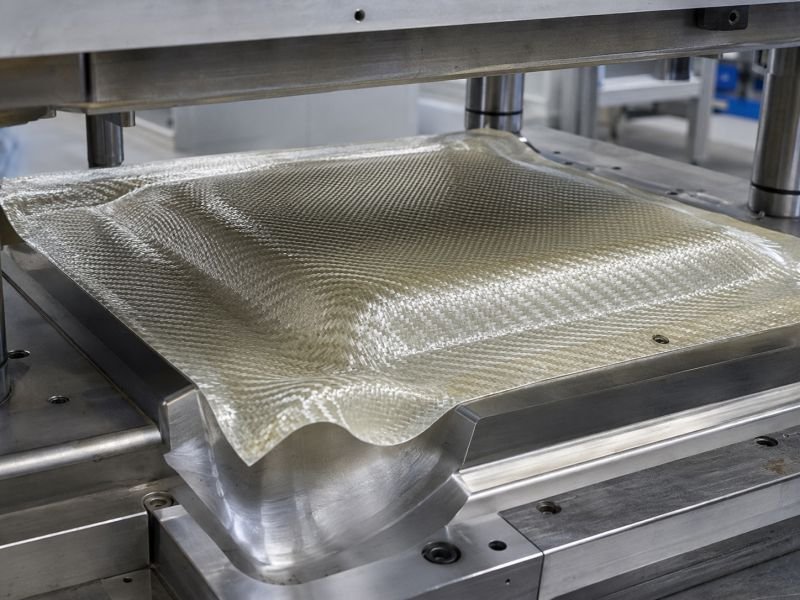
One development that is genuinely shifting this constraint is the move toward thermoplastic composites. Traditional composite materials use thermoset matrices, meaning the resin cures chemically and cannot be remelted. Once a thermoset composite is shaped, it is permanent. It cannot be re-formed or recycled by heat.
Thermoplastic composites use a matrix that melts above a threshold temperature and solidifies when cooled. The fiber reinforcement stays embedded in the matrix, but the part can be reheated, reshaped, and in principle recycled by remelting. Several manufacturers including Toray, Solvay, and TenCate are producing thermoplastic composite products for aerospace and automotive applications. The recycling infrastructure to process them at end of life does not yet exist at industrial scale. The physical pathway is open. The supply chain has not been built.
That gap between what the physics permits and what the industrial system can currently execute is the honest description of where sustainable manufacturing in material science sits today. The science is ahead of the logistics by roughly a decade, depending on which specific material transition is being examined.
The View From NoSuchDevice
I find the framing of sustainable manufacturing as a production problem almost completely backwards. The standard story focuses on factory emissions, renewable energy for industrial processes, and more efficient machinery. Those things matter. None of them change the number in the embodied energy calculation.
The material decision happens before the factory turns on. A company that switches its entire energy supply to renewable sources while continuing to specify primary aluminum for structural components has solved the wrong problem. The carbon in that aluminum was spent at a smelter, powered by electricity from a grid that may or may not have been clean, in a country that may or may not track this seriously.
What strikes me most in the actual science here is how much of it is already solved. The thermodynamics of recycling are understood. The chemistry of bio-based polymers is understood. The LCA methodology is mature enough to give real answers. The constraint is not physics. It is the inertia of manufacturing systems built around specific materials that have been optimized for decades and are deeply embedded in tooling, supply chains, and qualification certificates.
I think the most useful framing is also the most boring one: sustainable manufacturing at the material science level is a substitution problem, executed one component at a time, subject to actual performance requirements, and constrained by supply chain availability. There is no elegant pivot. There is only the bracket in the door panel, multiplied by ten billion decisions made by procurement teams who also have a budget to meet.
That is genuinely hard. It is also the correct shape of the problem.
Technologies Related to This Concept
| Technology | Concept |
|---|---|
| Smart Material Recyclers | Concept: Materials embedded with nanotech that allows them to self-recycle when triggered. |
| Molecular Disassembly Reactors | Concept: Reactors that break down complex waste into basic molecular components for reuse. |
| Bioengineered Plastic-Eating Organisms | Concept: Genetically modified organisms that consume plastic waste and excrete useful compounds. |
| Carbon-Sequestering Building Materials | Concept: Construction materials that absorb and store atmospheric carbon dioxide over time. |
| Self-Healing Infrastructure Materials | Concept: Concrete and road materials that repair micro-cracks automatically to extend lifespan and reduce waste. |
You read the whole thing.
That is rarer than it should be, and it is the exact kind of attention I built this archive for. I make every piece alone, with no ads and no investor deciding what gets written. If you want the next machine taken apart like this one, you can help me make it.
A coffee a month is enough to keep it free for everyone.
Prefer crypto or a one time gift? Other ways to give →