





What Is Inertial Confinement Fusion?
Inertial confinement fusion is a fusion approach that compresses a tiny fuel target so rapidly that its own inertia holds the hot plasma together for a short reaction interval. The fuel is usually a spherical pellet containing hydrogen isotopes. Lasers, ion beams, or pulsed-power drivers heat the outer layer, causing ablation that drives the remaining fuel inward. A key condition is areal density, often written rho R, which measures compressed mass per unit area.
In real systems, timing and symmetry dominate performance. Uneven drive energy can wrinkle the implosion, mix cold material into the hot spot, and lower fusion yield. For pulsed fusion energy systems, engineering must also solve target manufacture, high-repetition drivers, chamber protection, and heat extraction.
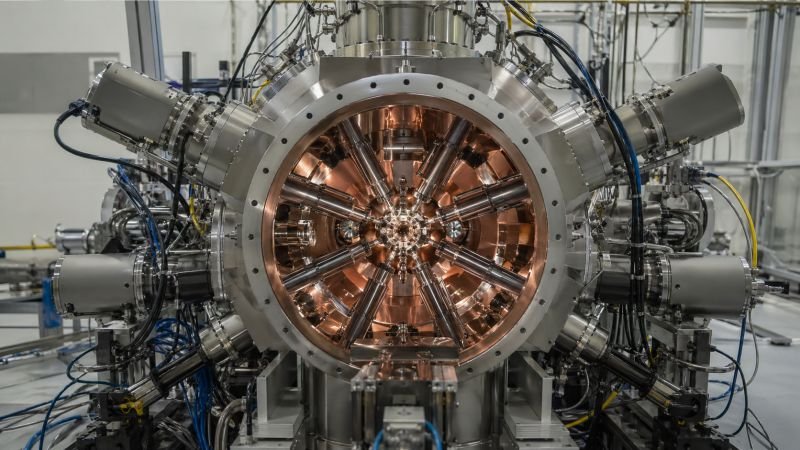
The concept matters because it offers a route to fusion without holding plasma inside a magnetic bottle for seconds or minutes. Used in devices include laser fusion chambers, pulsed-power fusion machines, heavy-ion drivers, and high-energy-density physics facilities. It also provides a laboratory method for studying matter at extreme pressure, radiation transport, alpha-particle heating, and nuclear reaction conditions similar to stellar interiors.
Example:
A laser fusion experiment can compress a deuterium-tritium capsule until the central hot spot ignites before the pellet expands.
Related Terms:
- Deuterium
- Plasma Confinement
- Laser Fusion
NoSuchDevice is a free archive of machines that do not exist yet but already have a shadow in physics. I research and write every entry alone, with no ads. Take a look around the archive, or help keep it free.