

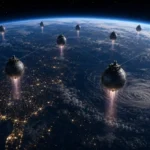

There is a moment in every large power outage when the same thought occurs to everyone standing in the dark: the electricity was coming from somewhere very far away. A coal plant two hundred kilometers distant. A hydrodam in a mountain range most residents have never visited. A grid built on the assumption that generation must be centralized and delivery must travel. Nobody decided this deliberately. It accumulated over a century of engineering choices that made sense when generators were large, fuels were bulk commodities, and the alternative was candles.
A fusion-powered microgrid starts from the opposite premise. The machine belongs in the neighborhood. The fuel – deuterium separated from ordinary water – arrives in quantities measured in kilograms, not tanker trucks. Power leaves as electrons at the distribution voltage the street already uses. The distance between generator and consumer collapses from hundreds of kilometers to perhaps two. The physics that powers stars does not specify a minimum address. The engineering, however, has strong opinions about what “compact” can mean before the concept dissolves into wishful thinking.
The short version: A fusion-powered microgrid is a compact fusion reactor – occupying a building-sized footprint rather than an industrial campus – designed to supply electricity, heat, and hydrogen fuel directly to a defined community. At 50 to 200 MW of thermal output, a single unit could serve between 15,000 and 60,000 households without transmitting power across a national grid. The plasma physics is real. The full device does not yet exist. That gap is exactly what makes this worth examining.
Key Takeaways
- A device producing 50 MW of electrical output could power roughly 30,000 households – the machine does not need to be enormous to be locally decisive
- Classical tokamak geometry cannot be miniaturized – compact fusion demands a different confinement architecture entirely
- High-temperature superconducting magnets operating above 20 Tesla are the single enabling technology that unlocks compact fusion geometry
- A fusion microgrid produces three usable outputs simultaneously – electricity, district heat, and hydrogen – and total energy utilization can reach 75-80%
- A city of interlocked fusion microgrids has a failure topology fundamentally different from anything built on Earth today
Table of Contents
Why the Grid’s Architecture Is the Problem
Most people treat energy infrastructure as a solved problem with an efficiency challenge. The real problem runs deeper than efficiency. A national grid built around large, remote generators inherits structural fragility at every transmission step: high-voltage corridors that fail in storms, substations that become single points of failure for entire districts, and a routing logic that requires electricity to travel hundreds of kilometers because the generation and consumption points were never designed to share a neighborhood.
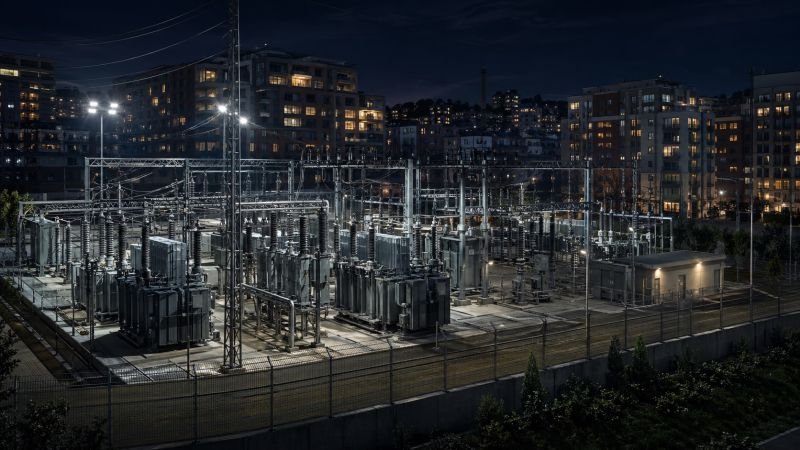
A fusion microgrid does not improve that system. It replaces the logic underneath it.
The device described here is not a power station with a shorter cable. It is a neighborhood-scale fusion reactor that generates electricity, recovers heat for local distribution, and produces hydrogen fuel from surplus output – all within a building-sized footprint at the edge of the community it serves, or underground beneath it. The national grid connection becomes optional rather than load-bearing. For a neighborhood with a functioning fusion microgrid, the grid is redundancy infrastructure, not primary supply.
What separates this concept from generic decentralization proposals is the energy density of fusion. Solar panels covering a neighborhood’s rooftops might, on a clear day, supply a fraction of demand. A fusion microgrid running continuously at 80 MW electrical output supplies roughly 2,700 watts per household in a district of 30,000 homes. Around the clock. In winter. Without weather dependence. The thermodynamic logic of heat engines sets the efficiency ceiling, but the energy source itself is not constrained by the sun’s schedule or the wind’s direction.
What a Tokamak Cannot Do – and What Replaces It
The engineering obstacle to a fusion microgrid is not public familiarity or regulatory will. It is plasma confinement geometry. The dominant fusion architecture of the past seventy years – the tokamak – was not designed for compact deployment, and the physics makes simple miniaturization genuinely difficult.
Why Compression Breaks the Tokamak
A tokamak confines plasma through a combination of external magnetic fields and a current driven through the plasma itself. At large plasma volumes, this arrangement is thermodynamically favorable: fusion power scales with volume, heat losses scale with surface area, and a large enough torus tips the balance toward net energy. Compress the machine, and the balance tips the other way. Surface area decreases more slowly than volume as dimensions shrink, wall heat loads per unit area increase, and the plasma current that stabilizes confinement also creates instabilities capable of terminating the plasma suddenly. In a compact device, each disruption produces proportionally more mechanical and thermal stress per unit volume.
A fission microgrid – a small modular fission reactor – avoids this problem entirely. Fission uses solid fuel in a subcritical arrangement that can be engineered to shut down safely at any scale. Fission SMRs are real and approaching deployment today. The reason to pursue fusion over fission at microgrid scale is not engineering convenience; fission wins that comparison at this moment. The argument for fusion is long-horizon fuel economics: deuterium from seawater versus enriched uranium, with a supply chain orders of magnitude simpler and no long-lived radioactive waste in the primary output. The engineering difficulty of fusion is genuinely higher. The fuel case justifies the pursuit anyway.
The Stellarator and the Inertial Alternative
Two architectures sidestep the tokamak’s compact geometry problem. The first is a stellarator. Where a tokamak uses a plasma current as part of its confinement scheme, a stellarator generates the entire confining magnetic field through external coils wound in a precisely calculated three-dimensional twist. No plasma current means no disruptions. The plasma can run stably for hours or days without the sudden termination events that make compact tokamak operation so difficult to manage.
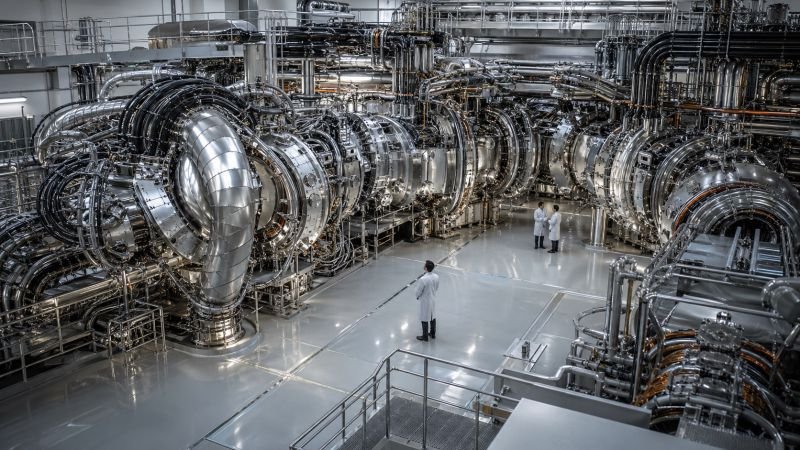
The engineering cost of a stellarator is geometric complexity. The coil shapes required for three-dimensional field generation are not manufacturable through conventional methods – each coil has a different, non-standard geometry. Modern computational design and precision CNC machining, developed primarily for aerospace components, made stellarator coil fabrication physically achievable in the last fifteen years. The Wendelstein 7-X device in Germany demonstrated sustained stellarator plasma in 2016 at quality and duration that earlier stellarator designs could not reach. The power-generating version of that physics, engineered for neighborhood energy demand, is the primary architecture this article examines.
The second path is inertial confinement fusion. A high-repetition energy source – a laser array or particle accelerator – compresses and heats small fuel pellets at hundreds of cycles per second, each pellet releasing a burst of fusion energy. The thermal output averages into continuous heat suitable for electricity generation. The National Ignition Facility demonstrated ignition in late 2022: fusion energy output exceeding the energy delivered to the fuel pellet itself. The full power-generating version would look, from the outside, like an industrial complex: a pulse driver hall, a target injection system, a heat exchanger, a turbine building. Less elegant than a stellarator. Possibly more manufacturable.
How the Device Could Operate
Take the compact stellarator as the working model. The device occupies a purpose-built structure of perhaps 50 by 80 meters – the footprint of a city block’s worth of building, possibly underground beneath a park or public square to minimize surface disruption and visual intrusion.
Plasma Heating: Two Methods in a Compact Space
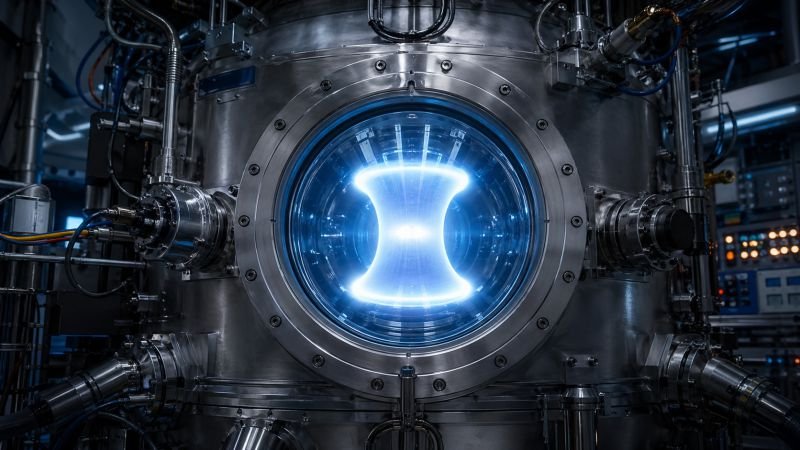
Deuterium fuel, separated from ordinary water by isotope distillation, feeds in controlled quantities into the stellarator’s plasma chamber. The plasma must reach temperatures approaching 100 million degrees Celsius – well above anything achievable by conventional heating alone. Two methods handle this at compact scale.
Neutral beam injection fires a stream of high-energy neutral atoms into the plasma. The atoms pass through the magnetic field that would deflect charged particles, penetrate the plasma volume, and transfer kinetic energy through collisions, heating ions directly. Radiofrequency heating applies oscillating electromagnetic fields tuned to the resonant frequencies of ions or electrons in the plasma – targeted energy deposition that heats the plasma where confinement demands it most. Both methods have been demonstrated in large research devices; the physics does not change with scale, only the absolute power levels required.
At fusion temperatures, deuterium reactions release energy as fast neutrons and energetic helium nuclei. The helium nuclei remain in the plasma and heat it further through collisions – this self-heating, called alpha heating, is what makes a burning plasma different from an externally-driven one. The plasma becomes partly self-sustaining rather than entirely dependent on external input.
From Plasma Heat to Distributed Electrons
The fast neutrons carry the majority of fusion energy outward through the plasma vessel walls and into a surrounding blanket of lithium compounds, where they are absorbed and their kinetic energy converts to heat. A coolant loop – helium gas or liquid lithium-lead alloy – circulates through the blanket and transfers thermal energy to a secondary steam cycle.
The efficiency ceiling follows directly from the Carnot relation:
η = 1 – (T_cold / T_hot)
Where T_hot is the temperature at which heat enters the steam turbine in Kelvin, and T_cold is the temperature at which heat is rejected. At T_hot = 750 K and T_cold = 310 K, the theoretical maximum efficiency reaches 59%. Real steam turbines achieve roughly 65-70% of the Carnot limit, placing practical electrical conversion at 38-40%. At 200 MW thermal input, that gives approximately 80 MW of electrical output. The turbine and generator feed AC power at distribution voltage. No high-voltage transmission step is required. The connection to the neighborhood’s existing cable infrastructure is direct.
Everything here is free. Readers are the reason it stays that way.
I make all of it alone, with no ads. If it is worth a coffee a month to you, that keeps the next one coming.
Keep it alive →The Magnet That Changes the Geometry
The superconducting coils that generate the confining magnetic field are not supporting infrastructure for the fusion reaction. They are the reason the device is physically possible at compact scale in the first place.
Classical low-temperature superconductors – niobium-tin, niobium-titanium – can generate magnetic fields of 8 to 12 Tesla. At large plasma volumes, this is sufficient for confinement. Compress the plasma volume and the required field strength climbs. A compact stellarator operating at 20 Tesla or above can achieve adequate confinement quality in a plasma volume ten to twenty times smaller than a conventional research device. That compression is what transforms a machine the size of a sports stadium into one that fits in a large building.
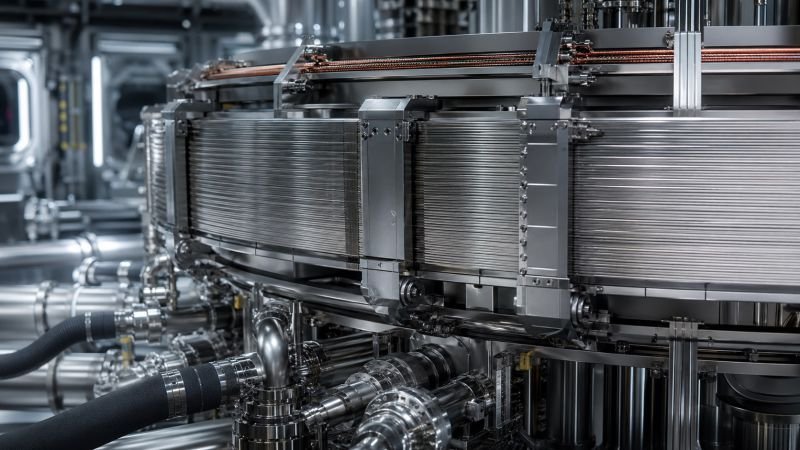
Rare-earth barium copper oxide (REBCO) superconductors changed what is manufacturable at those field strengths. REBCO tape sustains current densities enabling 20-plus Tesla fields in coil geometries that would mechanically fail under the same fields in earlier materials. The practical advantage is operating temperature: REBCO functions at liquid nitrogen temperatures (around 77 K) rather than the liquid helium temperatures (4 K) required by classical superconductors. The cooling infrastructure simplifies dramatically – a meaningful factor for a device intended to run continuously in an urban environment without specialized maintenance teams standing by. Commonwealth Fusion Systems demonstrated a 20 Tesla REBCO magnet in 2021. That demonstration did not produce power. It established that the field strength required for compact confinement exists in manufacturable form today.
For a stellarator geometry, the coil complexity multiplies this challenge further. Each of the dozens of coils generating the three-dimensional confining field has a distinct shape. Manufacturing them to the tolerances required for field accuracy – deviations of fractions of a millimeter in structures several meters across – is a precision manufacturing problem, not a physics problem. That distinction matters: physics problems may have no solution. Manufacturing problems have cost curves, and cost curves move in one direction over time.
Three Outputs From One Plasma
A fusion device optimized purely for electrical output leaves significant energy on the table. At 40% electrical conversion efficiency, roughly 60% of thermal input exits the secondary steam cycle as low-grade heat. In a remote power station, this heat goes to a river or a cooling tower. In a neighborhood, it has addresses.
District Heating and the Urban Heat Sink
Hot water at 80-120°C is precisely the temperature range required for district heating systems. A neighborhood grid of insulated underground pipes carries this thermal energy to building heat exchangers, replacing individual gas boilers at the building level. For a fusion microgrid supplying 200 MW thermal, the available low-grade heat after electricity extraction approaches 120 MW. Distributed across a district of 30,000 homes, that covers typical European heating loads through most of the winter without additional fuel combustion.
Total energy utilization – the fraction of fusion energy converted to something useful rather than rejected – climbs from 40% (electricity only) to 70-80% when district heat is captured alongside power. The thermodynamic constraints governing all heat engines are not overcome here; the heat that cannot become electricity is redirected rather than wasted.
Hydrogen as the Third Product
Surplus electrical output during overnight hours – when residential demand drops to perhaps 40% of peak – can drive electrolysis systems that split water into hydrogen and oxygen. The hydrogen stores in compressed form or in metal hydride tanks at low pressure, distributes to local refueling infrastructure, or feeds back into the electrical system through fuel cell reconversion during the following day’s demand peak. A community already operating hydrogen fuel cell vehicles finds itself refueling them from locally produced hydrogen – which is, traced back to the source, fusion energy in temporarily stored molecular form.
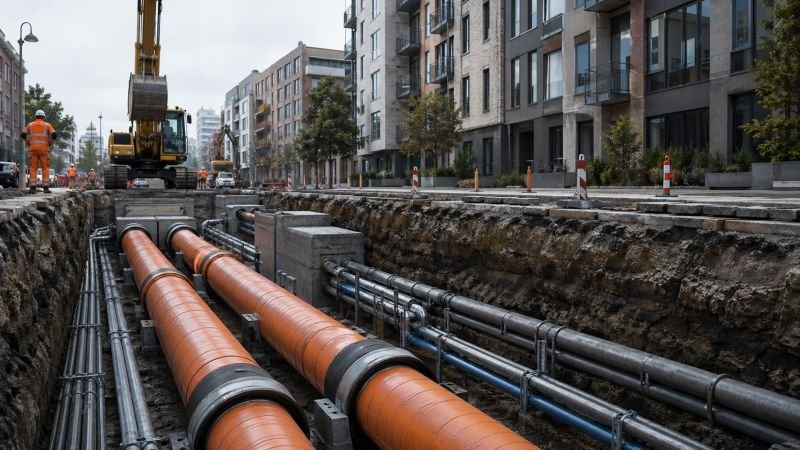
The combination changes the energy accounting of the neighborhood entirely. The device stops being a power station and becomes an energy hub: continuous electricity, recovered heat through winter, and hydrogen through every overnight cycle. The thermodynamics that set the ceiling on each individual output are the same thermodynamics they have always been. The architecture that captures all three outputs simultaneously is what makes the total picture different.
How Small Before the Physics Says No
There is a lower bound on the device’s size, and it is set by plasma physics, not by neighborhood planning preferences.
Fusion power in a confined plasma scales with the square of plasma density and with plasma volume. Heat losses from the plasma scale with the surface area of the confining region. As the device shrinks, surface area decreases more slowly than volume – the familiar surface-to-volume ratio problem that appears everywhere from biology to engineering – and the power balance deteriorates. Below a certain plasma volume, losses gain on the reaction rate until the device consumes more energy sustaining the plasma than the fusion reactions return.

For a compact stellarator at 20 Tesla field strength, physics analyses place the minimum viable plasma volume at roughly 10 to 20 cubic meters for net energy output at the plasma level. The full device – plasma vessel, neutron blanket, magnet coils, cooling systems, turbine hall, control infrastructure – occupies a structure of approximately 30 by 50 meters at minimum. A community of 500 homes cannot justify this device. A district of 15,000 homes almost certainly can, both in available footprint and in aggregate energy demand.
| Configuration | Thermal Output | Electrical Output | Households Served | Minimum Footprint |
|---|---|---|---|---|
| Minimum viable | 50 MW | ~20 MW | ~12,500 | ~1,500 m² |
| Neighborhood unit | 100 MW | ~40 MW | ~25,000 | ~2,500 m² |
| District unit | 200 MW | ~80 MW | ~50,000 | ~4,000 m² |
| Borough unit | 500 MW | ~200 MW | ~125,000 | ~8,000 m² |
At first-generation capital costs estimated between 500 million and two billion dollars per unit, the economic threshold requires a population large enough to amortize the investment over a plausible operating lifetime. A device running for forty years on near-free deuterium fuel looks different against a forty-year natural gas bill than it does against a five-year planning horizon. The minimum working unit is not defined by plasma physics alone. It emerges from the intersection of plasma physics, thermal engineering, and the density of energy demand in a given urban geography.
From Single Block to City Nervous System
A single fusion microgrid serving one district is an interesting engineering achievement. A city with a dozen of them interlocked is a different kind of infrastructure.
The Topology Shift
Today’s urban electrical grid flows in one direction: generation at large remote stations, transmission across high-voltage corridors, distribution down to streets and buildings. A single point of failure – a substation fire, a storm-damaged transmission line – can cascade across thousands of homes in minutes. The topology is hierarchical, and hierarchy carries fragility in proportion to its depth.
A city of fusion microgrids has a mesh topology. Each neighborhood unit is a generator. Connections between units exist for load-sharing and redundancy, but no single device is load-bearing for the whole network. A unit going offline for scheduled maintenance does not interrupt supply – neighboring units absorb the affected district’s load while the tie-lines carry balance. The failure mode changes from cascade to localized adjustment. The difference is not incremental. It is architectural.
Integration with existing local infrastructure follows a natural sequence. Battery storage already deployed at the neighborhood level absorbs rapid demand fluctuations that the fusion device’s thermal inertia cannot track instantaneously – a steam turbine spins at constant speed; battery banks handle the two-minute spikes. Rooftop solar feeds into the local grid during daylight, reducing draw on the fusion unit and increasing the hydrogen surplus available overnight. Wind resources in adjacent areas connect to the same local network. The fusion microgrid is the baseload anchor that makes intermittent sources economically rational. Without reliable baseload, storage requirements for solar and wind become prohibitive. With one, intermittent sources can be sized for contribution rather than coverage.
The Evolutionary Arc
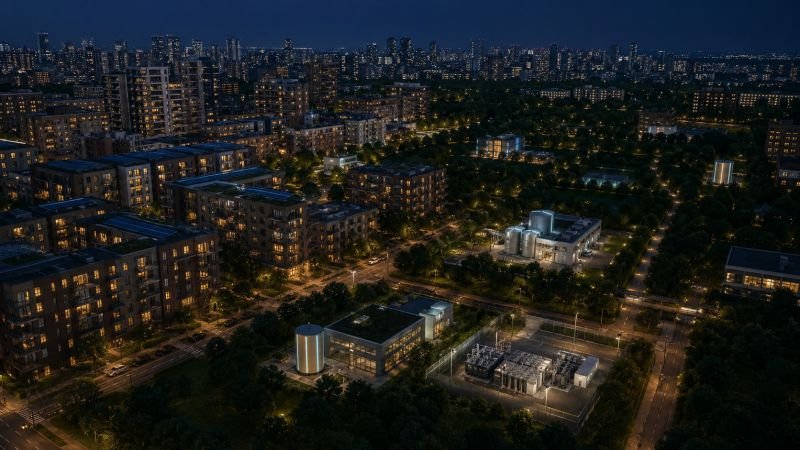
First-generation fusion microgrids would not appear in existing neighborhoods. They would appear in purpose-built contexts: new urban districts planned from scratch, large university campuses or hospital complexes with stable long-term energy demand, industrial zones where heat and hydrogen are both commercially useful outputs. These early deployments generate real operational data – actual maintenance cycles, true fuel consumption, failure modes not anticipated in design. They prove the concept in conditions controlled enough to be informative.
Second-generation devices, refined through operating experience and manufacturing scale, become retrofit candidates. Aging electrical substations in dense city centers occupy building-scale footprints and serve populations of precisely the size a fusion microgrid would serve. The replacement logic is direct: same footprint category, same service population, incomparably simpler long-term fuel logistics. By the third generation, the device is urban infrastructure in the way gas mains and water treatment plants are today – present, maintained, unremarkable to the people it serves.
At city scale, the accumulated effect is not simply cleaner energy. The fuel flows in as water. The energy flows out as electrons, heat, and hydrogen. The grid, still present, carries balance rather than primary supply. A city that runs on interlocked fusion microgrids has a different relationship to energy scarcity, to fuel geopolitics, and to the physical meaning of a blackout. The physics of the heat engine is unchanged throughout this arc – the source of heat just moved from combustion a hundred kilometers away to a fusion reaction two blocks over.
The View From NoSuchDevice
I find the fusion microgrid a more honest concept than most fusion proposals currently in public circulation, and I want to say exactly why.
The standard fusion narrative is about building a better coal plant. A large tokamak or inertial fusion facility produces gigawatts, feeds a national grid, and replaces fossil generation without changing anything else about how energy infrastructure is organized. It is a fuel swap inside an unchanged system. That version of fusion requires a working large-scale device, decades of grid transition, and institutional structures capable of managing gigawatt-class assets. It is possible. It is also, as a concept, not particularly interesting: the infrastructure logic it produces is identical to what coal and nuclear already built.
The fusion microgrid asks a different question. It asks whether the centralized grid is a legacy constraint rather than an engineering necessity. If the device works at neighborhood scale, the answer is that it is. Energy independence at the district level – not the household level, which the physics will not permit at any reasonable cost – is a structurally different condition from energy delivery as a utility service from a remote provider. That difference ramifies through urban planning, emergency resilience, and the political economy of infrastructure in ways that a better large power station does not.
I do not think the engineering is close. A compact stellarator producing net electricity in a controlled research setting probably arrives in the 2030s or 2040s. A device engineered for continuous operation in an urban environment is another fifteen to twenty years beyond that. First purpose-built deployments before 2070 seems defensible. City-scale infrastructure by 2090 requires sustained manufacturing cost reduction that has historical precedent in solar panels and semiconductor fabrication but cannot simply be assumed.
What I find worth noting is the failure mode if the timeline slips. Fission small modular reactors are a real alternative at this scale and will deploy earlier. They solve the same energy independence problem with proven physics and harder fuel logistics. If fusion microgrids arrive in a world already restructured around fission microgrids, the transition is still positive – better long-term fuel economics, simpler waste profile. The concept survives its own delay. The most fragile scenario is not technical failure. It is political and institutional inertia treating neighborhood-scale nuclear in any form as inherently unacceptable without engaging the physics of what is actually being proposed.
The machine under the park, turning seawater into the electricity for 30,000 homes – that is not a science fiction image. It is extrapolated engineering with a long horizon. The physics already casts its shadow. The engineering just has not caught up yet.
You read the whole thing.
That is rarer than it should be, and it is the exact kind of attention I built this archive for. I make every piece alone, with no ads and no investor deciding what gets written. If you want the next machine taken apart like this one, you can help me make it.
A coffee a month is enough to keep it free for everyone.
Prefer crypto or a one time gift? Other ways to give →