





What Is intercalation?
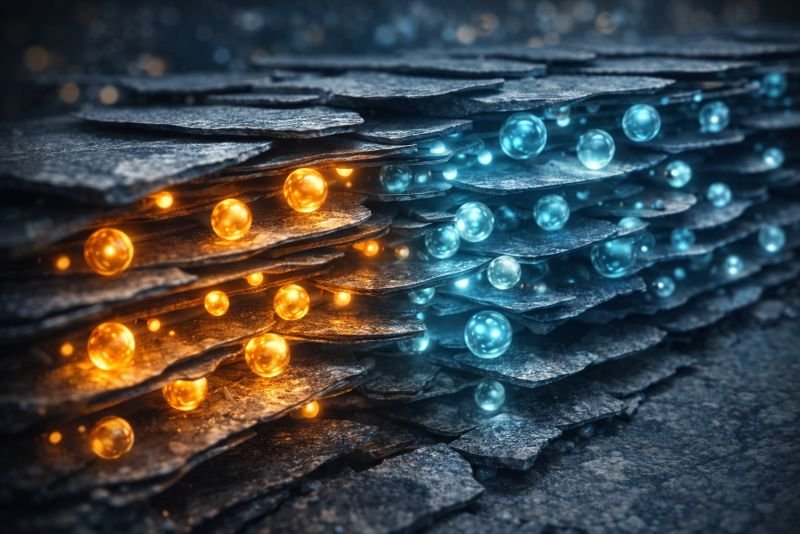
Intercalation is the reversible insertion of ions into the gaps of a host material without destroying the host crystal framework. In lithium-ion cells, lithium ions move between layered or porous electrode structures and occupy available sites. A simplified reaction is xLi+ + xe- + Host <-> LixHost, which shows that charge storage depends on both ion uptake and electron balance.
Graphite anodes and many cathode materials work because their structures can accept and release ions repeatedly with limited rearrangement of the lattice. The rate depends on diffusion distance, particle size, and local Electrochemical Potential, while the surface behavior of the anode is often shaped by the Solid Electrolyte Interphase (SEI). Large volume change or slow diffusion makes fast charging more difficult.
The concept matters because intercalation is what makes high-cycle rechargeable batteries possible. In lithium-ion battery reaction design, engineers choose host materials that can store many ions, hold their structure over repeated cycles, and release those ions quickly enough to meet power and lifetime targets. That is why rechargeable electrodes are judged for structural reversibility as well as raw capacity.
Example:
During charging, lithium ions slide into graphite layers at the anode instead of plating out as bulk metallic lithium.
Related Concepts:
- Diffusion
- Graphite Anode
- Cathode Lattice
NoSuchDevice is a free archive of machines that do not exist yet but already have a shadow in physics. I research and write every entry alone, with no ads. Take a look around the archive, or help keep it free.