





In the Atacama Desert of northern Chile, one of the driest places on Earth, engineers are pulling lithium from ancient salt flats using a process that takes nearly two years from brine extraction to refined metal. That metal ends up in battery cells. Those cells end up in electric vehicles, grid storage systems, and the device you are probably reading this on. The Atacama holds roughly 40 percent of the world’s known lithium reserves, and the entire global battery industry depends on the chemistry that makes that lithium useful.
Batteries are not tanks. They do not hold electricity the way a water tower holds water. They hold chemistry, and chemistry is where the energy lives.
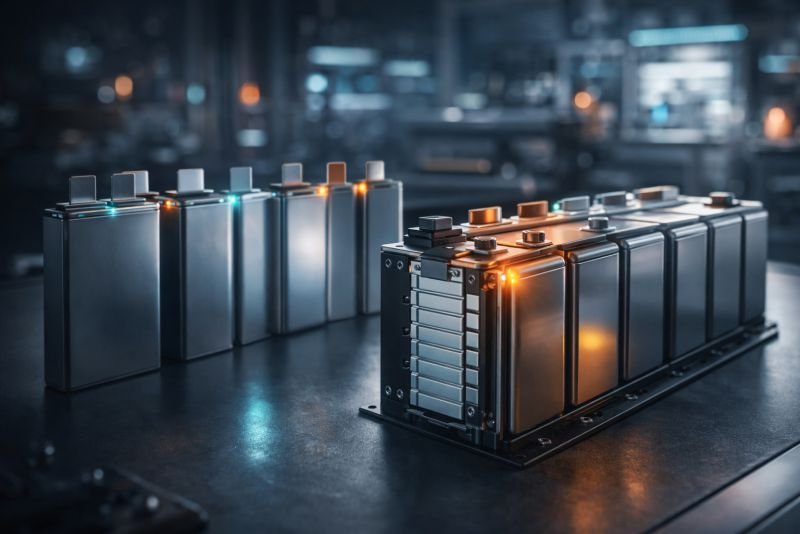
The short version: A battery stores energy by separating two materials that want to react with each other. When a circuit connects them, electrons flow through it as current while ions move through an internal electrolyte, releasing the stored energy. A typical lithium-ion cell stores around 250 watt-hours per kilogram of mass, making it the most energy-dense rechargeable technology widely available today. Understanding the electrochemistry behind that figure explains both why batteries work so well and where their fundamental limits come from.
Table of Contents
How Battery Chemistry Stores Energy as Chemical Potential
Every battery contains two electrodes and a medium between them. The electrodes are named the anode and cathode, and the medium is the electrolyte. These three components are not interchangeable parts. Their specific chemistry determines everything: how much energy a battery can store, how fast it can release that energy, how many times it can be recharged, and at what temperatures it functions safely.
Energy enters the battery during charging and leaves during discharge. But it does not enter or leave as electricity in any direct sense. It enters as a rearrangement of atoms and electrons across the electrodes. The electricity is a consequence of that rearrangement, not a substance being pumped in.
The Anode: Where Electrons Accumulate During Charging
The anode is the negative electrode during discharge. In a lithium-ion cell, the anode is typically made of graphite, a layered form of carbon. During charging, lithium ions are pushed out of the cathode, travel through the electrolyte, and are intercalated into the graphite layers on the anode side. The word intercalation describes a physical process: the lithium ions slide between the carbon layers and sit there without breaking the structure. The anode is now holding lithium under tension, electrochemically speaking. It wants to release it.
The Cathode: Where Energy Density Is Determined
The cathode is the positive electrode. In lithium-ion batteries, the cathode is typically a lithium metal oxide compound. Common cathode chemistries include lithium cobalt oxide (used in smartphones), lithium iron phosphate (used in grid storage and some EVs), and lithium nickel manganese cobalt oxide. The choice of cathode chemistry directly controls the voltage, energy density, and thermal stability of the entire cell. Lithium cobalt oxide delivers high energy density but degrades quickly and generates heat under stress. Lithium iron phosphate delivers lower energy density but can survive thousands of charge cycles and is far more thermally stable.
The Electrochemical Reaction: What Actually Happens When a Battery Discharges
When the battery is connected to a load, a circuit is complete, and two things happen simultaneously. Electrons leave the anode and travel through the external circuit. Lithium ions leave the anode and travel through the electrolyte toward the cathode. These two movements are coupled and cannot happen independently.
The electron movement through the external wire is what powers a device. The ion movement through the electrolyte maintains electrical neutrality inside the battery. Without the electrolyte conducting ions, the reaction would stop within milliseconds.
What drives this movement? The answer is electrochemical potential. The lithium atoms intercalated in the graphite anode are at a higher energy state than the lithium ions that will eventually settle into the cathode structure. Nature trends toward lower energy states. The reaction proceeds because it releases energy, and that released energy is what the circuit captures.
The full discharge reaction for a lithium-ion cell with a lithium cobalt oxide cathode looks like this:
Discharge reaction: LiC6 + CoO2 -> C6 + LiCoO2
At the anode, lithium atoms give up an electron and become lithium ions. At the cathode, those ions are absorbed into the cobalt oxide structure. The reaction is reversed during charging by applying an external voltage that forces the ions back to the anode against their natural tendency.
Cell Voltage and What the Numbers Mean
The voltage a cell produces is not an arbitrary specification. It is a direct consequence of the electrochemical potential difference between the anode and cathode materials. This potential difference is measured in volts and is called the cell potential.
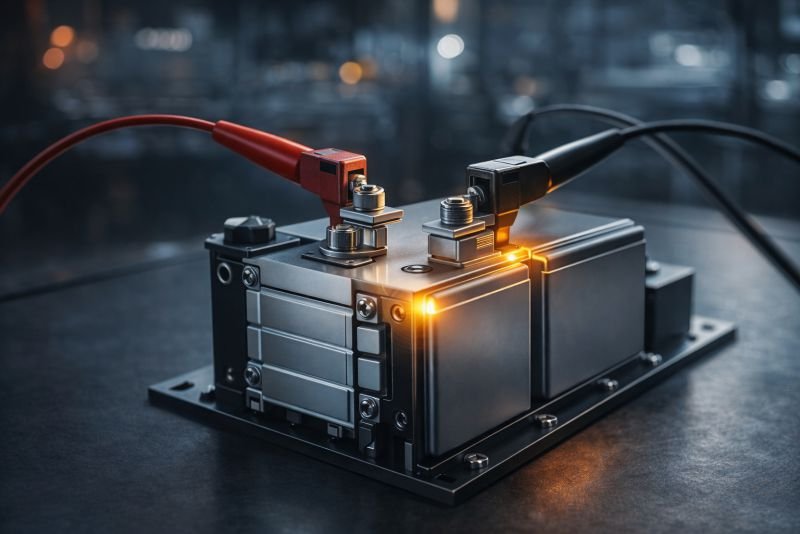
The Nernst equation describes how cell voltage relates to the chemistry:
E = E0 – (RT / nF) * ln(Q)
Each symbol carries a specific meaning. E is the actual cell voltage under operating conditions. E0 is the standard cell potential, a fixed property of the electrode pair measured under controlled laboratory conditions. R is the universal gas constant, 8.314 joules per mole per kelvin. T is the temperature in kelvin. n is the number of electrons transferred per reaction unit, which for a lithium-ion cell is 1. F is the Faraday constant, 96,485 coulombs per mole of electrons. Q is the reaction quotient, a ratio that describes the current concentrations of reactants and products.
Put in concrete terms: a lithium cobalt oxide cell has a standard potential E0 of approximately 3.7 volts. At room temperature (298 K) with n equal to 1, the term (RT/nF) equals about 0.026 volts. When the cell is fully charged and Q is small, the logarithm term is negative, which pushes the actual voltage slightly above 3.7 volts. As the cell discharges and Q increases, the voltage drops. This is exactly why a lithium battery shows around 4.2 volts when fully charged and around 3.0 volts when nearly depleted: the chemistry is changing in real time, and the voltage is reporting that change.
The Electrolyte: An Ion Highway That Cannot Conduct Electrons
If both electrodes were connected by a wire inside the cell as well as outside, the battery would short-circuit instantly. The electrolyte solves this problem. It conducts ions but not electrons, which forces the electrons to take the only path available: the external circuit.
In most lithium-ion cells, the electrolyte is a lithium salt dissolved in an organic solvent. A common formulation is lithium hexafluorophosphate dissolved in a mixture of ethylene carbonate and dimethyl carbonate. The lithium ions can move freely through this solution. Electrons cannot.
The electrolyte also sets a ceiling on performance. Organic electrolytes are flammable, which introduces safety constraints. They become viscous and sluggish at low temperatures, which is why lithium-ion batteries lose significant capacity in cold weather. And they have a limited electrochemical stability window, meaning that cell voltages too far above or below a certain range will cause the electrolyte to break down. This is why lithium-ion cells cannot simply be charged to a higher voltage to extract more energy without simultaneously reformulating the electrolyte chemistry.
Solid-state electrolytes replace the liquid with a ceramic or polymer material. Ions can still move through these materials, but electrons cannot. Solid electrolytes are not flammable, tolerate higher voltages, and may eventually enable energy densities significantly above what liquid-electrolyte cells can achieve. They remain expensive and difficult to manufacture at scale.
| Electrolyte Type | Ion Conductivity | Flammability | Voltage Stability | Manufacturing Maturity |
|---|---|---|---|---|
| Liquid organic | High | Yes | Moderate (~4.5V) | Mass production |
| Solid ceramic | Moderate | No | High (~6V) | Early scale-up |
| Solid polymer | Moderate | No | Moderate | Pilot scale |
| Gel polymer | High | Low | Moderate-high | Growing |
| Aqueous | High | No | Low (~1.5V) | Mature (limited use) |
Everything here is free. Readers are the reason it stays that way.
I make all of it alone, with no ads. If it is worth a coffee a month to you, that keeps the next one coming.
Keep it alive →Energy Density and the Physical Limits That Constrain It
How much energy can a battery store per kilogram? This number, the gravimetric energy density, is the single most scrutinized figure in the industry. Current lithium-ion cells achieve roughly 200 to 300 watt-hours per kilogram at the cell level. The theoretical maximum for a lithium-ion chemistry is somewhere around 400 watt-hours per kilogram, and current commercial cells are already approaching the ceiling.
Why is there a ceiling at all? The answer comes from the atomic mass of the materials involved. Every ion that stores charge also adds mass. Every structural component of the cell adds mass without storing charge. The ratio of charge-carrying material to total mass is fixed by chemistry and physics, not engineering choices.
The specific capacity of a cathode material is measured in milliamp-hours per gram (mAh/g). Graphite anodes deliver around 372 mAh/g. Lithium cobalt oxide cathodes deliver around 140 mAh/g. The cathode is the bottleneck. Silicon anodes can theoretically deliver around 3,590 mAh/g, roughly ten times graphite, which is why silicon is the subject of intense battery research. The problem is that silicon expands by nearly 300 percent when it absorbs lithium, and this expansion cracks the anode material, destroying the cell within a few hundred cycles.
What does achieving 300 watt-hours per kilogram mean in practical terms? An electric vehicle with a 75 kWh battery pack contains roughly 250 kilograms of cells at that density. A theoretical cell achieving the same energy at 600 watt-hours per kilogram would weigh 125 kilograms, cutting battery mass in half and extending range proportionally. This calculation is why energy density dominates the conversation in energy storage research.
Charge Cycles and Degradation: What Repeated Reactions Cost
Every charge and discharge cycle stresses the materials involved. The electrodes expand and contract as ions move in and out. The electrolyte undergoes side reactions that deposit thin films on electrode surfaces. These films, called the solid electrolyte interphase or SEI layer, are not entirely unwanted. A stable SEI layer on the anode actually protects the electrode. An unstable or growing SEI layer consumes lithium that can no longer participate in the main reaction, reducing capacity over time.

How fast does a lithium-ion cell degrade? A well-designed cell retains around 80 percent of its original capacity after 500 to 1,000 full charge cycles. Lithium iron phosphate cells, with their more stable cathode chemistry, can last 2,000 to 4,000 cycles before reaching the same threshold. For grid storage applications where a battery may cycle once per day, the difference between 1,000 and 3,000 cycles represents the difference between three years and eight years of useful life.
Degradation is not only from cycling. Calendar aging occurs even when a battery sits unused. The electrolyte slowly reacts with the electrodes at rest, and this process accelerates at elevated temperatures and high states of charge. A lithium-ion battery stored at 100 percent charge in a warm environment degrades significantly faster than one stored at 50 percent charge in cool conditions. Most battery management systems in well-designed devices deliberately avoid holding cells at 100 percent to extend lifespan.
Battery Chemistry in Grid-Scale Energy Storage
The demands placed on batteries in a vehicle differ substantially from the demands placed on them in a grid storage installation. A vehicle battery needs high energy density to maximize range within a constrained weight budget. A grid battery sits stationary, which means weight is irrelevant, but it needs to cycle frequently and cheaply over many years.
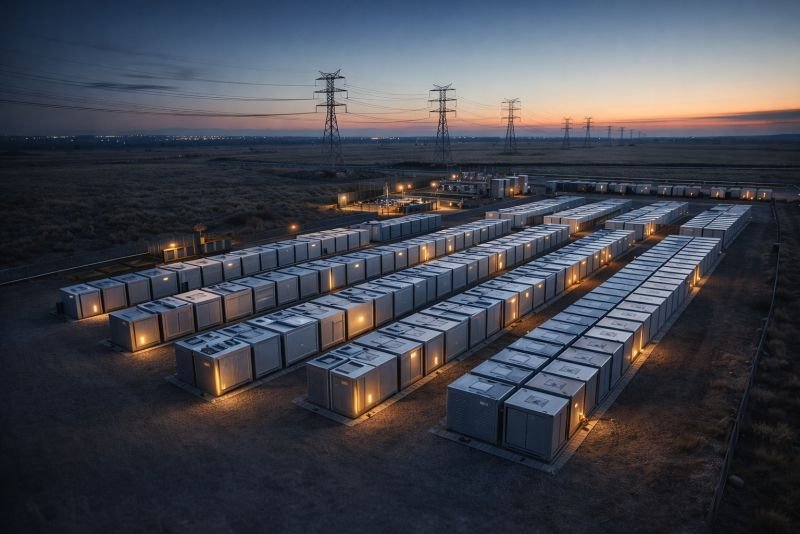
This mismatch explains why different chemistries dominate different markets. Lithium cobalt oxide and lithium nickel manganese cobalt oxide are used in vehicles, where energy density earns its cost. Lithium iron phosphate dominates grid storage, where cycle life and cost per kilowatt-hour matter more than density. Vanadium redox flow batteries, a completely different architecture in which the electrolyte is pumped through an electrochemical cell, are entering grid storage deployments because their capacity can be scaled by simply enlarging the electrolyte tanks and their electrolyte does not degrade in the way solid electrode materials do.
Hornsdale Power Reserve in South Australia, a 150 megawatt-hour lithium-ion installation using Tesla battery packs, has been providing frequency regulation services to the South Australian grid since 2017. It responds to grid frequency deviations within 140 milliseconds, far faster than any gas turbine can spin up. This performance comes directly from the electrochemistry: chemical reactions respond to electrical signals in milliseconds, not the seconds or minutes required by mechanical systems.
The chemistry of batteries is not incidental to the energy transition. It is the constraint that the energy transition must solve.
Where Battery Chemistry Is Heading
Several research directions are pushing beyond the constraints of current lithium-ion chemistry.

Lithium-sulfur cells pair a lithium anode with a sulfur cathode. Sulfur can theoretically store 1,672 mAh/g compared to lithium cobalt oxide’s 140 mAh/g, which would place the theoretical energy density of a lithium-sulfur cell above 2,600 watt-hours per kilogram. The practical challenge is a phenomenon called the polysulfide shuttle: during cycling, sulfur dissolves into the electrolyte as intermediate compounds and migrates to the anode, where it degrades both electrodes. Researchers have partially contained the shuttle through modified electrolytes and cathode encapsulation, and some lithium-sulfur cells have now demonstrated over 1,000 cycles in laboratory conditions.
Lithium-air cells take the concept further. They pair a lithium anode with oxygen from the surrounding air as the cathode material. Because oxygen does not need to be stored inside the cell, the theoretical energy density exceeds 11,000 watt-hours per kilogram, approaching the specific energy of gasoline. The practical challenges are formidable: oxygen must be kept dry, reaction products block the cathode, and no lithium-air cell has yet demonstrated meaningful cycle life outside controlled laboratory conditions. But the physics permits it.
Sodium-ion batteries substitute sodium for lithium, using materials that are abundant globally. Sodium cells carry less energy per kilogram than lithium cells because sodium ions are heavier, but sodium is far cheaper and more evenly distributed geographically than lithium. Commercial sodium-ion cells are now entering the market, primarily for applications where energy density is not the primary constraint.
The diversity of approaches reflects a deeper truth about electrochemistry: the periodic table contains many elements, and the space of possible electrode pairs, electrolytes, and reaction mechanisms is enormous. The chemistry of batteries is not a solved field. It is a field where the fundamental physics is understood, but the applied engineering still has decades of discovery ahead.
You read the whole thing.
That is rarer than it should be, and it is the exact kind of attention I built this archive for. I make every piece alone, with no ads and no investor deciding what gets written. If you want the next machine taken apart like this one, you can help me make it.
A coffee a month is enough to keep it free for everyone.
Prefer crypto or a one time gift? Other ways to give →
Technologies Related to This Concept
| Technology | Concept |
|---|---|
| Graphene Supercapacitors – Revolutionizing Electric Vehicle Charging | Concept: Exploring how graphene-based supercapacitors can drastically reduce EV charging times. |
| Graphene Supercapacitors in Renewable Energy Storage | Concept: Using graphene supercapacitors to store energy from solar and wind sources efficiently. |
| Solar Road Studs with Energy Storage | Concept: Road markers that collect solar energy and store it for lighting. |
| Hydrogen Fuel Cells for Smartphones: A New Era of Battery Life | Concept: Integrating hydrogen fuel cells into smartphones to dramatically extend usage time. |
| Innovations in Energy Storage for Hydrokinetic Power | Concept: New storage technologies complementing generation. |
| Bio-Reactors with Energy Storage Capabilities | Concept: Integrated batteries to store excess energy produced. |