






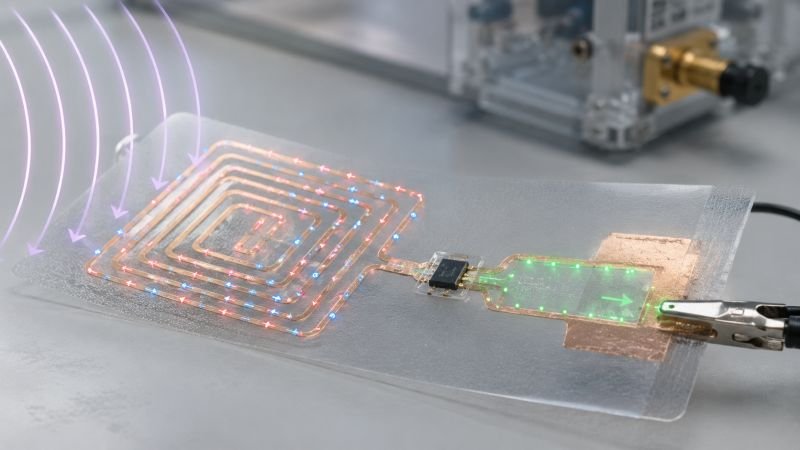
What Is Rectenna?
A rectenna is an antenna connected to a rectifier so incoming electromagnetic waves are converted directly into direct current. The antenna captures oscillating electric fields and produces an alternating voltage at its terminals, while the rectifier allows charge to pass more easily in one direction than the other. This combination turns radio, microwave, infrared, or terahertz radiation into usable electrical output when the components are matched to the target frequency.
The basic power relation is P_dc = eta P_rf, where eta is conversion efficiency and P_rf is the captured radio-frequency or electromagnetic input power. In real designs, performance depends on antenna resonance, impedance matching, diode response time, junction capacitance, polarization, and load resistance. At very high frequencies, nanoscale tunnel junctions may be needed because ordinary semiconductor diodes cannot switch quickly enough.
The concept matters because it provides a compact bridge between wave energy and electronic power without a rotating generator or intermediate thermal stage. In terahertz antenna arrays, rectennas can collect small electromagnetic fluctuations across many repeated elements. Used in devices include RFID tags, wireless power receivers, microwave energy harvesters, infrared detectors, and nanoscale antenna grids for low-power electronics.
Example:
An RFID tag uses a small antenna and rectifier circuit to draw operating power from a reader’s electromagnetic field.
Related Terms:
NoSuchDevice is a free archive of machines that do not exist yet but already have a shadow in physics. I research and write every entry alone, with no ads. Take a look around the archive, or help keep it free.