






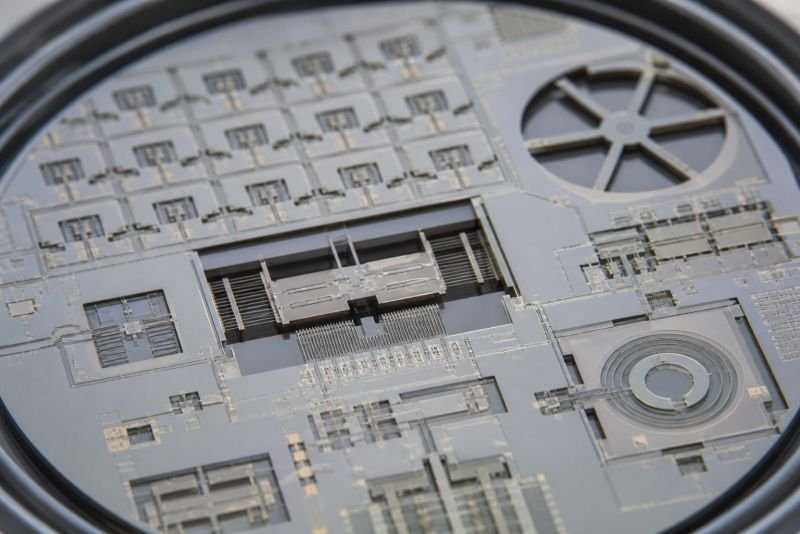
What Is MEMS?
MEMS, short for Micro-Electro-Mechanical Systems, are miniaturized devices that combine mechanical structures, sensing elements, actuators, and electronics on or near a microfabricated substrate. They are built with processes adapted from semiconductor manufacturing, so tiny beams, membranes, cavities, and electrodes can be repeated with high precision. When a MEMS structure vibrates or deflects, its behavior often follows f = (1/2pi)sqrt(k/m), relating resonance to stiffness and effective mass.
In real systems, performance depends on geometry, material stress, damping, packaging, and the way electrical readout is coupled to motion or heat flow. MEMS can sense pressure, acceleration, sound, flow, or gas composition, and they can also move mirrors, valves, or nozzles. In miniaturized environmental sensing, MEMS fabrication helps shrink sampling hardware so instruments carry more capability for a given mass and power budget.
The field matters because it brings batch manufacturing to precise mechanical functions that once required larger machined parts. Used in devices include accelerometers, pressure sensors, inkjet heads, projection mirrors, and compact gas-monitoring modules. Engineers value MEMS when they need low mass, repeatable fabrication, and close integration with control electronics, while managing drift, contamination, and package design that can dominate behavior at very small scales.
Example:
A smartphone accelerometer uses a MEMS proof mass whose motion changes capacitance when the phone is tilted or shaken.
Related Terms:
- Electrochemical Sensor
- VOC
- Microfabrication
NoSuchDevice is a free archive of machines that do not exist yet but already have a shadow in physics. I research and write every entry alone, with no ads. Take a look around the archive, or help keep it free.