






What Is No-communication theorem?
The no-communication theorem is the quantum rule that entanglement alone cannot transmit usable information faster than light. Measurements on one part of an entangled system can change correlations, but they do not control what a distant observer sees locally. In no-signalling notation, P(b|y,a,x) = P(b|y): the remote outcome distribution is unchanged.
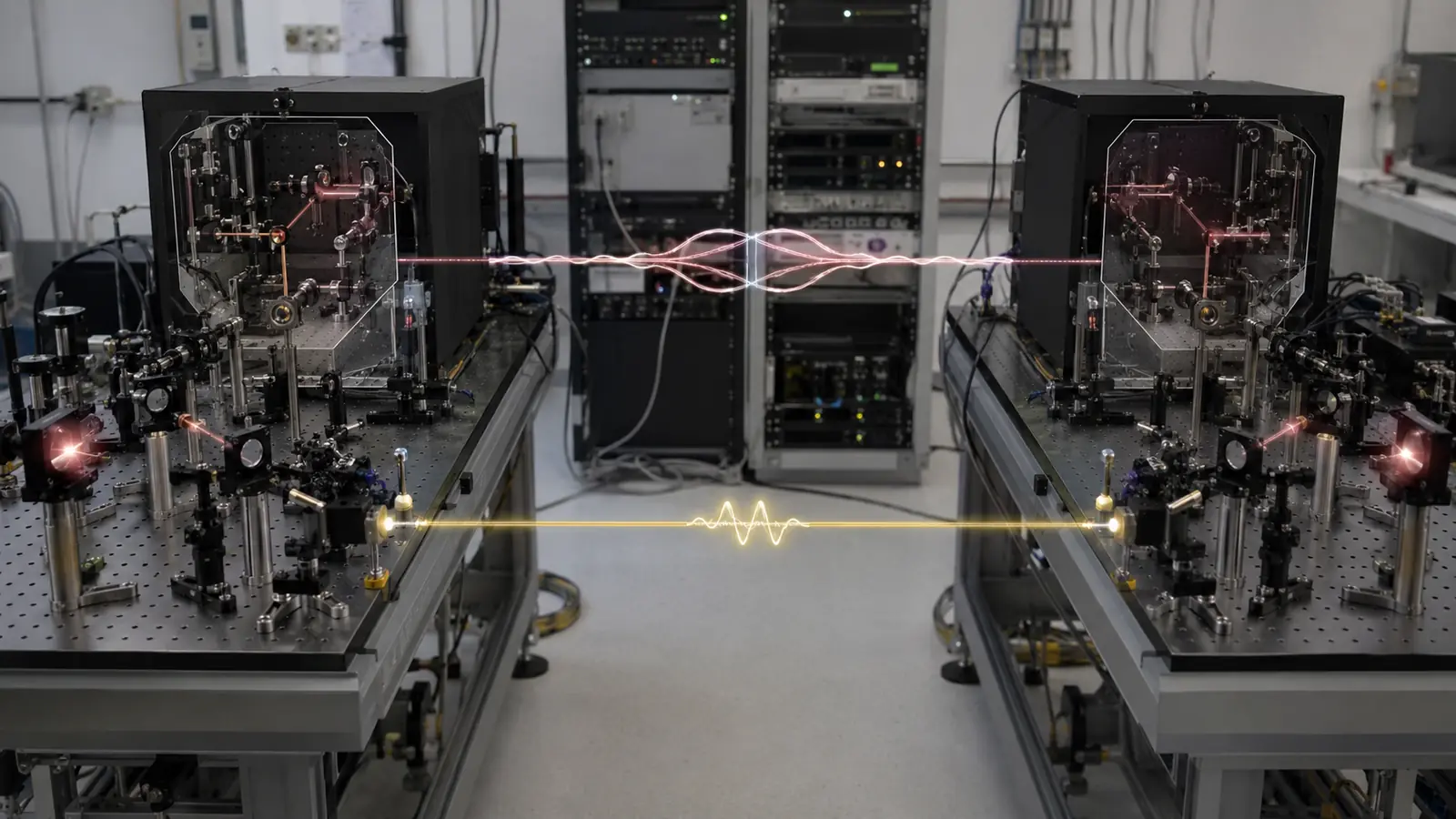
In real experiments, two observers can measure entangled particles and later compare results through an ordinary communication channel. The correlations may be stronger than classical physics allows, but neither observer can choose a message by selecting a measurement result. In quantum communication architecture, this rule forces any coordinated quantum operation to include a classical control path.
The theorem matters because it keeps quantum mechanics compatible with relativity and prevents entanglement from becoming a faster-than-light signal wire. Used in devices include quantum key distribution links, entanglement networks, quantum repeaters, and teleportation experiments. Designers can use entanglement for security, synchronization, sensing, and state transfer only when the required classical information is delivered through a causal channel. It also shapes timing, authentication, and bandwidth planning for quantum protocols in deployed systems.
Example:
In quantum teleportation of a qubit state, the receiver cannot reconstruct the state until two ordinary classical bits arrive from the sender.
Related Terms:
NoSuchDevice is a free archive of machines that do not exist yet but already have a shadow in physics. I research and write every entry alone, with no ads. Take a look around the archive, or help keep it free.