


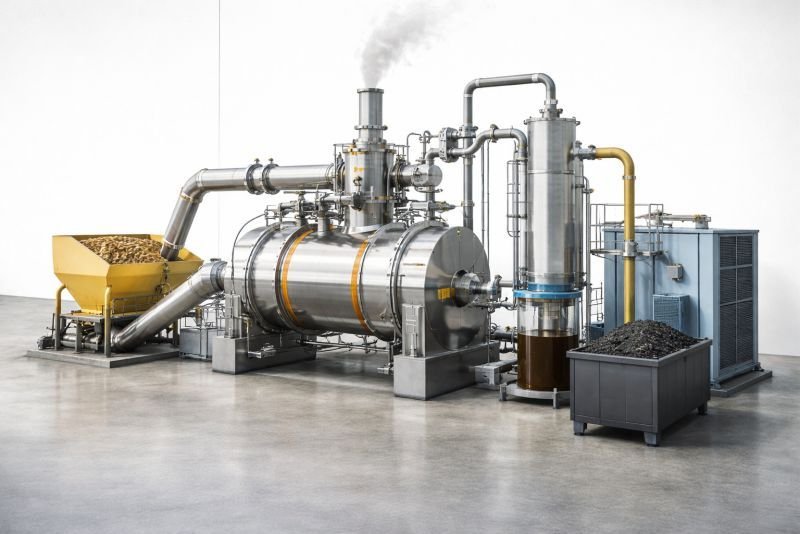
What Is Pyrolysis?
Pyrolysis is the thermal decomposition of organic material at elevated temperature in little or no oxygen, producing gases, condensable vapors, and solid char. Unlike complete combustion, it limits oxidation and splits complex molecules into smaller products whose distribution depends on heating profile and residence time. A common operating parameter is heating rate, represented as dT/dt.
In practical reactors, feedstock moisture, particle size, and heat transfer determine whether the process favors bio-oil, syngas, or char. Fast pyrolysis uses rapid heating and short vapor residence to maximize liquids, while slow pyrolysis generally increases char yield. Designers use thermal decomposition pathways in bioenergy process engineering to match equipment choices with target products and downstream cleanup requirements.
Why It Matters: Pyrolysis enables conversion of agricultural residues, forestry waste, and other biomass streams into usable energy carriers and material inputs. It can support decentralized production, carbon management through biochar applications, and broader resource recovery strategies where direct electrification or conventional fuels are not practical.
Used In Devices:
- Fluidized Bed Pyrolyzer
- Auger Reactor System
- Bio-Oil Condenser Train
Example:
A fast pyrolysis unit converts dry sawdust into condensable vapors that are cooled into bio-oil for fuel processing.
Related Concepts:
- Syngas
- Anaerobic Digestion
- Gasification
NoSuchDevice is a free archive of machines that do not exist yet but already have a shadow in physics. I research and write every entry alone, with no ads. Take a look around the archive, or help keep it free.