




What Is Quantum Zeno effect?
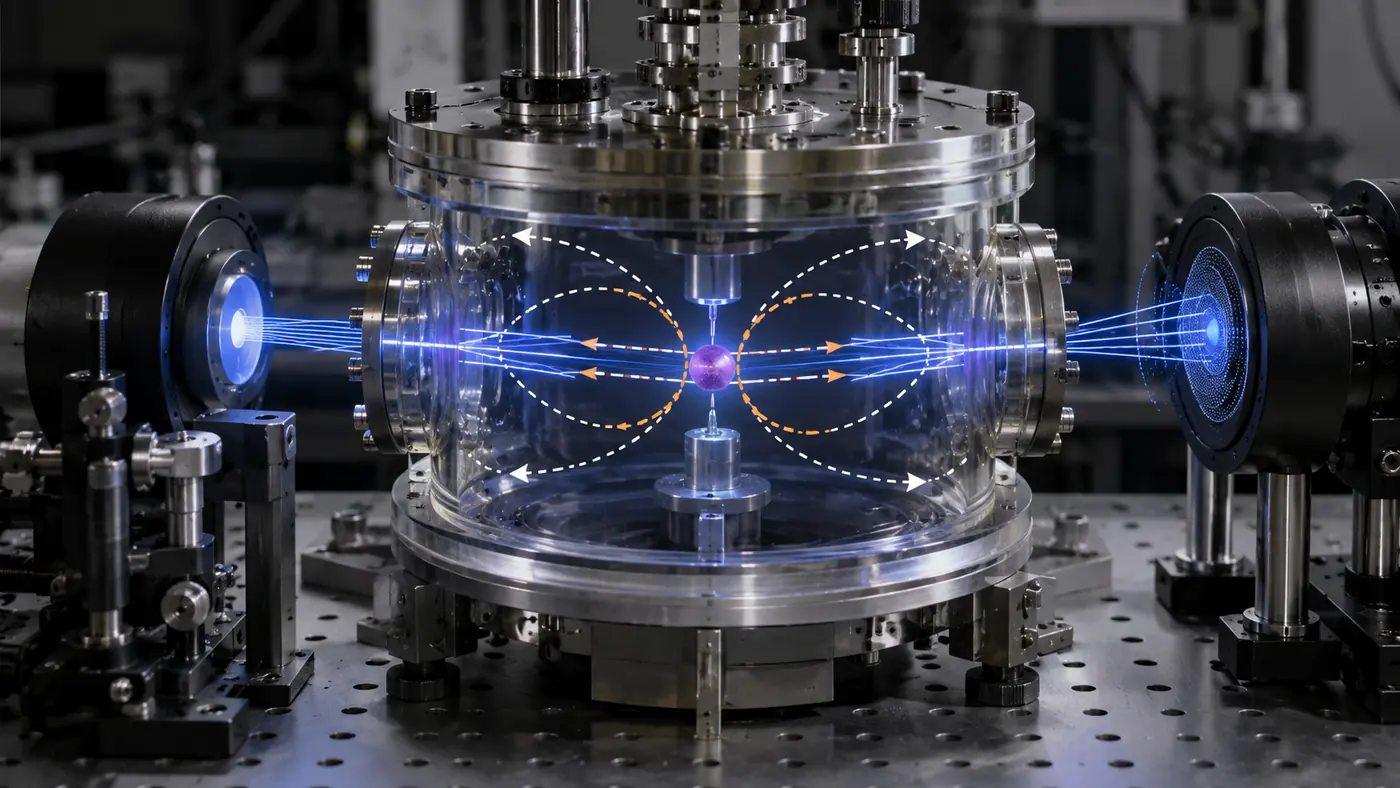
The Quantum Zeno effect is the inhibition of a quantum system’s change when it is measured very frequently. A particle or state normally evolves over time, but repeated observations can interrupt that evolution and keep the system near its initial condition. One simplified relation is P_surv(t) approx [1 – (Delta t/tau_Z)^2]^N, where shorter measurement intervals can raise the probability that the original state survives.
In real systems, the effect depends on measurement rate, coupling strength, noise, and how cleanly the system can be separated from its surroundings. It does not mean that looking with human eyes freezes matter; it means that physical interactions used as measurements can reshape quantum evolution. In quantum sensing and control, this principle can help suppress unwanted transitions or gate which states are allowed to proceed.
The concept matters because measurement is not passive at quantum scale. The act of extracting state information can become part of the dynamics, which is central to quantum computing, spectroscopy, precision metrology, and controlled nanoscale systems.
Used in devices include quantum logic experiments, trapped-ion systems, superconducting qubits, and sensor arrays that manage transitions through repeated state interrogation.
Example:
In a trapped-ion experiment, rapid measurement pulses can reduce the chance that an ion leaves a chosen quantum state during a controlled operation.
Related Terms:
NoSuchDevice is a free archive of machines that do not exist yet but already have a shadow in physics. I research and write every entry alone, with no ads. Take a look around the archive, or help keep it free.