






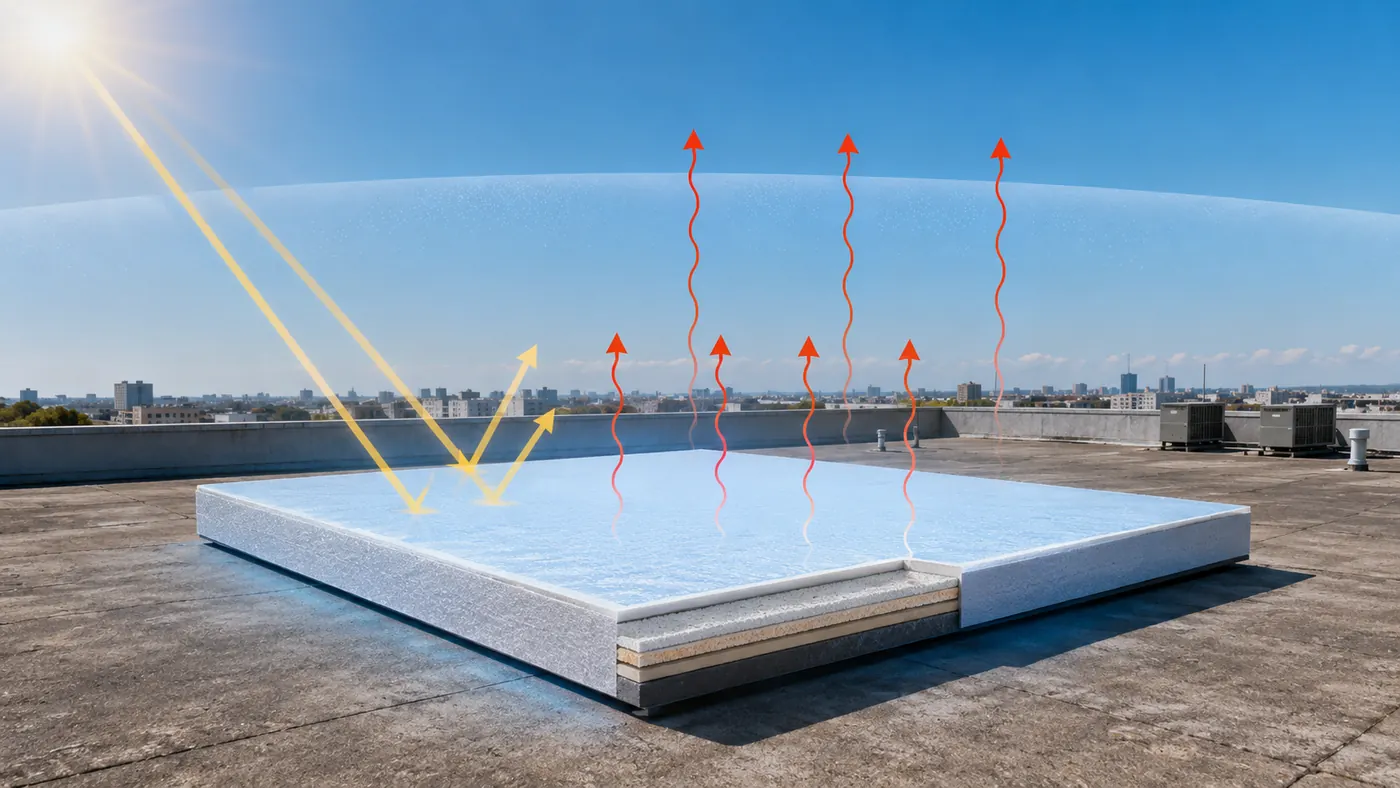
What Is Radiative sky cooling?
Radiative sky cooling is the loss of heat from a surface by emitting infrared radiation through the atmosphere toward cold outer space. It works best when a material emits strongly in the atmospheric window and reflects much of the sunlight that would otherwise warm it. The net cooling power can be written as P_net = P_emit – P_absorbed – P_air, comparing emitted radiation with absorbed sunlight and heat gained from air.
In real designs, performance depends on surface emissivity, solar reflectance, humidity, cloud cover, wind, insulation, and the temperature difference between the surface and surrounding air. A good radiator may cool below ambient temperature, but condensation, dust, aging, and mounting geometry can reduce output. Daytime operation requires strong solar rejection as well as infrared emission.
The concept matters because it provides passive thermal management without a compressor or refrigerant. In passive thermal management, radiative sky cooling shows how engineered surfaces can use space as a heat sink. Used in devices include rooftop cooling panels, building envelopes, cold-storage covers, thermal test plates, and infrared selective coatings.
Researchers measure cooling power with guarded plates, pyrgeometers, weather stations, and spectral instruments that separate surface emission from solar absorption and atmospheric back-radiation.
Example:
A white polymer film with high mid-infrared emissivity can cool a roof surface below the surrounding air on a clear day.
Related Terms:
NoSuchDevice is a free archive of machines that do not exist yet but already have a shadow in physics. I research and write every entry alone, with no ads. Take a look around the archive, or help keep it free.