





What Is Stefan-Boltzmann law?
Stefan-Boltzmann law states that the total thermal radiation emitted by an ideal blackbody rises with the fourth power of its absolute temperature. The standard form is j = sigma T^4, where j is radiant exitance and sigma is the Stefan-Boltzmann constant. For real surfaces, emissivity modifies the result because most materials emit less than a perfect blackbody.
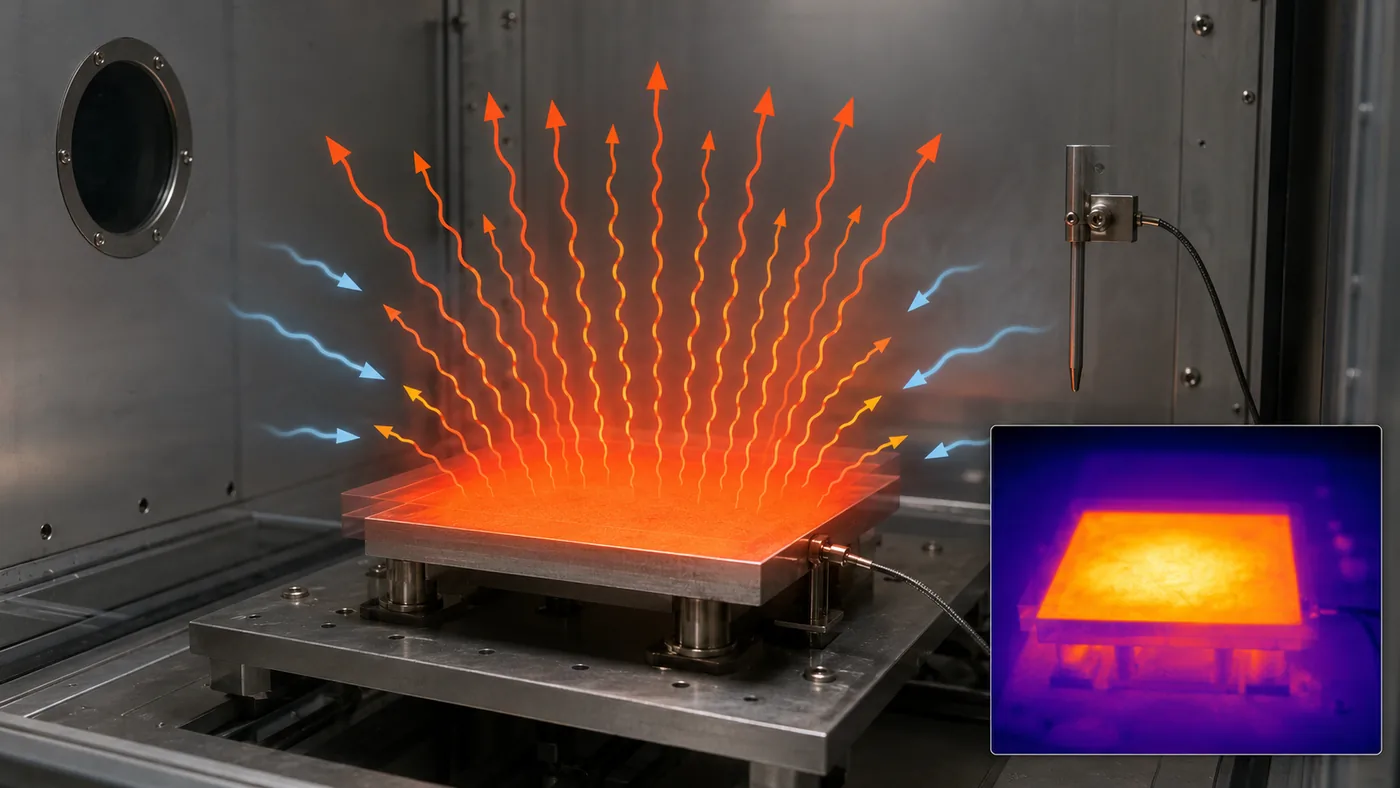
In practical systems, the fourth-power dependence means small temperature changes can produce larger changes in emitted power. Engineers also account for surface area, emissivity, view factor, surrounding temperature, and wavelength-dependent behavior. A surface facing a colder environment loses net radiative heat according to the difference between its own emission and radiation received from surroundings.
The law matters because it links temperature measurement, heat transfer, astronomy, climate physics, and thermal design through one compact relation. In thermal radiation physics, it gives the baseline for estimating how much power a warm surface can emit. Used in devices include infrared thermometers, thermal cameras, radiators, spacecraft heat shields, and furnace sensors.
Measurements often combine temperature probes or infrared detectors with emissivity corrections, because a shiny metal, painted surface, ceramic, and biological tissue can radiate very different power at the same temperature.
Example:
A spacecraft radiator must increase emitting area or temperature to reject more waste heat through thermal radiation.
Related Terms:
NoSuchDevice is a free archive of machines that do not exist yet but already have a shadow in physics. I research and write every entry alone, with no ads. Take a look around the archive, or help keep it free.