




What Is Shockley-Queisser Limit?
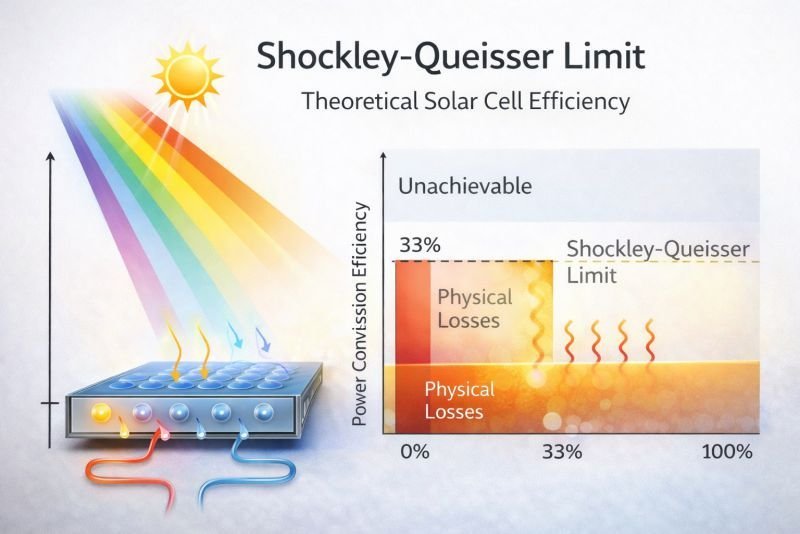
The Shockley-Queisser limit is the theoretical maximum efficiency that a single-junction solar cell can achieve when converting sunlight into electricity. Calculated in 1961 by physicists William Shockley and Hans-Joachim Queisser, the limit arises from fundamental constraints in semiconductor physics. It describes how much of the energy carried by sunlight can realistically be converted into electrical power by a photovoltaic device with a single P-N junction.
The limit results from unavoidable physical losses during energy conversion. Photons with energy below the semiconductor band gap pass through the material without being absorbed, while photons with energy far above the band gap lose their excess energy as heat after exciting electrons. These effects place a strict ceiling on performance for single-junction cells used in systems such as semiconductor photovoltaic energy conversion architectures.
Under ideal conditions with sunlight as the energy source, the Shockley-Queisser limit predicts a maximum efficiency of roughly 33 percent for a single semiconductor junction with an optimal band gap near 1.34 electron volts. Engineers work around this constraint by developing multi-junction solar cells that stack several materials with different band gaps to capture a wider portion of the solar spectrum.
Example:
A single-junction silicon solar cell cannot exceed the Shockley-Queisser limit because fundamental photon absorption and heat losses restrict its efficiency.
Related Concepts:
- Band Gap
- P-N Junction
- Multi-Junction Solar Cells
NoSuchDevice is a free archive of machines that do not exist yet but already have a shadow in physics. I research and write every entry alone, with no ads. Take a look around the archive, or help keep it free.