




What Is Solar Irradiance?
Solar irradiance is the radiant power from the Sun received per unit area at a surface. It is commonly written as G = P/A and measured in watts per square meter, with the value set by solar angle, atmosphere, cloud cover, altitude, and orientation. Irradiance describes an instantaneous energy rate, not the total energy accumulated over time.
In real systems, solar irradiance changes throughout the day as the Sun moves and local conditions modify the beam and diffuse components. A horizontal road, roof, or panel receives a different flux than a tilted surface because geometry changes the intercepted power. In solar energy conversion, irradiance determines how much input is available for heating, electricity generation, or optical sensing at any moment.
The term matters in photovoltaics, climatology, building design, and remote measurement because many performance models begin with the incoming solar flux. Engineers use irradiance data to size solar modules, evaluate thermal loads, choose coatings, and compare sites across seasons. Used in devices include pyranometers, satellite imagers, solar trackers, weather stations, and thermal test chambers. It is measured directly with radiometers or estimated from modeled atmospheric conditions.
Example:
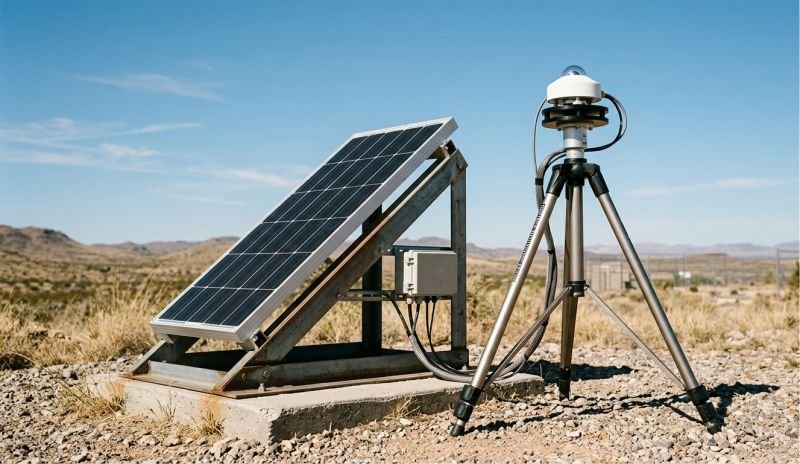
A pyranometer mounted beside a solar array records midday solar irradiance so operators can compare expected and actual electrical output.
Related Terms:
- Albedo
- Thin-Film Photovoltaic Cells
- Insolation
NoSuchDevice is a free archive of machines that do not exist yet but already have a shadow in physics. I research and write every entry alone, with no ads. Take a look around the archive, or help keep it free.