






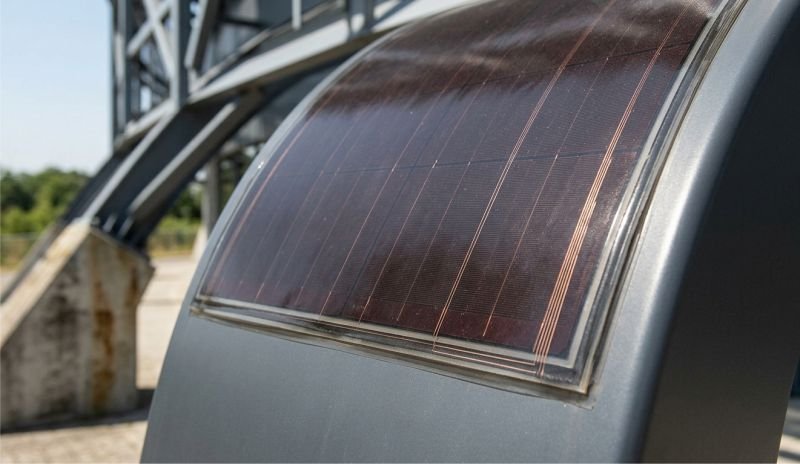
What Is Thin-Film Photovoltaic Cells?
Thin-film photovoltaic cells are solar cells made by depositing very thin semiconductor layers onto glass, metal, or flexible polymer substrates. Instead of using thick crystalline wafers, they rely on micrometer-scale absorber films such as amorphous silicon, cadmium telluride, or CIGS to convert light into electricity. A basic relation is P_out = eta x G x A, linking output power to efficiency, irradiance, and active area.
In operation, photons create charge carriers inside the absorber layer, and built-in electric fields separate those carriers so current can flow through external circuitry. Because the semiconductor layer is thin, these cells can be lightweight, large-area, and mechanically adaptable, though efficiency and durability depend strongly on material quality and encapsulation. In integrated solar surfaces, thin-film cells are useful where rigid module thickness or weight would be limiting.
The term matters in solar engineering, building integration, and portable power because thin-film devices trade maximum efficiency for design flexibility and manufacturability. Engineers use them when curvature, low mass, partial transparency, or large coverage area is more important than peak cell performance. Used in devices include facade laminates, vehicle panels, wearable chargers, remote sensors, and experimental pavement modules. Performance is assessed with current-voltage curves, spectral response, and temperature-corrected power tests.
Example:
A lightweight solar sensor station may use thin-film photovoltaic cells on a curved housing where a rigid crystalline panel would crack or add too much mass.
Related Terms:
NoSuchDevice is a free archive of machines that do not exist yet but already have a shadow in physics. I research and write every entry alone, with no ads. Take a look around the archive, or help keep it free.