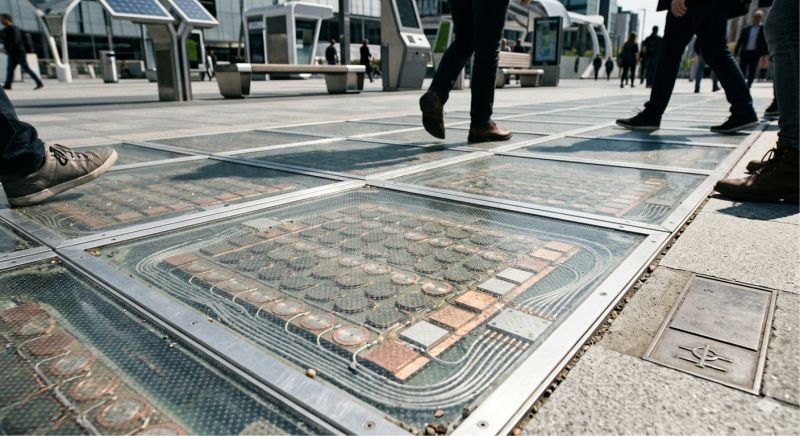






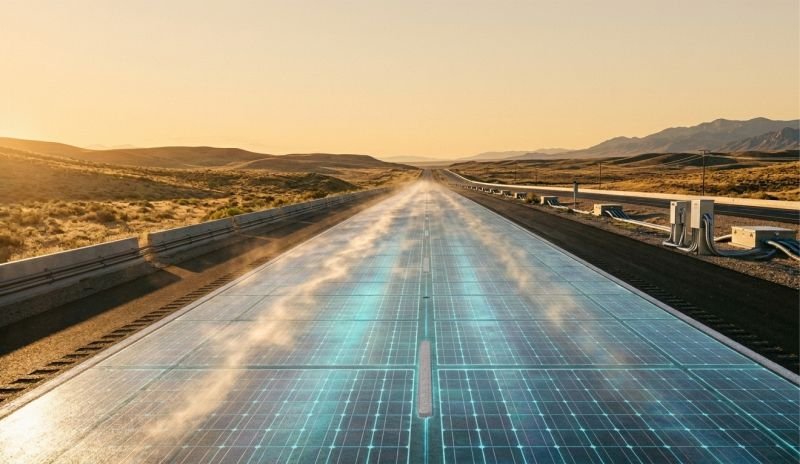
A stretch of motorway in southern Spain reaches 72 degrees Celsius at the surface on a clear July afternoon. The air above it sits at 38. Two meters below the asphalt, the ground holds steady at 17. That 55-degree differential exists for eight to ten hours, across every kilometer of that road, and not a single watt of electricity comes out of it.
Roads cover approximately 64 million kilometers of the Earth’s surface. Every one of them is dark, heat-absorbing, engineered to intercept solar radiation and convert it to stored heat. The conversion happens reliably, every day, at massive scale. The next step – capturing any of that energy before it dissipates into the atmosphere – has never been built into the road itself.
The short version: A solar-absorbing road surface layers thermoelectric generators and embedded photovoltaic elements into the road structure, using the temperature differential between the hot surface and the cooler subgrade to generate continuous electrical current, while the upper PV lattice converts direct solar radiation during daylight hours. One kilometer of two-lane highway in a temperate climate produces an estimated 200 to 350 MWh per year. The device continues generating after sunset, drawing on heat stored in the road’s thermal mass. The physics is well understood. The engineering, at deployment scale, has not been assembled.
Key Takeaways
- Asphalt absorbs 92 to 96 percent of incoming solar radiation – roads are among the most effective solar collectors ever built, with zero energy recovery
- Two conversion pathways operate in parallel: thermoelectric runs day and night from a heat gradient; photovoltaic runs during daylight from direct radiation
- The thermoelectric layer and the urban heat island problem have the same root cause – and the same physical fix
- A desert highway produces roughly double the thermoelectric output of an identical road in central Europe, which changes where this device should be built first
- At 10 percent surface adoption across Germany’s road network, annual output reaches approximately 16 TWh – generated from infrastructure that already absorbs the energy and currently does nothing with it
Table of Contents
The Surface That Has Always Been a Solar Collector
Standard asphalt has an albedo between 0.04 and 0.08. For every 100 watts of sunlight arriving at the road surface, between 4 and 8 watts reflect back. The rest become heat. Fresh asphalt sits at the low end of that range – closer to 4 percent reflectance, 96 percent absorption. A black body absorbing solar radiation more efficiently than this would require deliberate engineering.
Compare that to a rooftop photovoltaic panel: it absorbs roughly 80 percent of incoming radiation and converts about 20 to 22 percent of total input to electricity. The road absorbs more energy per square meter than the panel does. The difference is that the panel is built to intercept the conversion. The road is not.
On a clear summer day at mid-latitude, solar irradiance at road level reaches 800 to 1,000 W/m². A standard two-lane road is approximately 7 meters wide. One kilometer of that road presents 7,000 square meters of absorbing surface. At peak irradiance, that single kilometer is intercepting between 5.6 and 7 megawatts of solar power – every clear afternoon, across every country where paved roads exist.
The surface temperature differential is the other operating condition. Asphalt in summer reaches 60 to 72°C at the surface. At a depth of 1.5 to 2 meters, ground temperature holds within a few degrees of the annual average air temperature – 10 to 17°C in temperate European climates, 18 to 22°C in Mediterranean regions. The gap between the surface and the subgrade runs from 40°C on a mild day to over 55°C during a heat event.
That gap is not a thermal management problem. For a thermoelectric generator, it is the fuel.
How the Device Operates
The solar-absorbing road surface is a layered system. Each stratum performs a distinct function. The two conversion pathways – thermoelectric and photovoltaic – run in parallel without competing for the same physics, because they extract energy from different parts of the same incoming solar flux.
The Surface Layer and the PV Pathway
The uppermost layer – the surface that tires contact – is a semi-transparent ceramic-polymer composite engineered to maintain friction characteristics equivalent to conventional road aggregate while passing a calculated fraction of incoming solar radiation downward. Below it sits an embedded photovoltaic lattice: thin-film photovoltaic cells arranged in a load-distributing matrix, separated by rigid structural spacers that carry compressive and shear loads away from the photovoltaic material itself.
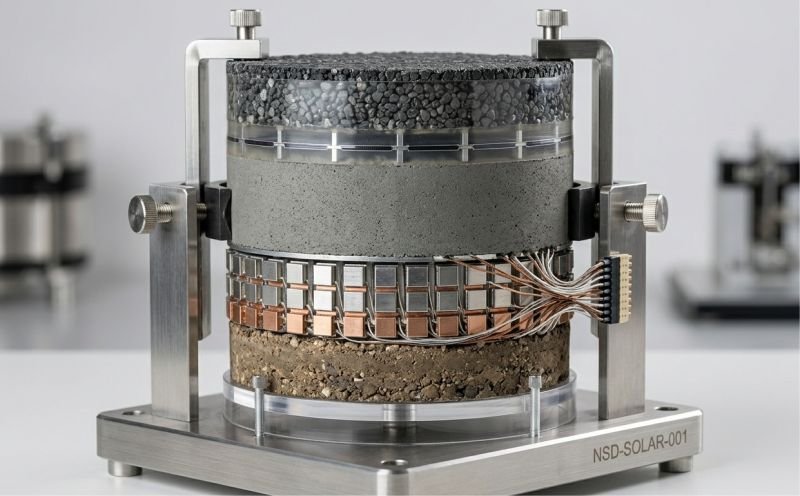
The cells are optimized for the spectral band that penetrates the surface layer, which filters ultraviolet while transmitting visible and near-infrared wavelengths. Conversion efficiency in this configuration is lower than an exposed panel – the photovoltaic effect operates at reduced input intensity because the surface layer absorbs and scatters a portion of the incoming light. At scale, the surface area compensates for what the efficiency curve cannot.
Below the PV lattice, a thermal management layer prevents residual heat from the photovoltaic conversion from diffusing upward. Heat moves downward.
The Thermoelectric Layer and the Heat Gradient
At the interface between the warmer road structure and the cooler subgrade, an array of thermoelectric modules converts the temperature differential directly into electrical current. The operating mechanism is the Seebeck effect: when two dissimilar semiconductor materials are joined at two junctions held at different temperatures, a voltage develops proportional to the temperature difference.
Output power per module follows:
P = S² × ΔT² / (4 × R)
Where S is the Seebeck coefficient of the material pair (in volts per kelvin), ΔT is the temperature differential in kelvin, and R is the module’s internal electrical resistance.
With bismuth telluride modules – S approximately 0.0002 V/K – and a ΔT of 45°C, a conservative summer figure for a temperate climate, a single 100 cm² module produces 1.8 to 2.5 milliwatts. That number scales. Per square meter of road, with modules packed at 70 percent coverage, output reaches 1.3 to 1.75 watts. Per kilometer of two-lane road at 7,000 m², the thermoelectric layer delivers between 9 and 12 kilowatts at peak differential.
After sunset, the road surface begins cooling while the subgrade retains heat. The differential inverts slightly, output drops, but the gradient does not collapse until several hours past midnight. The device generates through the night.
| Conversion Pathway | Peak Output per km (2-lane) | Operating Window | Climate Sensitivity |
|---|---|---|---|
| Photovoltaic (embedded lattice) | 140-220 kW | Daylight hours only | High – cloud cover, sun angle, surface dust |
| Thermoelectric (subgrade differential) | 9-12 kW | Day and night | Moderate – seasonal ΔT variation |
| Combined annual generation (estimated) | 200-350 MWh/year | Continuous | Significant between climate zones |
The PV pathway dominates peak output. The thermoelectric layer is what makes the device a continuous generator – the distinction between something that produces electricity when the sun cooperates and something that produces electricity as a physical consequence of the road existing.
Everything here is free. Readers are the reason it stays that way.
I make all of it alone, with no ads. If it is worth a coffee a month to you, that keeps the next one coming.
Keep it alive →Where This Device Makes Sense and Where It Does Not
The same device performs differently depending on climate, road geometry, and traffic load. The honest version of this analysis does not treat all roads as equivalent.
Desert and Semi-Arid Roads
In an arid environment, surface temperatures regularly exceed 80°C. Subgrade temperatures may hold at 20 to 25°C. The thermoelectric differential reaches 55 to 60°C, and Seebeck output roughly doubles compared to a temperate installation. Clear-sky days number 280 to 320 per year. PV output per kilometer runs 40 to 60 percent higher than in central Europe.
A highway in Nevada, Saudi Arabia, or northern Chile represents the optimal operating environment for this device. The roads exist. The solar flux is already there. The question is electrical evacuation infrastructure – which a desert highway does not automatically have nearby.
Temperate and Northern Climates
In Germany, Scandinavia, or the UK, the thermoelectric differential averages 30 to 40°C in summer and narrows significantly in winter. Annual output per kilometer drops. But a secondary behavior emerges: the device’s heat extraction from the road surface slows ice formation in cold months. The thermal management layer that pulls heat downward for electricity generation simultaneously reduces the surface temperature that determines freeze timing. Passive de-icing is a side effect of the energy conversion, not an additional system.
Urban Surfaces and Parking Infrastructure

City streets carry lighter loads than motorways and have shorter resurfacing cycles – both of which simplify early deployment. Parking lots and parking structures are flat, largely unshaded, mechanically simple surfaces that currently absorb solar energy and release it as urban heat without any recovery mechanism. They are also typically close to electrical demand, which reduces transmission losses. For the first generation of this device, the parking lot is a more tractable installation context than a motorway – not because the physics is different, but because the engineering variables are easier to control.
Roads as Distributed Power Infrastructure
Two Architectures for Grid Connection
A solar-absorbing road surface generates electricity in a distributed pattern – modest outputs from many locations simultaneously. Two grid connection models are possible and they produce different economic outcomes.
In a centralized model, power from several kilometers of road collects at a single inverter station and feeds into the medium-voltage transmission network. In a distributed model, each road segment connects to local demand: a charging station, traffic signaling, adjacent buildings. The distributed model wastes less energy in transmission and makes each road segment independently legible as a generating asset.
The more compelling architecture is the second. A road segment that powers its own lighting and nearby fast-charging points does not depend on national grid policy or transmission infrastructure to demonstrate value. The economic case for local installation closes locally, which is where infrastructure decisions actually get made.
The National Scale Number
Germany has approximately 231,000 kilometers of paved road. At 10 percent surface adoption – roughly 23,100 km – and a conservative average annual output of 700 MWh per two-lane-equivalent kilometer, total generation reaches approximately 16 TWh per year. Germany’s total electricity consumption runs around 550 TWh annually. One device type, applied to 10 percent of existing road infrastructure, covers roughly 3 percent of national demand.
That 3 percent is not a dramatic number on its own. What makes it interesting is the source: infrastructure with no land-use footprint, no competing agricultural displacement, no zoning conflict, and no visual alteration beyond a slight surface texture change. The energy was always there. The road was always absorbing it.
The Urban Heat Island and the Same Physical Fix
Cities are measurably warmer than surrounding countryside, partly because dark road surfaces absorb solar energy and release it as heat into the air above. A solar-absorbing road that extracts heat downward for electricity generation simultaneously removes that heat from the surface-to-air cycle. Urban ambient temperatures decrease as a direct consequence of the energy conversion. The electricity generation and the urban cooling are not separate design goals achieved by separate systems – they are the same physical process producing two outputs.
The Evolutionary Arc: From Test Strip to Active Grid
First Generation – Proving the Subgrade
The first deployable form of this device is not a highway. It is a controlled surface: a parking structure, an airport apron, or a section of industrial road where loads are predictable, access is straightforward, and monitoring equipment can run continuously. At this scale, the device proves the thermoelectric layer’s long-term behavior under cyclic load – how the module interface holds up after three winters of freeze-thaw cycling, and what happens to Seebeck output as the subgrade compaction settles.
The first generation does not need to be economically self-justifying. It needs to produce a performance dataset that the second generation can be designed from.
Mature Generation – Active Road Network
When material science delivers thermoelectric modules with Seebeck coefficients two to three times those of bismuth telluride – a target already demonstrated in laboratory conditions using skutterudite and half-Heusler compounds – the per-kilometer output of the thermoelectric layer increases accordingly. At that point, a kilometer of highway in a temperate climate stops being a marginal generator and starts being a meaningful one.
The mature-generation device also integrates with autonomous vehicles as cooperative infrastructure. A road segment that both generates electricity and communicates load status in real time allows a vehicle to modulate regenerative braking based on surface generation capacity – feeding energy back into the road’s local distribution system when the segment is underloaded, drawing from it when the vehicle needs fast charging. The road and the vehicle stop being separate systems and become participants in the same energy loop.
System-Level Form – Infrastructure That Generates as a Property
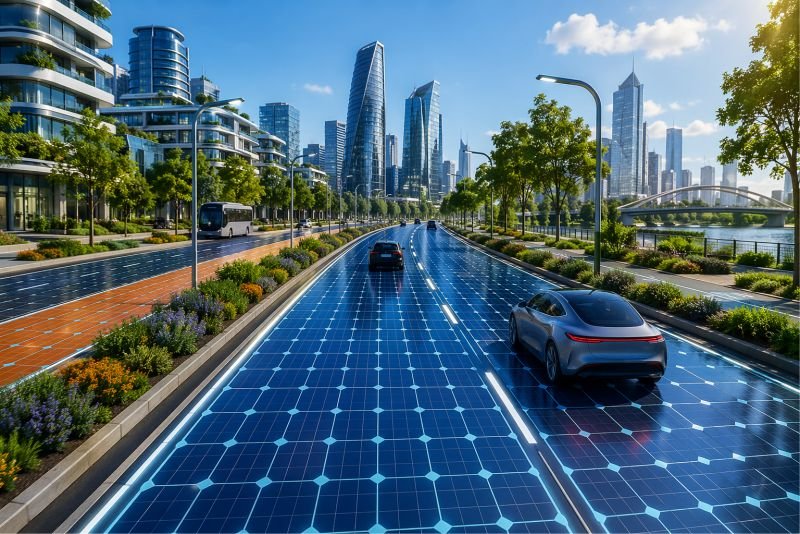
The long-horizon version of this device is not a road with solar panels embedded in it. It is a road network that functions as distributed energy infrastructure by default – where generating electricity is as intrinsic to the road’s function as providing a driving surface. At civilizational scale, the distinction between “road” and “generator” dissolves. Every paved surface is both.

That is not an optimistic projection. It is the logical endpoint of a trajectory that begins with the parking lot and ends with the national grid drawing a non-trivial fraction of its baseload from surfaces that were absorbing the same solar energy anyway.
Open Questions for the Engineers Who Build This
Three problems sit unresolved at the level of fundamental engineering.
The first is thermal interface degradation. The thermoelectric layer depends on tight thermal coupling between the warmer road structure and the module array. Under cyclic traffic loading, microfractures form in the subbase material, and thermal conductivity across the module interface drops as the layers decouple mechanically. Output at year ten is not output at year one. The acceptable degradation rate over a 20-year service cycle – the standard road engineering horizon – has not been established, and it determines whether the economics close.
The second is the albedo optimization conflict. Making the road surface slightly lighter in color, moving from 0.05 to 0.15 albedo, reduces the solar absorption available to the thermoelectric layer while improving urban heat island performance. Maximizing electricity generation and maximizing urban cooling point in different directions. A surface material that shifts the balance seasonally – absorbing more in summer, reflecting more in winter – would resolve this, but no material with that behavior at road-surface durability has been demonstrated at scale.
The third is the grid interconnection standard. Every hundred meters of road generating different voltages and currents at different times of day, across a city or a highway network, requires a distributed interconnection architecture that does not currently exist for physical infrastructure at this density. The device is easier to build than the grid that accepts its output cleanly.
The View From NoSuchDevice
I find this device more defensible than most energy concepts that circulate in serious technical discussions, and I want to be precise about why.
The thermoelectric component is the part worth taking seriously. Photovoltaic road surfaces have been attempted – Solar Roadways, Wattway, various others – and the honest assessment of those attempts is that embedding fragile semiconductor cells in a surface that heavy trucks drive over is a poor allocation of photovoltaic technology. The structural loads and the optical fragility are a bad combination. But the thermoelectric layer is structurally different in a way that matters. It sits deeper in the road, insulated from direct traffic impact, and it operates from a gradient that exists regardless of whether anyone tries to capture it. The road will be hot. The ground beneath it will be cooler. That differential runs whether the device is there or not. Installing the device does not create the energy source. It intercepts one that is currently running to waste.
The urban heat island reduction is the angle I think gets underappreciated in discussions about this device. Two problems – cities running 3 to 5 degrees warmer than surrounding areas, and urban infrastructure generating no electricity – have the same physical root cause. The same physical fix addresses both simultaneously. That kind of convergence, where one intervention solves two distinct problems from the same mechanism, is rare in infrastructure design. When it happens, it is usually a signal that the right frame has been found.
Where I remain genuinely uncertain is the degradation question. Infrastructure that performs at specification in year one and underperforms at year seven is not infrastructure – it is a liability with a delayed disclosure. Road authorities operate on 20 to 30-year planning horizons and have no framework for managing a surface that generates electricity and degrades on its own performance curve. Solving the thermal interface coupling problem is not a materials science challenge alone. It requires an entirely new class of maintenance contract and a performance monitoring system embedded in every road segment. That is not a reason to abandon the concept. It is a reason to be honest about where the engineering work actually needs to happen.
The trajectory I find most credible starts with parking structures, moves to urban streets during normal resurfacing cycles, and reaches motorways only after the subgrade coupling behavior is understood across a decade of real-world data. That is a slower arc than the device’s proponents would prefer. It is also the arc that produces a device worth trusting.
You read the whole thing.
That is rarer than it should be, and it is the exact kind of attention I built this archive for. I make every piece alone, with no ads and no investor deciding what gets written. If you want the next machine taken apart like this one, you can help me make it.
A coffee a month is enough to keep it free for everyone.
Prefer crypto or a one time gift? Other ways to give →