






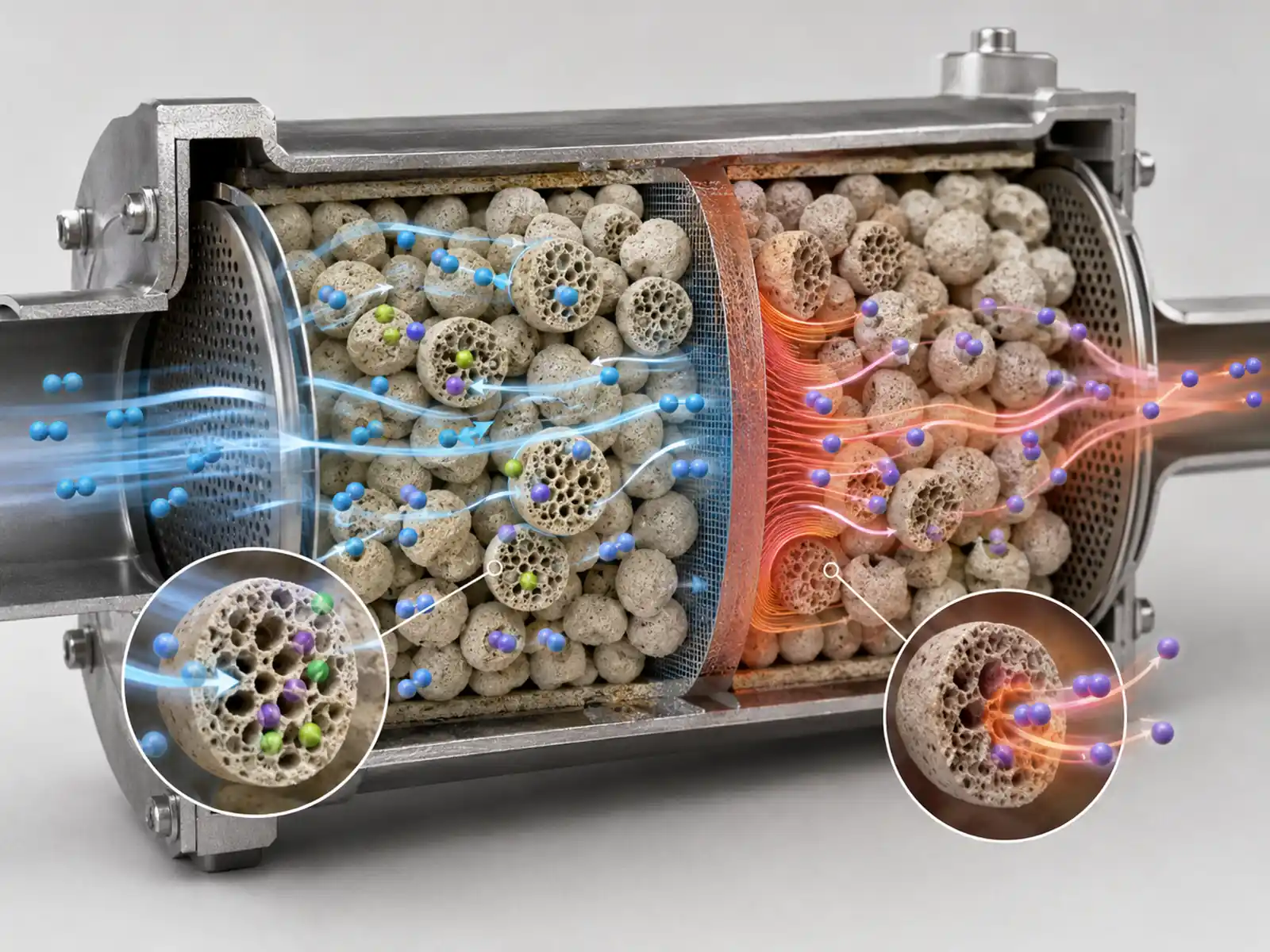
What Is Sorbent?
Sorbent is a material that captures another substance from a gas or liquid by adsorption, absorption, or a combination of both. In adsorption, molecules attach to internal or external surfaces; in absorption, they enter the bulk material. A common loading measure is q = n_captured / m_sorbent, which relates captured amount to sorbent mass.
In real systems, sorbents are chosen for selectivity, capacity, regeneration energy, reaction speed, and resistance to degradation. They may be porous solids, amine-functional materials, alkaline liquids, zeolites, activated carbons, metal-organic frameworks, or polymer membranes. They are central to carbon dioxide capture chemistry because the material must distinguish CO2 from far more abundant nitrogen, oxygen, water vapor, and trace gases. Used in devices include gas scrubbers, air contactors, respirator cartridges, chromatography columns, water filters, and vacuum swing adsorption units.
The concept matters because sorbent behavior often sets the cost and practicality of a separation process. High capacity is useful only if the material can be regenerated many times without losing structure or selectivity. Engineers therefore evaluate full cycles, not just a single capture step.
Testing usually tracks breakthrough curves, uptake rate, working capacity, heat release, and performance after repeated loading and regeneration.
Example:
A solid amine sorbent can bind CO2 from low-concentration air and release it when heated under reduced pressure.
Related Terms:
- Direct Air Capture
- Adsorption
- Absorption
NoSuchDevice is a free archive of machines that do not exist yet but already have a shadow in physics. I research and write every entry alone, with no ads. Take a look around the archive, or help keep it free.