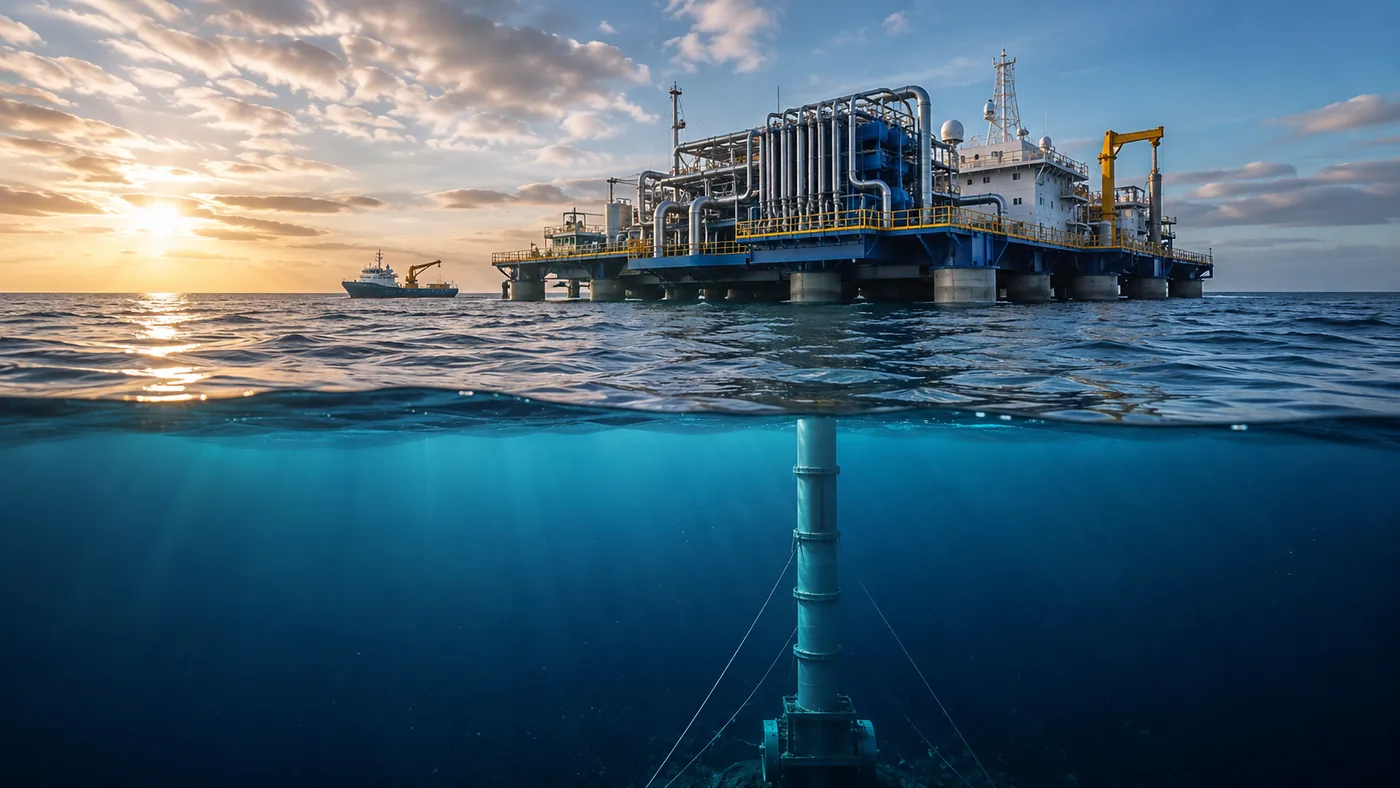


There is something quietly strange about the air above your head right now. Of every million molecules drifting past, roughly 420 are carbon dioxide. Four hundred and twenty. The rest is nitrogen, oxygen, and a scattering of other gases with no political problem. CO₂ is not absent from the atmosphere. It sits at about 420 parts per million, thin in the way a lean seam of ore is thin, and it is everywhere at once.
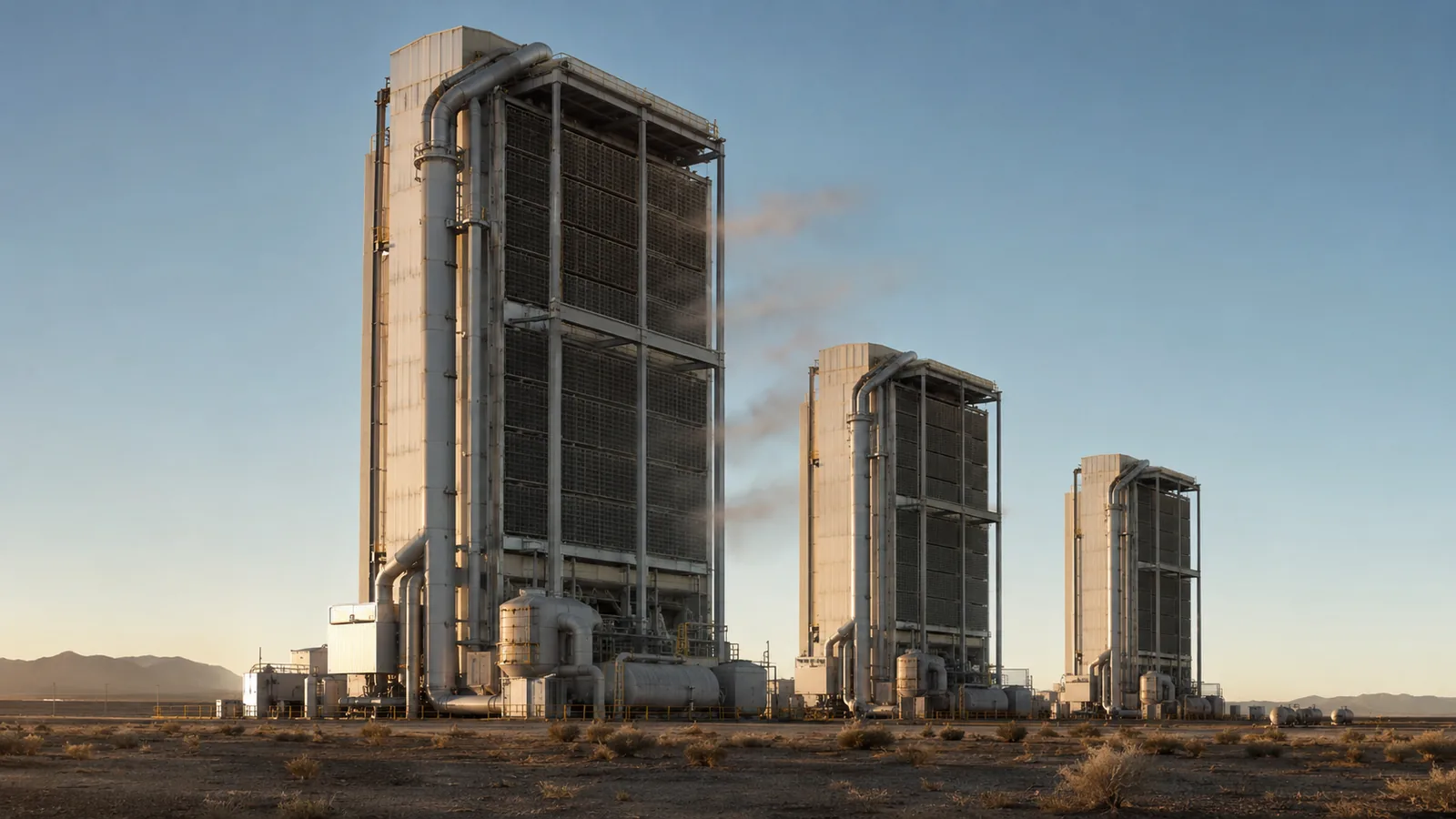
An atmospheric carbon sequestration tower is a machine designed to mine that seam. Not to intercept emissions at a smokestack, where concentrations run at ten percent or higher and the engineering is relatively forgiving. To pull CO₂ from open air, where it is dilute and indifferent to being harvested, and convert it into solid carbon that stays out of the atmosphere permanently.
The short version: An atmospheric carbon sequestration tower draws ambient air through a chemical sorbent that selectively binds CO₂, releases it under heat or vacuum, and converts the captured gas into solid carbon through high-temperature chemistry. A single tower processing one million cubic meters of air per day could capture roughly 800 to 1,000 tons of CO₂ annually. The energy cost runs between 1,500 and 2,000 kilowatt-hours per ton of CO₂ removed. That makes the power source the whole argument.
Key Takeaways
- Atmospheric CO₂ sits at roughly 420 parts per million, making Direct Air Capture (DAC) around 300 times more dilute than intercepting emissions at an industrial smokestack.
- The device works in two distinct stages: chemical capture first, then thermochemical or electrochemical conversion of CO₂ gas into solid carbon.
- An energy requirement of 1,500 to 2,000 kWh per ton means a tower powered by coal achieves nothing on a net basis. It produces more CO₂ than it removes.
- Converting captured carbon dioxide into carbon black or synthetic graphite creates a material with real market value, which changes the financial structure of the whole system.
- Making a measurable dent in atmospheric concentration requires tens of thousands of towers operating continuously for decades.
Table of Contents
The Sky as a Carbon Mine, and Why the Ore Grade Is the Problem
Coal seams below the Appalachians average roughly 60 to 70 percent carbon by weight. The atmosphere offers 0.042 percent CO₂. Placing those two numbers side by side is a useful calibration exercise. It shows exactly what kind of engineering problem Direct Air Capture (DAC) represents.
Point-source carbon capture, where equipment sits on a power plant or cement works and intercepts concentrated exhaust, operates in a fundamentally different regime. Flue gas runs at CO₂ concentrations of 4 to 15 percent. The sorbent encounters thousands of CO₂ molecules for every contact event. An atmospheric tower encounters four hundred and twenty.
Why dilution is not just an inconvenience
That difference in concentration changes the minimum work required to separate CO₂ from air by roughly an order of magnitude compared to industrial flue gas. The Gibbs free energy for pulling CO₂ from 400 ppm air sits around 20 kilojoules per mole, which is the physical floor before any real-world friction or engineering loss. Actual systems land five to ten times above that floor.
The question is whether dilution can be overcome by scale and clever chemistry. It can, but the terms are strict.
What the atmosphere does have in its favor
The ore is free. No mining lease, no extraction permit, no royalty structure. A tower can operate anywhere on Earth with a functioning atmosphere. And unlike point-source capture, which only prevents new emissions, atmospheric capture draws down what is already up there.
Forests do the same thing, slowly and at the mercy of drought, fire, and land-use pressure. A tower does it mechanically, predictably, at any location the operator chooses. That distinction matters enormously for any honest accounting of climate intervention. It is also the reason a device this expensive is worth taking seriously at all.
How an Atmospheric Carbon Sequestration Tower Would Actually Work
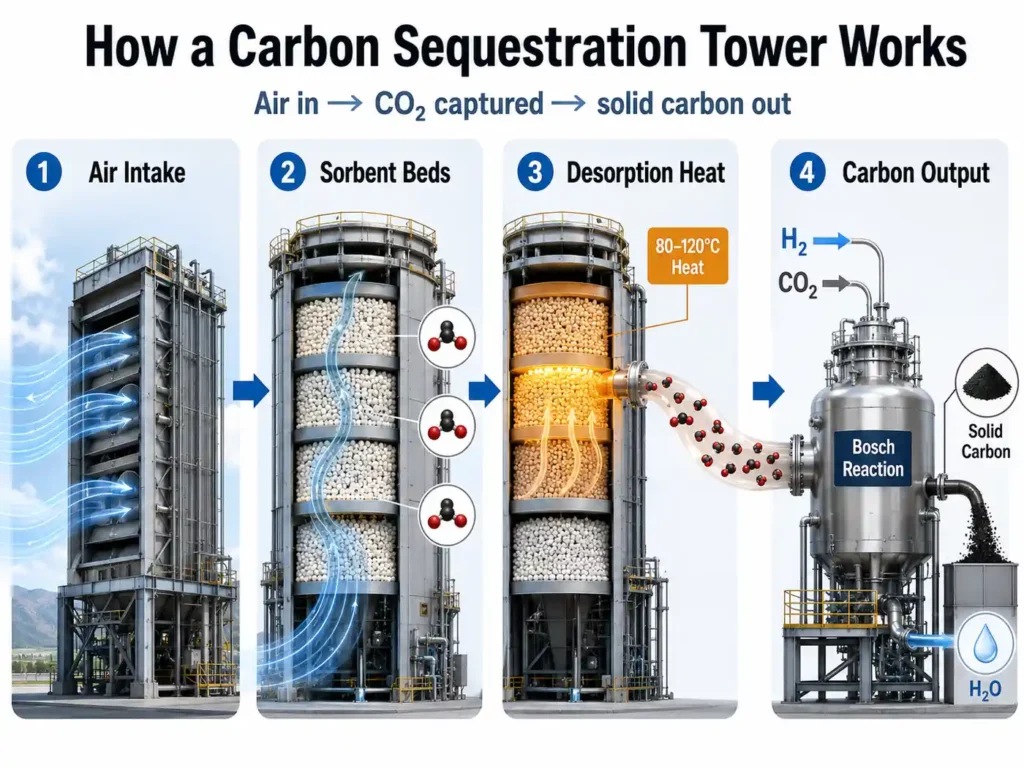
Air goes in one end. Solid carbon comes out the other. Between those two facts lies a chain of chemistry where each step is individually understood and none of which has been assembled into a tower at meaningful scale. That is the engineering territory this device lives in.
Stage one: catching CO₂ from air
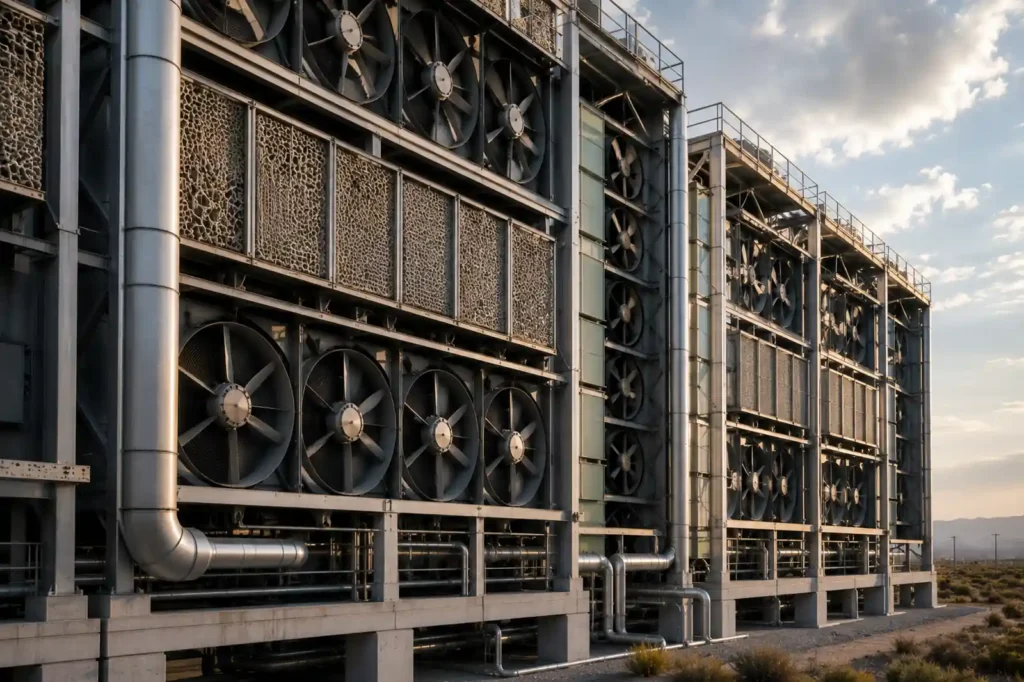
The tower’s core is a contactor, a large structure designed to maximize the surface area of air in contact with a chemical sorbent while minimizing the energy spent moving that air. Two sorbent approaches compete here.
Solid amine sorbents are porous pellets or monoliths coated with amine groups that grab CO₂ molecules on contact and hold them until released. They work at ambient temperature, which is useful. They are also sensitive to moisture and degrade over repeated thermal cycles, which is not. Liquid alkaline solvents, typically potassium hydroxide solutions, absorb CO₂ continuously and are regenerated in a separate reactor through a calcination step requiring substantial heat around 900°C. Both approaches have been demonstrated at pilot scale. Neither is cheap.
Once the sorbent is loaded, the tower enters a desorption phase. For solid sorbents, a temperature swing of roughly 80 to 120°C is enough to release the CO₂ as a concentrated gas stream, low enough to be supplied by waste heat or small solar thermal units. The result is a stream of CO₂ at 90 to 95 percent purity, suitable for the conversion step downstream.
Stage two: converting CO₂ gas to solid carbon
A device that captures CO₂ as a gas and stores it underground is a different machine altogether; the science of what happens after capture is covered in depth in Understanding Carbon Capture and Storage. The tower described here goes further: it converts the gas to solid carbon before releasing anything.
The Bosch reaction is the most direct route. Under a hydrogen-rich atmosphere at 500 to 800°C with an iron catalyst, CO₂ reacts with hydrogen to produce elemental carbon and water:
CO₂ + 2H₂ → C + 2H₂O
At 600°C with excess hydrogen, conversion efficiency reaches 80 to 90 percent per pass. The carbon deposits on the catalyst surface as fine carbon black, the same material used to reinforce rubber in tires, to manufacture carbon electrodes, and increasingly as a precursor for synthetic graphite in battery anodes. Hydrogen can be supplied from electrolysis powered by renewable electricity, closing the carbon loop without new fossil inputs.
Molten oxide electrolysis offers a more direct alternative: CO₂ dissolved into a high-temperature molten carbonate salt is electrochemically split into solid carbon and oxygen at around 750°C. No hydrogen required. Higher energy cost, but the carbon deposits as graphitic fibers with useful structural properties. The choice between these routes will be addressed in dedicated articles. What matters at this level is that multiple conversion pathways exist, each producing a different form of solid carbon with different downstream value.
The Arithmetic of Pulling CO₂ From Thin Air
Here is the number that decides everything: roughly 1,700 kilowatt-hours of electricity to remove one metric ton of CO₂ from ambient air and deliver it as a concentrated gas stream ready for conversion. Add the energy for the Bosch conversion step and the total rises to around 2,000 to 2,400 kWh per ton of CO₂ converted to solid carbon.
A tower capturing 1,000 tons of CO₂ per year consumes roughly 2 to 2.4 million kWh annually. That is close to the annual output of a 700-kilowatt wind turbine running at 40 percent capacity factor. One wind turbine, net, keeps one medium-capacity tower running.
The parasitic CO₂ problem
If that electricity comes from a grid powered by natural gas, the tower produces more CO₂ in its operation than it removes from the air. A gas-fired plant emitting roughly 450 grams of CO₂ per kWh would generate about 1,080 tons of CO₂ for every 1,000 tons captured. The tower is a net emitter. Powered by coal, the ratio worsens further.
This is not a flaw in the tower. It is a constraint that makes the energy source non-negotiable. An atmospheric carbon sequestration tower only functions as a climate intervention when powered by electricity with near-zero emissions.
A co-located solar array at current commercial efficiency, covering roughly two hectares, can supply enough electricity to run the tower continuously at 1,000 tons per year. Desert installations with high direct solar irradiance are the best candidates. Ambient humidity above 80 percent also reduces solid sorbent efficiency, which points the same direction.
| Scenario | Energy source | Net CO₂ per ton targeted |
|---|---|---|
| Coal grid | Thermal coal | +1,080 kg (net emitter) |
| Gas grid | Natural gas | +80 kg (near breakeven) |
| Renewable grid | Solar or wind | -1,000 kg (net removal) |
| On-site solar | Dedicated array | -950 kg (net removal, slight embodied cost) |
The table makes the dependency plain. A tower on a gas grid is a very expensive way to accomplish almost nothing. A tower on solar is the only version worth building, and as renewable electricity becomes cheaper and more abundant across the coming decades of development in all adjacent technologies, that version becomes financially closer to viable with each passing year.
1,700 kilowatt-hours per ton is the number where the energy source stops being a detail and becomes the whole argument.
I make all of it alone, with no ads. If it is worth a coffee a month to you, that keeps the next one coming.
Keep it alive →What Happens to the Carbon Once the Tower Has It
Solid carbon is not a waste product. Carbon black trades on global commodity markets at $500 to $1,200 per ton depending on grade and purity. Synthetic graphite for battery anodes commands higher prices, between $3,000 and $10,000 per ton in current supply chains. A tower converting 1,000 tons of CO₂ annually produces roughly 270 tons of elemental carbon (the mass ratio is 12 to 44, carbon to CO₂). At carbon black pricing, that is $135,000 to $324,000 in output per year.
Revenue at those levels does not cover operating costs at current energy prices. But it changes the financial structure from pure remediation cost to partially offset remediation cost, which affects how the tower gets financed, insured, and regulated. A facility producing a sellable commodity is a different kind of investment proposition from a facility that only consumes.
The permanence question
Not all solid carbon is permanent. Carbon black used in tire rubber eventually oxidizes at end of life, returning some fraction of its carbon to the atmosphere over years or decades. Structural carbon fiber in buildings or bridges can sequester carbon for a human lifetime. Graphite in a sealed battery has an uncertain pathway at end of life, depending on recycling infrastructure. Carbon deposited as mineral carbonate in geological formations does not come back on any timescale that matters to the atmosphere.
A device that removes CO₂ from the air and converts it into a product that re-emits in twenty years has achieved delayed emissions, not sequestration. The distinction matters for any serious accounting of what these towers accomplish. The material science behind how different carbon forms behave across their lifecycle points toward the applications where the carbon ends up in long-lived form: structural composites, geological mineralization, or industrial feedstocks with known slow cycling. For the tower to count as a sequestration device, the downstream fate of its output has to be part of the design.
Moving a Million Cubic Meters of Air Every Single Day
A tower capturing 1,000 tons of CO₂ per year from ambient air at 420 ppm needs to process approximately 900 million cubic meters of air annually, which is around 2.5 million cubic meters per day. Moving that volume through a contactor bed requires careful attention to fan energy, pressure drop across the sorbent material, moisture management, and the structural engineering of a building designed to sustain constant airflow while withstanding decades of thermal cycling and desert wind loading.
The infrastructure that has to come with the tower
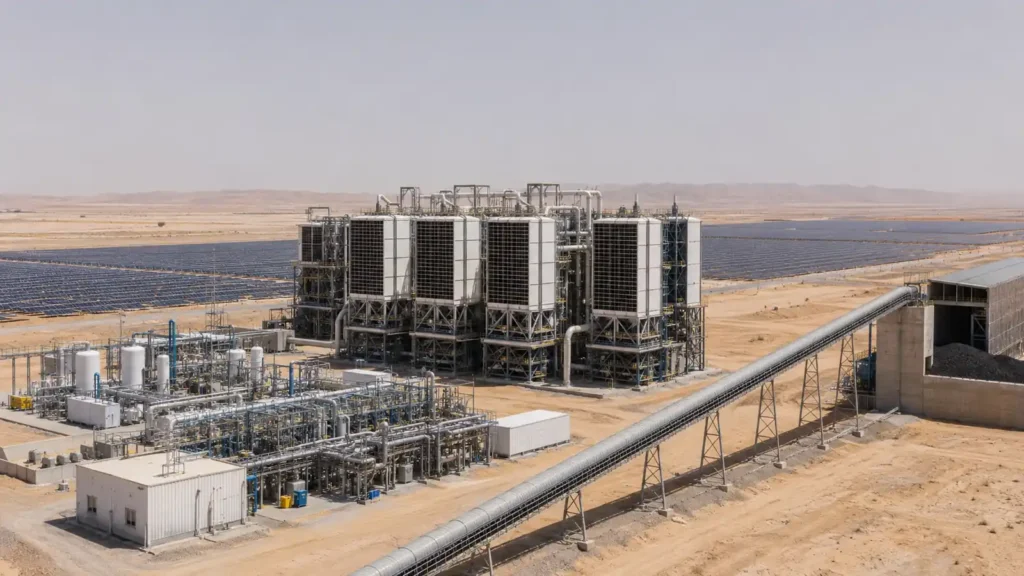
A sequestration tower is not self-contained. It requires a hydrogen supply or an on-site electrolysis unit for the Bosch conversion step. It requires a high-temperature reactor running continuously at 600°C. It requires cooling or dry heat rejection for the desorption phase. It requires transport infrastructure for the solid carbon output: a pipeline, rail loading facility, or significant on-site storage. A tower sited in the Moroccan desert with no existing infrastructure must bring all of that with it.
The comparison with forests is grounding here. A hectare of mature temperate forest sequesters roughly 2 to 5 tons of CO₂ per year through photosynthesis, returning some fraction through soil respiration and decomposition. A single medium-capacity tower on two hectares sequesters 1,000 tons per year, which is 200 to 500 times more CO₂ per unit of land area than a managed forest. The land efficiency argument is real. The energy and material inputs the forest does not require are also real, and they do not cancel each other out.
Why arid regions keep appearing in the planning documents
Dry air improves solid sorbent efficiency by reducing competitive water adsorption. High solar irradiance reduces renewable electricity costs. Low land value reduces site acquisition costs. The optimal geography for atmospheric sequestration towers converges on regions with high sun hours and low humidity: the American Southwest, North Africa, the Arabian Peninsula, central Australia. None of these are adjacent to the population centers generating most of the emissions, which means the carbon, once solidified, needs a destination reachable from there.
From One Tower to a Planetary Carbon Management System
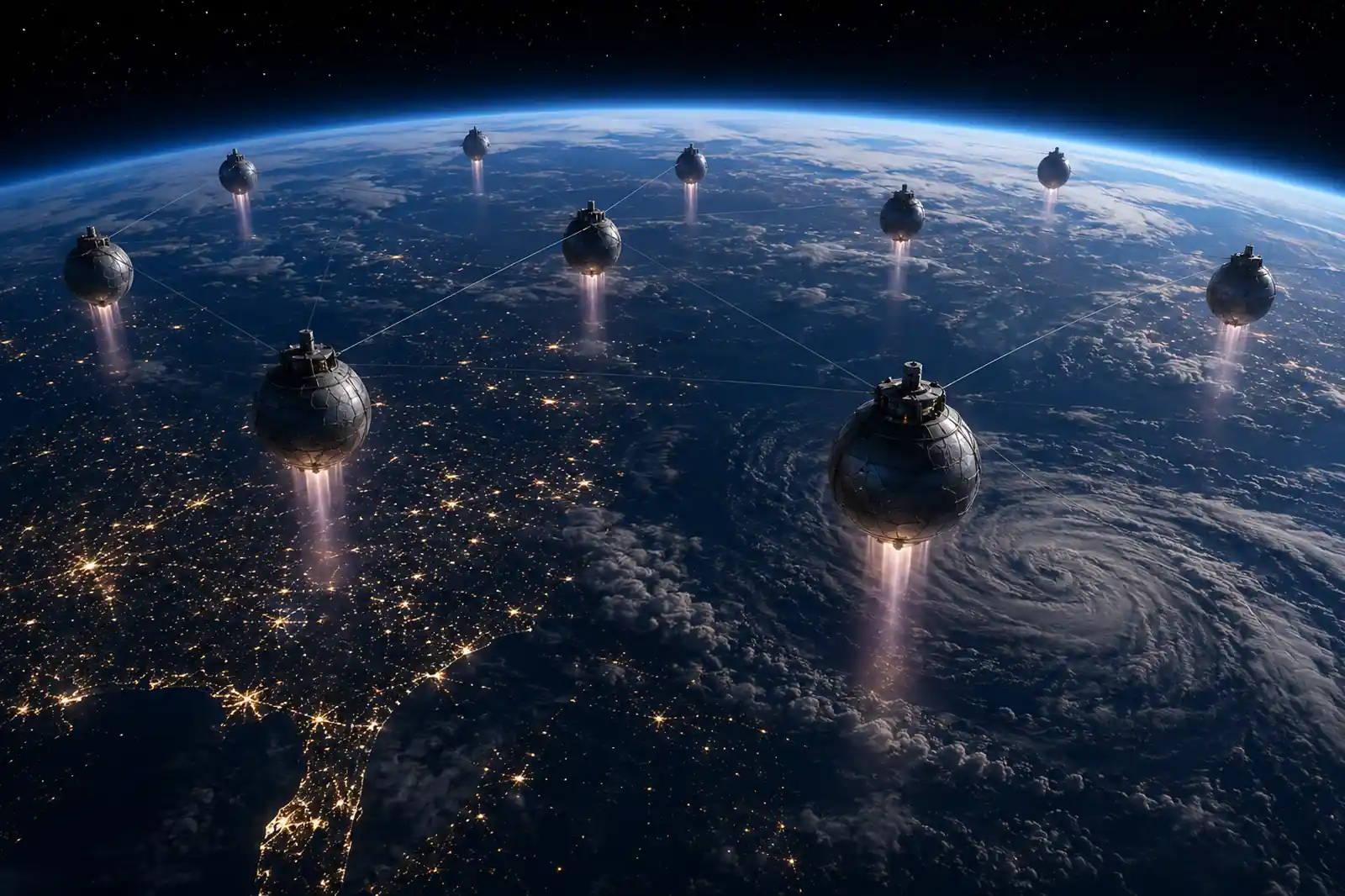
The global atmosphere contains roughly 3.2 trillion tons of CO₂. Annual human emissions add approximately 37 billion tons. Removing one billion tons per year, a target some climate scenarios treat as meaningful, would require roughly one million towers at 1,000-ton annual capacity each. At current construction cost estimates of $200 to $400 million per large facility, that is a number measured in fractions of global GDP.
The more tractable question is what ten thousand towers, operational by 2055 with two decades of cost and efficiency improvements, actually accomplish. Ten thousand towers at 2,000 tons annual capacity, credible for a mature second-generation design, remove 20 million tons per year. Against 37 billion tons of annual global emissions, that is 0.054 percent. Not nothing. Not nearly enough on its own.
But by 2055, those towers will not be operating in a world identical to today’s. Wind and solar costs will be lower. Sorbent lifetimes will be longer. Adjacent decarbonization will have reduced the baseline emissions figure. The honest framing is not whether towers alone can fix the atmosphere; they cannot. The better question is what role atmospheric sequestration plays in a system that has already cut emissions significantly and still needs to address the residual. Against that target, 20 million tons per year is a meaningful industrial contribution.
Where the Sabatier pathway splits the road
An alternative conversion route replaces solid carbon output with synthetic methane or liquid hydrocarbon fuel. The Sabatier reaction combines CO₂ with hydrogen to produce methane (CO₂ + 4H₂ → CH₄ + 2H₂O), which feeds into existing gas distribution infrastructure. The Bosch reaction produces solid carbon and water. The Sabatier reaction produces fuel and water. The choice between them depends on what the operator needs more: a carbon sink or a storable energy carrier.
A tower network built around Sabatier synthesis effectively becomes a synthetic fuel plant, capturing CO₂ from ambient air and producing drop-in fuel for aircraft or ships. The carbon cycles through the atmosphere again, but the fossil carbon it displaces stays in the ground. Whether that counts as atmospheric remediation depends on the accounting framework, and that framework is not settled. Both pathways are worth building and testing at scale, for different reasons.
Integration with industrial sites, and what that unlocks
Co-location with industrial facilities changes the economics substantially. A cement plant operating at 1,000°C generates large volumes of waste heat. An atmospheric tower needing 600 to 900°C for calcination or Bosch conversion can draw on that waste stream directly, cutting electrical demand significantly. A data center running on renewable electricity generates heat in the 30 to 60°C range, which is useful for amine sorbent desorption that requires no more than 120°C. Neither integration requires new physics. Both require a developer willing to treat carbon capture as infrastructure.
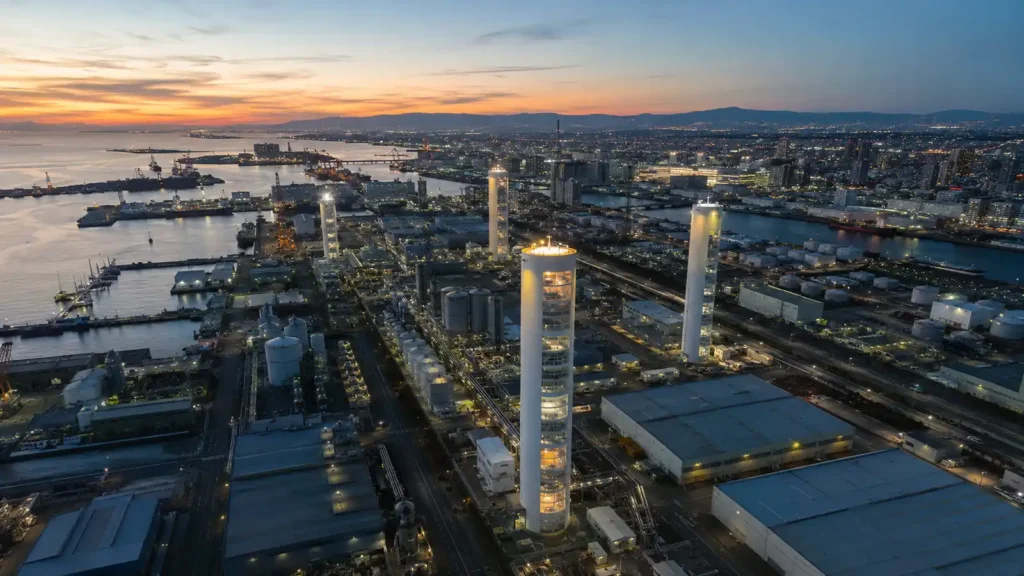
The visual dimension also shifts in urban co-location. A sequestration tower in the Sahara is invisible to most of the people it is supposed to benefit. A tower integrated into a city’s skyline, architectural in form, lit at night, a known feature of the built environment, carries a different kind of weight. Whether that weight is useful or merely symbolic is a question about communication. Both answers are probably correct, for different audiences.
The View From NoSuchDevice
I find this device interesting for reasons that have nothing to do with optimism.
The atmospheric carbon sequestration tower does not need new physics. The Bosch reaction is from 1908. Amine chemistry for gas separation has been industrial practice for decades. What the tower needs is cheap renewable electricity, better sorbent cycle lifetimes, and an honest answer to the permanence question: what form does the carbon stay in, and for how long. Those are engineering and policy problems. The science is already there. The invoice has been written. What remains is the willingness to pay it.
What I keep returning to is the asymmetry. We spent 200 years adding CO₂ to the atmosphere at industrial scale, without thinking much about it. Removing it at comparable scale would require industrial effort of roughly similar magnitude, powered by energy sources that did not exist when the adding started. There is something almost arithmetically fair about that, in the way that a debt is fair: it records accurately what actually happened.
The towers are, in a sense, the invoice for the previous century of inattention. Priced in kilowatt-hours. Paid in decades. Almost certainly insufficient on their own, but that insufficiency does not make the device wrong. It makes it one component of a larger system that does not yet fully exist.
The tower that pulls CO₂ from desert air and converts it to graphite for battery anodes is doing two useful things at once. The tower co-located with a cement plant, running on its waste heat, is cheaper to operate than either facility built alone. A thousand towers feeding solid carbon into a mineral sequestration pipeline are doing something no forest can do: removing carbon from the atmosphere on a schedule that does not depend on rainfall, fire seasons, or land-use decisions of governments that may not be in office next decade.
I think these towers get built. Not soon, and not at the scale climate scenarios sometimes imply. But somewhere between the pilot project and the planetary infrastructure, there is a practical middle ground. Call it ten thousand towers by 2060, integrated into industrial sites that need the waste heat flow and can use the carbon black revenue. That version is not a solution. It is an industry. And an industry, unlike a promise, can be counted.
You read the whole thing.
That is rarer than it should be. A device that mines 420 parts per million from open air and locks it into solid carbon is exactly the kind of machine this archive was built to examine seriously. I make every piece alone, with no ads and no investor deciding what gets written. If you want the next machine taken apart like this one, you can help me make it.
A coffee a month is enough to keep it free for everyone.
Prefer crypto or a one time gift? Other ways to give →