



What Is Stellarator?
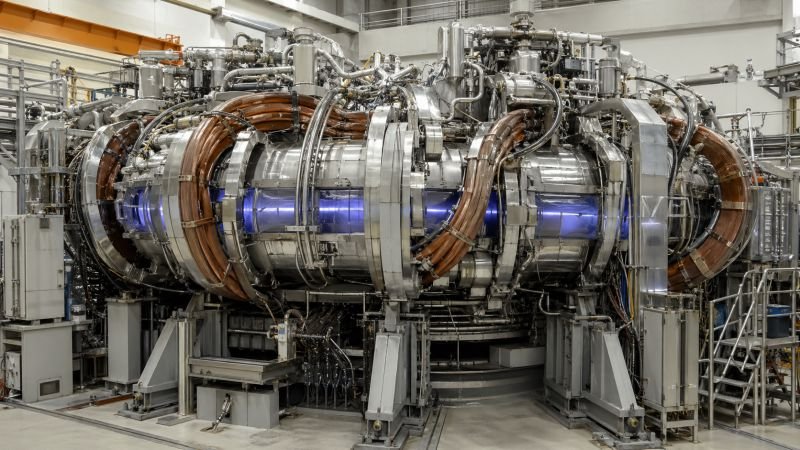
A stellarator is a magnetic confinement fusion device that uses external, three-dimensionally shaped coils to hold a hot plasma in a twisted toroidal path. Unlike a tokamak, it does not depend on a large current flowing through the plasma for its main confining field. The field geometry gives particles a repeated magnetic path that averages out drifts. One useful parameter is rotational transform, iota = dtheta / dphi, which describes how a field line winds around the torus.
In real machines, the complex coil shapes are designed by computational optimization and manufactured to tight tolerances. Small errors can create magnetic islands or extra transport paths that let heat escape. For compact fusion reactor architecture, the attraction is continuous plasma operation with fewer current-driven disruption risks.
Stellarators matter because they trade mechanical complexity for plasma stability and long-duration operation. Used in devices include research fusion reactors, optimized confinement experiments, fusion neutron sources, and high-field power reactor concepts. Their broad engineering challenge is to combine accurate magnets, plasma heating, shielding, and heat removal in a shape that can be built and maintained at power-plant scale.
Example:
A research stellarator can test how twisted magnetic fields confine plasma without relying on a strong toroidal plasma current.
Related Terms:
NoSuchDevice is a free archive of machines that do not exist yet but already have a shadow in physics. I research and write every entry alone, with no ads. Take a look around the archive, or help keep it free.