






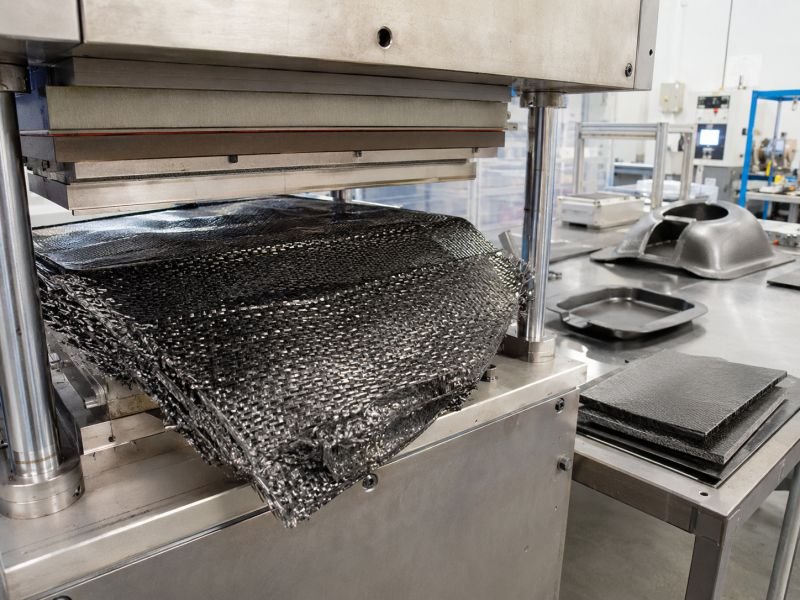
What Is Thermoplastic composite?
A thermoplastic composite is a reinforced material made from fibers embedded in a thermoplastic matrix that softens when heated and solidifies again on cooling. Unlike thermoset composites, it can be reheated after forming. A useful relation is E_c approx V_f E_f + V_m E_m, showing how composite stiffness depends on fiber and matrix fractions.
In practice, the matrix may be polypropylene, nylon, PEEK, or another melt-processable polymer, while the reinforcement may be glass or carbon fiber. Heating allows forming, welding, stamping, and reshaping without breaking the entire matrix chemistry. Used in devices include aircraft brackets, battery trays, interior panels, protective housings, and sporting structures where low mass and damage tolerance both matter.
The concept matters because remeltable matrices open a more practical end-of-life pathway than cured composites permit. That makes the material important in recyclable lightweight structures, where designers want the stiffness benefits of reinforcement without committing to a permanently crosslinked part.
Processing performance depends on melt viscosity, fiber volume fraction, cooling rate, and the temperature window between forming and degradation, all of which affect consolidation quality and later reprocessing options. Tooling design matters as well.
Example:
A heated press can form a glass-fiber thermoplastic laminate into a bracket, and offcuts can later be remelted for secondary products.
Related Terms:
- Polylactic Acid
- Embodied Energy
- Fiber Reinforcement
NoSuchDevice is a free archive of machines that do not exist yet but already have a shadow in physics. I research and write every entry alone, with no ads. Take a look around the archive, or help keep it free.