





What Is Vortex-Induced Vibration (VIV)?
Vortex-induced vibration is an oscillation that appears when fluid flow past a body sheds alternating vortices and applies repeating lateral forces to the structure. If the shedding frequency approaches the structure’s natural frequency, the motion can amplify through resonance and produce large cyclic deflections even when the mean wind force is modest.
In urban facade airflow harvesting, a slender body is tuned so that vortex shedding excites a useful vibration instead of being suppressed as a structural hazard. The oscillation frequency depends on flow speed and geometry, which is why device tuning matters more than simply placing hardware in the strongest wind.
A common relation is f_s = St x V / D, where shedding frequency depends on Strouhal number, flow velocity, and characteristic dimension. Why it matters is that the same phenomenon can destroy bridges, fatigue cables, or generate electrical output, depending on how damping, stiffness, and resonance are engineered.
Used in devices include bridge-cable dampers, chimney monitors, and vibration energy harvesters. Engineers track amplitude growth, fatigue loading, damping ratio, and lock-in behavior because repeated oscillation becomes either a design threat or a useful power source over long operating periods.
Example:
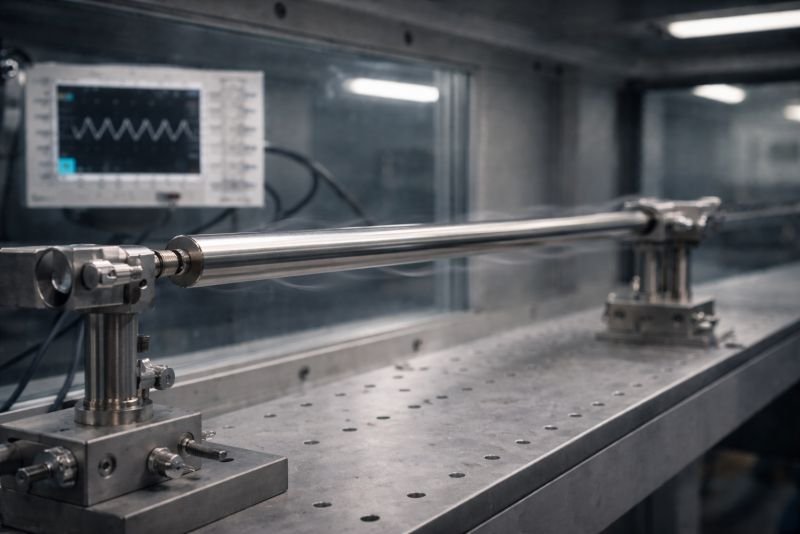
A thin cantilever on a building edge can oscillate at its resonant frequency when alternating vortices shed from the airflow around it.
Related Terms:
NoSuchDevice is a free archive of machines that do not exist yet but already have a shadow in physics. I research and write every entry alone, with no ads. Take a look around the archive, or help keep it free.