






What Is Acoustic Damping?
Acoustic damping is the reduction of sound or vibration amplitude through mechanisms that dissipate mechanical energy. That energy may be lost through internal material friction, fluid interaction, structural treatments, or conversion into another form such as heat or electricity, lowering the strength of resonant motion over time.
In ultrasonic structural coatings, damping can arise as a side effect of energy extraction. A surface treatment that captures vibrational energy reduces how much of that motion continues through the host structure, which can simultaneously lower audible noise, suppress resonance peaks, and reduce long-term dynamic stress.
A simple decay relation is A(t) = A0 x e^(-zeta omega t), where damping ratio zeta governs how quickly amplitude falls. Why it matters is that damping is one of the main levers for controlling vibration response, but increasing it can also reduce the peak motion available to a resonant energy harvester.
Used in devices include speaker enclosures, building panels, and vibration treatments on machinery. Engineers tune acoustic damping to balance bandwidth, efficiency, structural life, and noise control because too little damping invites resonance problems while too much damping can erase useful signal or harvested energy.
Example:
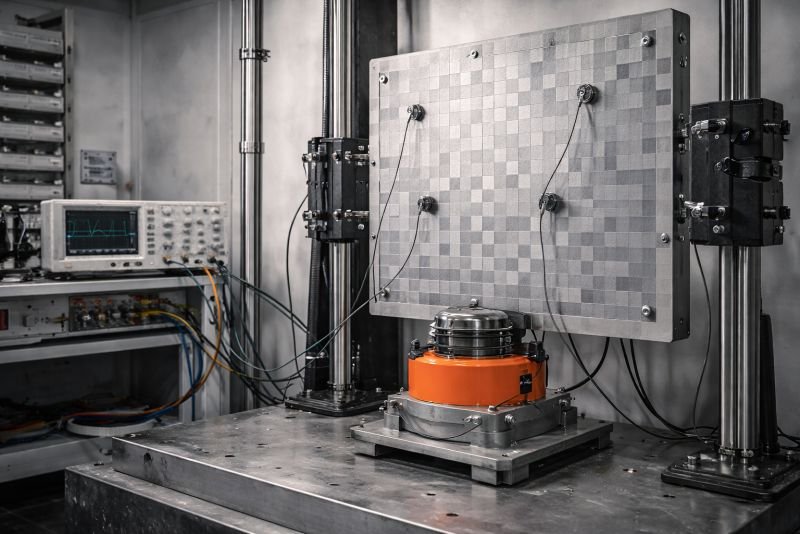
A damping layer on a vibrating panel can reduce ultrasonic motion by absorbing part of the mechanical energy on each cycle.
Related Terms:
NoSuchDevice is a free archive of machines that do not exist yet but already have a shadow in physics. I research and write every entry alone, with no ads. Take a look around the archive, or help keep it free.