






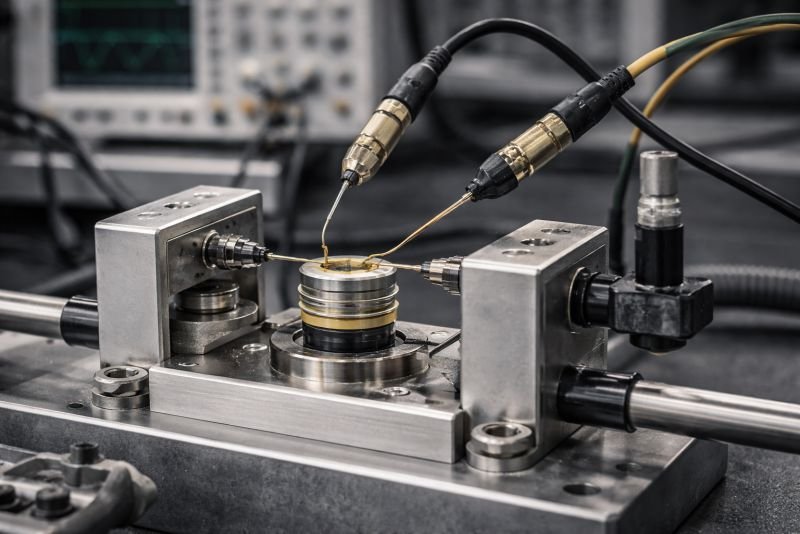
What Is Mechanical Quality Factor?
Mechanical quality factor is a dimensionless measure of how lightly damped a resonant system is. A high value means the structure stores vibrational energy efficiently and loses only a small fraction each cycle, while a low value means energy is dissipated quickly and resonance is broader, weaker, and easier to suppress.
In ultrasonic resonator design, mechanical quality factor controls the tradeoff between strong peak response and tolerance to frequency drift. High-Q resonators can generate large amplitudes near their tuned frequency, but they also become sensitive to small changes in wind-driven excitation and can accumulate higher cyclic stress.
A standard expression is Q = 2pi x (stored energy / energy lost per cycle). Why it matters is that Q sets resonance sharpness, bandwidth, ring-down time, and energy concentration, all of which determine whether a vibrating device behaves like a precise harvester, a stable sensor element, or a fragile narrow-band oscillator.
Used in devices include quartz oscillators, ultrasonic transducers, and resonant harvesters. Engineers balance quality factor against bandwidth, durability, and damping because a device that resonates very sharply may perform poorly once its excitation frequency drifts away from the design point.
Example:
A resonator with higher mechanical quality factor reaches larger vibration amplitude at resonance but responds over a narrower frequency range.
Related Terms:
NoSuchDevice is a free archive of machines that do not exist yet but already have a shadow in physics. I research and write every entry alone, with no ads. Take a look around the archive, or help keep it free.