






There is something strange about the wind hitting a bridge cable. The hum is audible – that low, sustained tone big suspension bridges make in a strong blow. What you cannot hear is the rest of what that cable is doing. Above 20,000 vibrations per second, past the ceiling of human hearing, the cable generates mechanical energy from the same moving air, continuously, and loses every joule of it as heat too diffuse to measure.
Nothing was ever built to collect it. A patch of harvesting surface the size of a sheet of paper could power a sensor node indefinitely in moderate wind.
Nobody built it.
The short version: Wind generates mechanical vibration above 20 kHz at every surface it encounters – inaudible, continuous, and currently uncollected. A piezoelectric harvester tuned to this frequency range could extract 1-10 milliwatts per 100 cm² in moderate sustained wind, enough to power a structural monitoring sensor indefinitely with no battery. The physics permits it. The engineering challenge is resonance matching against a wind speed that never stays constant.
Key Takeaways
- Wind turbines are optimized for rotation and miss the ultrasonic band entirely – two technologies targeting the same wind, with no overlap between them.
- The same cable humming in the wind is a continuous mechanical antenna for energy in the 20-200 kHz range.
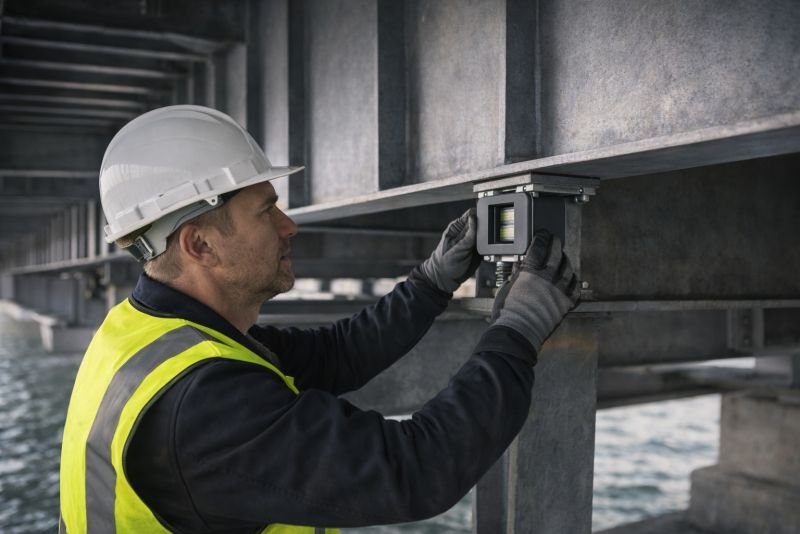
- A harvester the size of a thick credit card could eliminate battery replacements on sensors mounted 40 meters up a bridge pylon.
- The hardest engineering problem is frequency matching against a source that shifts every time a gust changes speed.
- At scale, a surface that absorbs ultrasonic wind energy also damps the vibration that causes structural fatigue – the harvester and the protective coating become one object.
Table of Contents
Wind’s Uncollected Frequencies
A conventional wind turbine extracts energy from bulk airflow. The rotor intercepts moving air, converts momentum into rotation, and the aerodynamics involved have been refined across a century of engineering work. What turbines do not do – what they are not designed to do – is engage with the turbulent, high-frequency mechanical behavior that wind generates when it meets an obstacle. That behavior is a separate physical process, and it produces energy in a frequency range that no rotating machine can address.

The Karman Vortex Street and What Happens at Small Scales
When wind flows past a cylindrical object, it does not divide neatly around both sides and continue. It separates into alternating vortices that shed from opposite sides in a repeating pattern – a Karman vortex street. The shedding frequency scales directly with wind speed and inversely with the object’s diameter. For a 10 mm bridge cable in a 10 m/s wind, shedding frequency sits around 700 Hz. For a 1 mm wire under the same conditions, it reaches 7 kHz. For sub-millimeter geometry – surface texture features, roughness elements, microfilaments in a structured coating – the shedding frequencies push into the ultrasonic range above 20 kHz.
Wind arriving at a real structure encounters geometry at every scale simultaneously. A bridge deck has large members that shed low-frequency vortices and surface texture features that generate ultrasonic vibration. Both processes run in parallel. The ultrasonic component carries energy continuously, propagates efficiently through solid material, and currently disperses inside the structure as a temperature increase too small to detect with standard instruments.
What Conventional Harvesters Cannot Reach
Low-frequency energy harvesting devices – pendulum systems, flapping membrane generators, small rotors – are designed around macroscopic displacement. They need deflection in the millimeter-to-centimeter range to produce useful output. Ultrasonic vibrations have amplitudes in the nanometer to micrometer range. A macroscopic harvester cannot engage with motion that small. The energy density per vibration cycle is lower than at low frequencies, but the cycle rate compensates: at 50 kHz, the device completes 50,000 energy cycles per second. Whether a transduction mechanism can extract net positive power from those cycles is the question the rest of this device is built to answer.
How an Ultrasonic Wind Harvester Could Operate
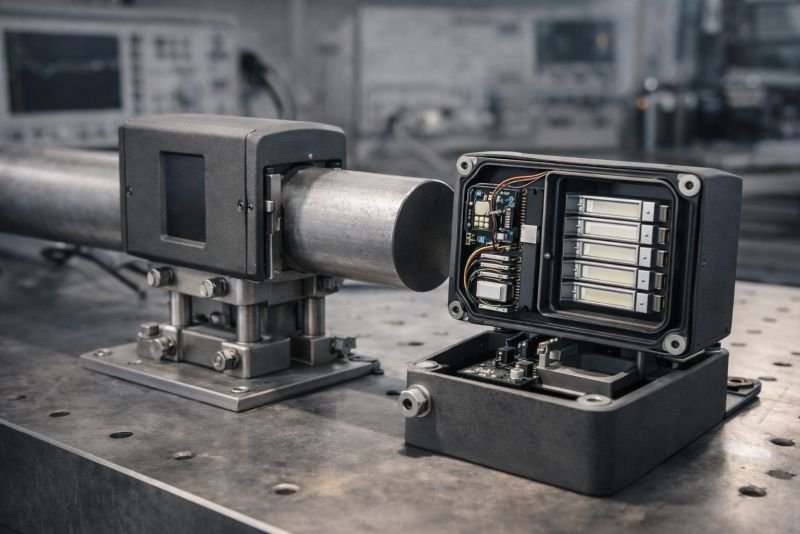
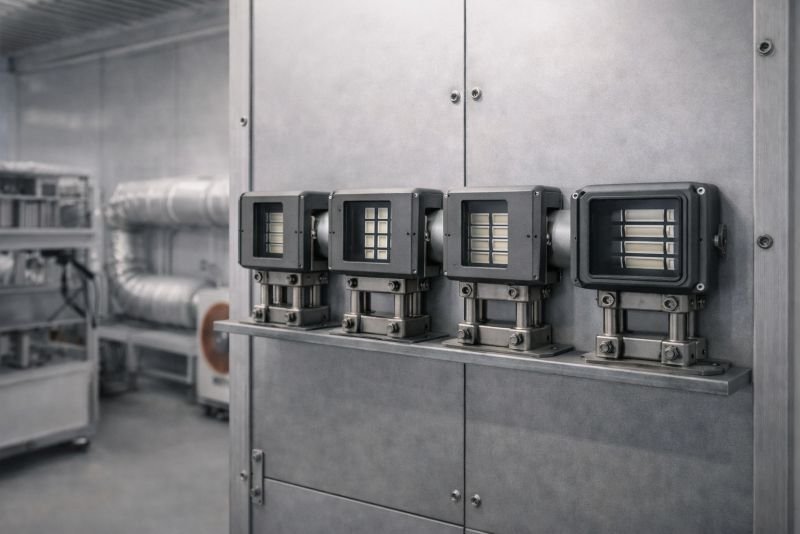
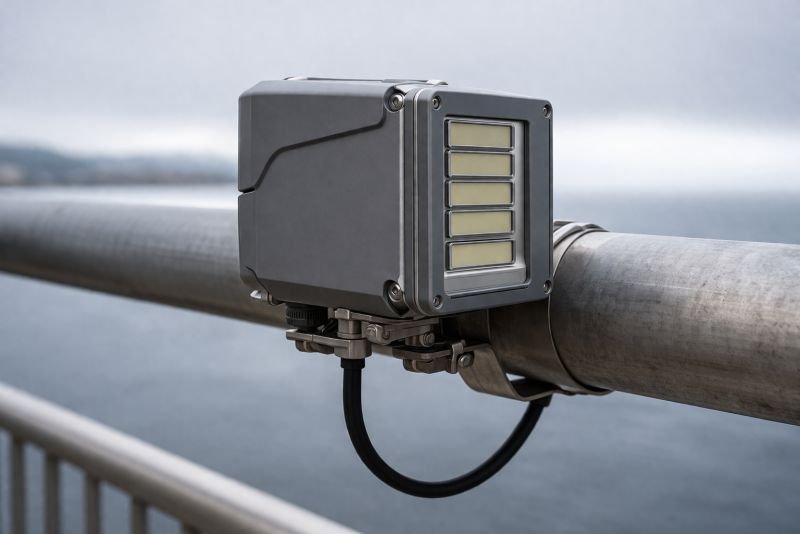
Picture a device roughly 15 cm by 10 cm and 8 mm thick, bonded to the surface of a bridge handrail or clamped around a structural cable. The housing is weatherproof composite. Inside, a stack of resonator elements sits bonded to the inner face of the casing, which couples mechanically to the structure beneath it. When wind drives vibration through the structure, those vibrations enter the harvester through the mounting interface, reach the resonator elements, and cause them to flex. Each flex generates a small electric charge. A conditioning circuit rectifies and stores that charge. A wireless sensor node on the exterior draws from the stored energy to transmit structural data at intervals. No cable runs. No battery. The device operates as long as the wind does.
Anatomy of the Resonator Array
The core of the harvester is an array, not a single element. One resonator tuned to 40 kHz produces strong output when wind drives vibration at exactly that frequency and near-zero output at anything else. Wind does not cooperate with that arrangement. An array containing elements tuned to 25, 35, 45, and 55 kHz spreads the response across a range corresponding to wind speeds from roughly 5 to 20 m/s in the target structure geometry. No single element operates at peak efficiency, but the aggregate output remains non-zero across most of the practical operating range. The elements are manufactured as thin ceramic discs or deposited films, stacked or tiled across the harvester’s inner face, each bonded to a backing material chosen to set its resonant frequency precisely.
The Conversion Step: Piezoelectric Film at Work
Piezoelectric materials generate electric charge when mechanically deformed. The relationship for output power from a single resonator element is:
P = (d² x E x Q x f x A²) / (2 x ε)
Where d is the piezoelectric charge coefficient in coulombs per newton, E is the elastic modulus in pascals, Q is the mechanical quality factor – a dimensionless measure of how sharply the element resonates – f is vibration frequency in hertz, A is amplitude in meters, and ε is permittivity in farads per meter.
For a lead zirconate titanate element with d = 300 x 10⁻¹² C/N, Q = 500, operating at 40 kHz with an amplitude of 500 nm: output power lands near 50-200 microwatts per cubic centimeter of active material, depending on coupling efficiency. A wireless structural sensor running at a 1% duty cycle typically consumes 5-15 microwatts averaged over time. The harvester’s output exceeds that threshold. The gap between what the physics delivers and what the sensor needs is not enormous, but it is on the right side.
Piezoelectric or Electromagnetic: The Trade-off in One Table
An electromagnetic path also exists – coil and magnet assemblies where vibration drives relative motion between the two. Both mechanisms have plausible routes to this frequency range, and they make different trade-offs:
| Property | Piezoelectric | Electromagnetic |
|---|---|---|
| Practical frequency ceiling | MHz range – well-suited for ultrasonic | Practical ceiling near 20-50 kHz |
| Vibration amplitude required | Nanometers sufficient | Micrometers preferred |
| Output impedance | High – capacitive | Low – inductive |
| Power conditioning complexity | Requires charge pump and rectifier | Simpler rectification |
| Integration on curved surfaces | Thin film deposition possible | Requires coil geometry |
| Long-cycle material behavior | Fatigue management required | Minimal at small amplitudes |
For the ultrasonic band specifically, piezoelectrics have the geometry advantage – they can be manufactured as films thin enough to conform to structural surfaces without disrupting the mechanical coupling that makes them work. A mature harvester might combine both: piezoelectric transduction for the 20-200 kHz portion of the wind spectrum, electromagnetic for the lower frequencies arriving from the same structure simultaneously.
Everything here is free. Readers are the reason it stays that way.
I make all of it alone, with no ads. If it is worth a coffee a month to you, that keeps the next one coming.
Keep it alive →The Frequency Drift Problem
Here is where the physics is honest and the engineering gets hard. Resonant harvesters work well when the incoming vibration matches the element’s resonant frequency. Wind does not stay at a fixed speed. A gust that drives 40 kHz vortex shedding from a cable geometry becomes 28 kHz when the wind drops by 30 percent. A narrow-band resonator tuned to 40 kHz captures essentially nothing at 28 kHz. That is not a marginal efficiency penalty. It is close to total loss of output.
Broadband Arrays and the Frequency Up-Conversion Path
The array approach addresses this partially – spreading resonators across a frequency range means some fraction is always near resonance. The fraction varies with wind conditions, which creates variable output rather than absent output. A different approach starts from the observation that low-frequency structural vibration is more consistent in amplitude and can be used to mechanically trigger high-frequency resonators through snap-through mechanisms. The structural vibration provides driving energy; the high-frequency resonator handles conversion at its preferred frequency.
Wind speed distribution data at a specific site allows the array’s frequency distribution to be tuned for that location’s typical wind character rather than a generic spectrum. A harvester on a coastal bridge faces a different wind profile than one on an urban facade, and an array designed with that site data harvests more effectively across seasonal variation.
The honest position: frequency matching at ultrasonic frequencies in outdoor conditions is the engineering problem that separates laboratory demonstrations from deployed systems. It is solvable. The physics does not forbid solutions. But it has not been solved at the durability and stability that a decade of field operation requires.
Where the Device Builds Its Case
The harvester is not competing with grid power or solar panels. The comparison that matters is a AA battery inside a sensor housing, 40 meters above a river, bolted to structural steel that nobody wants to climb more than twice a year. Against that specific alternative, the energy arithmetic shifts.
Urban Canyons and Turbulent Facades
City streets between tall buildings accelerate wind and generate turbulence at higher frequencies than open-field conditions. Facades, handrails, and light pole arrays in these corridors experience continuous, directionally variable wind loading. A harvester integrated into facade cladding – thin-film piezoelectric elements bonded to panel backing material – operates continuously regardless of which direction gusts arrive from. The urban geometry that makes certain corners feel like a wind tunnel in January is the same geometry that produces a richer ultrasonic vibration environment than any smooth rural site.
Offshore Platforms and the Maintenance Problem
Offshore structures stand in sustained, high-velocity wind with minimal obstruction. Platform jackets, risers, and grating panels vibrate continuously. Running power cables to individual structural monitoring sensors on an offshore installation is expensive; replacing batteries at sensors in hazardous locations carries its own cost and access risk. A harvester that eliminates battery maintenance at those sensor locations does not need to be impressive. It needs to generate enough power, reliably, for years. Ten milliwatts continuously is enough for that specific job.
Drone Frames as Vibration Sources
A drone’s propellers generate ultrasonic vibration in the frame, nacelle, and arm structure throughout every flight. A piezoelectric element bonded to a drone arm captures a fraction of that vibration. It does not solve the drone’s primary energy problem – propulsion power is orders of magnitude beyond what a small harvester reaches. But it can power the sensor payload independently of the main battery, removing sensor load from the primary energy budget and extending monitoring flight time by the equivalent of that load. The drone generates the vibration. The harvester catches some of it. The payload runs on what would otherwise be structural heat.
The Harvester That Also Protects the Structure
A structure with a harvester bonded to its surface loses some of the ultrasonic vibration energy it would otherwise carry. Energy transferred into the piezoelectric elements does not continue propagating through the host material. This is acoustic damping, achieved as a consequence of energy extraction rather than by a dedicated damping treatment.
Ultrasonic fatigue is a real failure mode in metal structures. Sustained high-frequency vibration at sufficient amplitude initiates microscale cracks that grow over years of cumulative loading. On bridge cables, offshore risers, and aircraft structural members, this process is monitored carefully and managed through scheduled inspection. A surface treatment that simultaneously harvests energy from ultrasonic vibration and damps that vibration addresses two separate engineering requirements with one installed component – and the monitoring sensors the harvester powers are measuring the same vibration load that the harvester is attenuating. The loop is nearly closed.
Whether the dual-function economics justify a piezoelectric surface treatment at a given installation depends on structure size, wind exposure, and monitoring requirements. On a 200-meter bridge with continuous inspection obligations, the numbers look different than on a 10-meter handrail section. The interesting design question is whether a future version of this concept gets optimized from the outset as a structural health management surface rather than as an energy harvester with a useful side effect.
From Resonator Array to Surface That Powers Itself
The evolutionary trajectory here follows a pattern that photovoltaics traced before it: discrete components first, then integration into surfaces, then infrastructure that generates power as a consequence of existing rather than as a dedicated function.
First Generation: The Sensor Power Problem Gets Solved
The first deployable form of an ultrasonic wind harvester is a packaged unit – a housing containing a resonator array and power conditioning circuit, mounted to a structure, wired to a sensor node. Its job is narrow: eliminate battery maintenance at one sensor location. Output is 1-5 milliwatts in favorable wind conditions. The engineering work at this stage centers on resonator manufacturing tolerance, power conditioning efficiency, and environmental sealing that survives a decade of outdoor exposure without attention.
Mature Form: Distributed Arrays as Structural Coating
When resonator elements become manufacturable as deposited films rather than discrete components, and when power conditioning reaches chip scale, the form factor shifts from discrete units to surface treatments. A layer of nanostructured piezoelectric material applied to a bridge deck section or a facade panel harvests across its entire area. At 5 milliwatts per 100 cm² element and a 10-square-meter installation, aggregate output approaches 500 milliwatts – enough to power a mesh network of sensors with local processing. The structure gains a distributed nervous system powered by its own mechanical response to wind.
Civilizational Scale: Infrastructure That Monitors Its Own Stress
At the far end of this arc, built structures do not carry passive loads under passive observation. Every gust produces a measurement from the surface that experienced it, powered by the vibration that report describes. Structural health monitoring stops being a system installed on infrastructure and becomes a property of how the structure is built. The materials science and manufacturing economics that would enable that outcome do not exist today. The physical principle that makes it possible is established, requires no new physics, and is waiting for engineering to close the distance.
The View From NoSuchDevice
Energy harvesting as a category has a credibility problem that this device inherits without fully deserving it. Most harvesting concepts are physically correct and practically useless – the energy is real, the amounts do not matter, and the honest analysis always ends in the same place: works great if you happen to need 50 microwatts in exactly this location. People stopped believing the category made sense, and the scepticism is not unreasonable.
I think ultrasonic wind harvesting is different in one specific and defensible way. The target application is not “power a building” or “offset the grid.” It is “power a sensor that currently runs on a battery that someone has to physically replace in a hazardous location.” Against that narrow comparison, the device does not need to be impressive. It needs to be reliable, durable, and just barely sufficient. That is a much more achievable bar.
The frequency matching problem is the honest obstacle, and I would not minimize it. A device that harvests well in steady wind and produces nothing in gusting, variable conditions is a laboratory result, not a sensor power solution. Broadband arrays and frequency up-conversion are both credible directions, but neither has been demonstrated at the durability a decade of outdoor operation requires. That gap between proof-of-concept and deployed system is where this technology actually lives.
What I find genuinely interesting is the dual-function angle. If a harvesting surface can also function as a structural damping treatment, the economics of installation change. The harvester is no longer justified by energy output alone but by energy output plus extended structural life plus reduced inspection frequency. That combination might clear a cost threshold that energy output alone cannot. Whether it does depends on numbers specific to each structure type and wind regime. But the logic of the combination is sound, and that matters more at this stage than the numbers.
This is a seed technology. The single harvester powering a single sensor is the first form. The interesting destination is infrastructure that generates its own monitoring power from the same mechanical loads it is designed to withstand. Physics permits that destination.
Engineering has not built the road yet.
You read the whole thing.
That is rarer than it should be, and it is the exact kind of attention I built this archive for. I make every piece alone, with no ads and no investor deciding what gets written. If you want the next machine taken apart like this one, you can help me make it.
A coffee a month is enough to keep it free for everyone.
Prefer crypto or a one time gift? Other ways to give →