






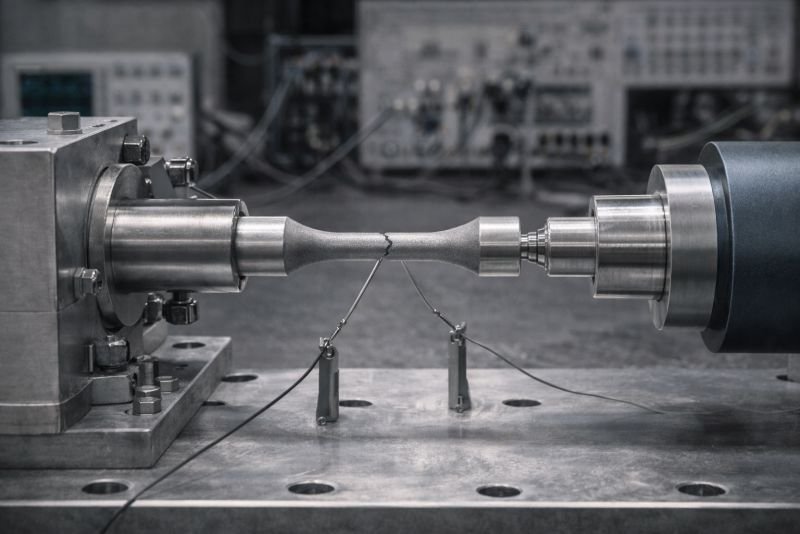
What Is Ultrasonic Fatigue?
Ultrasonic fatigue is material damage caused by repeated cyclic loading in the ultrasonic frequency range, typically above 20 kHz. Even when the motion amplitude is small, the enormous number of load cycles accumulated in a short time can initiate microcracks, accelerate crack growth, and change mechanical performance long before visible failure appears.
In high-frequency wind harvesting, ultrasonic fatigue becomes a lifetime issue rather than an edge case. Resonant elements may operate continuously in a narrow band for months or years, so durability depends not only on peak stress but on how fast billions or trillions of loading cycles accumulate.
A simple cycle-count relation is N = f x t, where total cycles equal operating frequency multiplied by elapsed time. Why it matters is that 40 kHz operation produces more than 3.4 billion cycles in a single day, which pushes fatigue behavior into a regime where small design flaws can become major lifetime limits.
Used in devices include ultrasonic welders, piezoelectric actuators, and resonant sensors. Engineers examine crack initiation, stress concentration, temperature rise, and phase stability because materials that look durable in low-frequency tests can degrade rapidly when pushed into sustained ultrasonic operation.
Example:
A piezoelectric resonator driven continuously at 30 kHz can accumulate damaging stress cycles far faster than a comparable low-frequency component.
Related Terms:
NoSuchDevice is a free archive of machines that do not exist yet but already have a shadow in physics. I research and write every entry alone, with no ads. Take a look around the archive, or help keep it free.