




What Is Aerosol optical depth?
Aerosol optical depth, often abbreviated AOD, is a dimensionless measure of how strongly airborne particles extinguish radiation along a viewing path through scattering and absorption. A common attenuation relation is I = I0 exp(-AOD), showing that larger optical depth means less direct radiation reaches the sensor or observer.
In real atmospheres, AOD changes with particle concentration, composition, size distribution, and wavelength, so it helps describe haze, smoke, dust, and pollution. This makes it important in atmospheric retrieval algorithms, air-quality analysis, climate studies, solar resource forecasting, and calibration of optical observations.
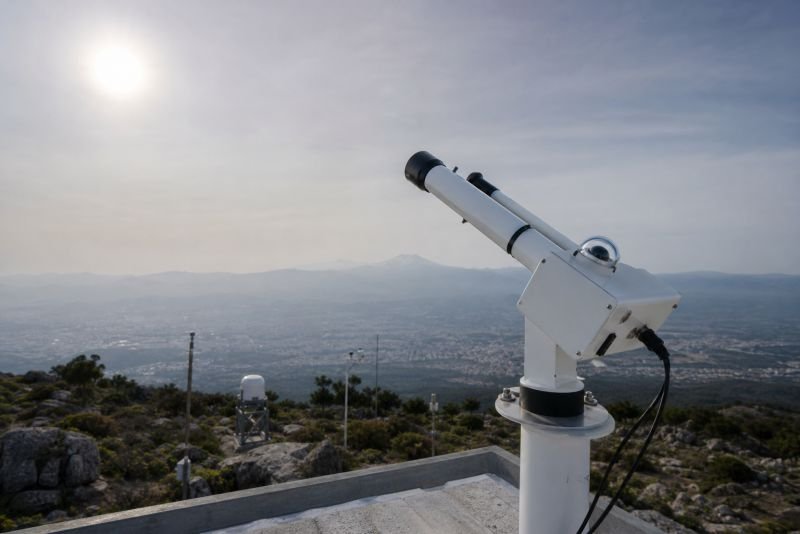
The parameter matters because suspended particles can strongly distort what an optical sensor sees even when the surface below has not changed. Used in devices include sun photometers, satellite aerosol products, atmospheric correction pipelines, climate-monitoring networks, and solar-energy assessment tools that estimate transmission losses through the air column.
AOD is not a direct measure of particle mass at the surface, so interpretation usually combines it with wavelength dependence, vertical profiles, and meteorology. Engineers use those supporting measurements to distinguish whether a high optical depth came from fine smoke, coarse dust, urban haze, or mixed aerosol layers.
Example:
A satellite image can look washed out during a smoke event because high aerosol optical depth reduces direct surface contrast before the signal reaches the sensor.
Related Terms:
NoSuchDevice is a free archive of machines that do not exist yet but already have a shadow in physics. I research and write every entry alone, with no ads. Take a look around the archive, or help keep it free.