



What Is Rayleigh scattering?
Rayleigh scattering is the elastic scattering of electromagnetic radiation by particles much smaller than the wavelength of the light. Its strength rises rapidly at shorter wavelengths, commonly summarized as I ~ 1 / lambda^4. That wavelength dependence is why blue light is scattered through the atmosphere more strongly than red light.
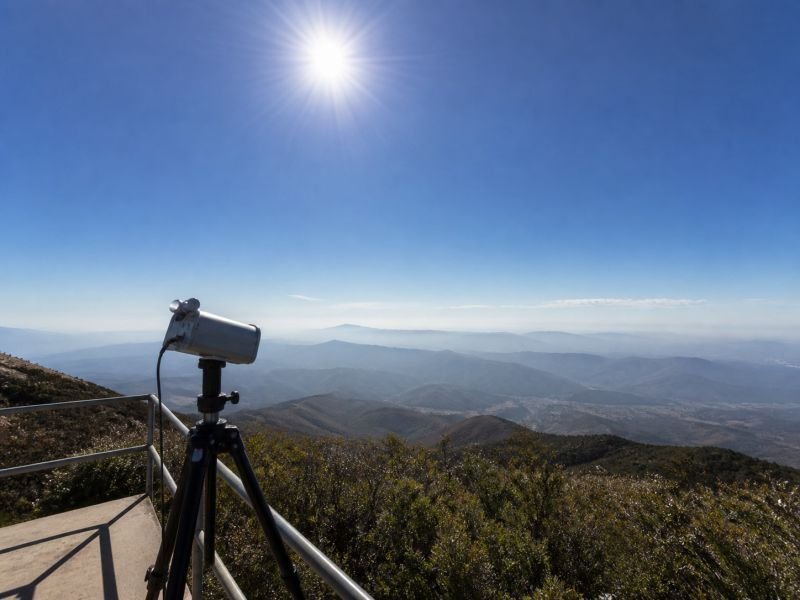
In real atmospheric paths, Rayleigh scattering adds background radiance, reduces contrast, and shifts how a scene appears to optical sensors. This makes it important in atmospheric optical retrieval, astronomy, sky-color modeling, radiative transfer, and calibration of visible-band measurements from aircraft or satellites.
The concept matters because scattering changes not only what humans see but also what detectors measure before surface information is interpreted. Used in devices include spectrometers, weather imagers, satellite cameras, sun photometers, laboratory scattering instruments, and calibration systems that correct visible-band observations for atmospheric contamination.
Engineers treat Rayleigh scattering separately from aerosol effects because gas molecules and larger particles produce different angular and spectral behavior. Accurate correction therefore depends on wavelength, pressure, and viewing geometry, especially when small differences in blue-band reflectance are being used for quantitative analysis.
Example:
A mountain lake can look brighter in a blue satellite band partly because atmospheric Rayleigh scattering adds extra path radiance above the water.
Related Terms:
NoSuchDevice is a free archive of machines that do not exist yet but already have a shadow in physics. I research and write every entry alone, with no ads. Take a look around the archive, or help keep it free.