





What Is Degree of polymerization?
Degree of polymerization is the average number of repeating units linked together in a polymer chain. It is a compact way to describe chain length, which strongly influences viscosity, toughness, melt behavior, and mechanical performance. The standard relation is DP = Mn / M0, where Mn is number-average molecular weight and M0 is the molar mass of one repeat unit.
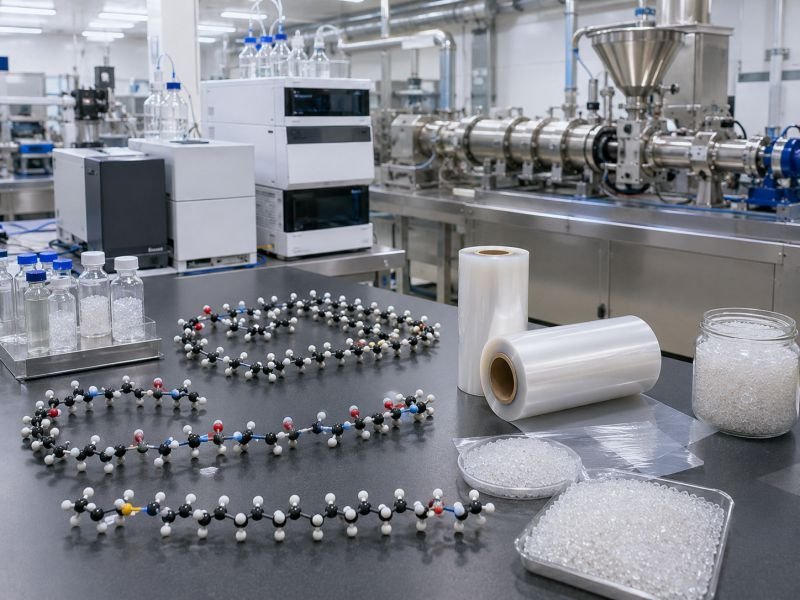
In real materials, a higher degree of polymerization usually means longer chains, greater entanglement, and better load transfer before fracture, although processing also becomes harder as melt viscosity rises. Used in devices include extrusion lines, injection molding tools, fiber spinning systems, medical polymer implants, and packaging films where chain length helps determine whether a part stays useful in service. The parameter is especially important in bio-based polymer manufacturing where small changes in chain growth can separate a brittle resin from a practical engineering plastic.
The concept matters because polymer chemistry alone does not define performance. Two materials with identical repeat-unit chemistry can behave very differently if one has short chains and the other has long, highly entangled chains.
Measurements are usually inferred from molecular weight methods such as gel permeation chromatography or end-group analysis, since real polymer batches contain distributions rather than one perfectly uniform chain length.
Example:
A PLA sample with low degree of polymerization may crumble during forming, while a higher-chain version can survive film or container production.
Related Terms:
NoSuchDevice is a free archive of machines that do not exist yet but already have a shadow in physics. I research and write every entry alone, with no ads. Take a look around the archive, or help keep it free.