



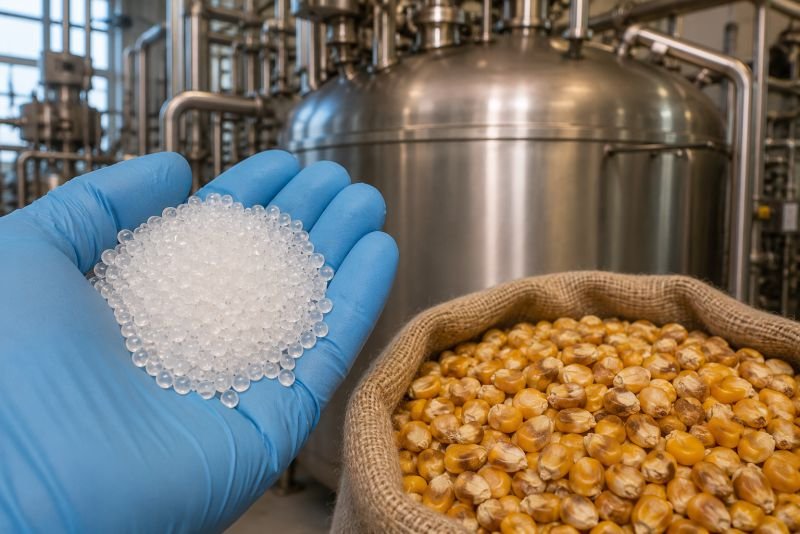
A 2,000-tonne fermentation tank in Blair, Nebraska is filled with something that looks like thin gruel. Corn steep liquor, the aqueous slurry left after wet milling separates starch from the kernel, sits in the tank at 40 degrees Celsius while a carefully managed culture of Lactobacillus bacteria converts dissolved sugars into lactic acid. The process runs for roughly 72 hours. When it finishes, the facility has the precursor to one of the most widely produced bioplastics in the world. Blair is home to NatureWorks, which operates the world’s largest polylactic acid plant with annual output of 150,000 tonnes. Corn goes in, plastic comes out, and the carbon cycle that connects those two facts is where the interesting science lives.
The short version: Bioplastics are polymers built from carbon extracted from plant material rather than petroleum. The most common type, polylactic acid (PLA), is produced through bacterial fermentation of plant sugars into lactic acid, which is then linked into long polymer chains. Around 2.2 million tonnes of bioplastics were produced globally in 2023, representing less than 1% of total plastic output. The chemistry is well understood. The physical limits and the meaning of “biodegradable” are considerably more specific than the packaging suggests.
Table of Contents
What Bioplastics Are Actually Made Of
Conventional plastics are built from hydrocarbons pulled out of crude oil and natural gas, then reorganized into polymer chains under heat and pressure. The carbon in a polypropylene food container was atmospheric CO2 that was buried underground across tens of millions of years. Bioplastics use a different carbon source: plant biomass that captured CO2 in the current carbon cycle, within decades rather than geological time.
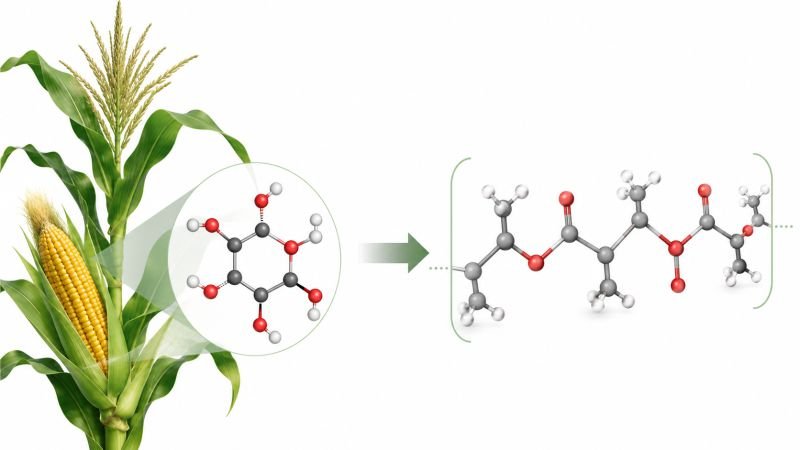
Corn starch, sugarcane, cassava root, and agricultural residues all serve as feedstocks. Each contains glucose and other simple sugars that biological systems can metabolize. A bioplastic built from these materials is not carbon-free, and growing, harvesting, and converting the crop requires energy at every stage. What changes is the carbon accounting: the CO2 released when the plastic eventually degrades was recently atmospheric, not sequestered.
The bioplastics family is not a single chemistry. Polylactic acid (PLA), polyhydroxyalkanoates (PHA), thermoplastic starch (TPS), bio-based polyethylene terephthalate (bio-PET), and polybutylene succinate (PBS) are distinct polymers with different synthesis routes, different physical properties, and different degradation behaviors. Treating them as one category is a persistent source of confusion in public discussion of bioplastics, particularly around the word “biodegradable.”
How Bioplastics Form – Fermentation and the Polymer Chain
PLA synthesis happens in two chemically distinct stages. The first is biological and runs inside a fermentation tank. The second is industrial and runs inside a polymerization reactor. Understanding both is what separates an accurate picture of bioplastics from the one printed on most product labels.
From Glucose to Lactic Acid
Lactobacillus bacteria are obligate fermenters. Without oxygen, they cannot complete aerobic respiration, so they convert glucose to lactic acid to regenerate the NAD+ they need to keep metabolism running. The reaction is:
C₆H₁₂O₆ → 2 C₃H₆O₃
Glucose (molecular weight 180 g/mol) yields two molecules of lactic acid (molecular weight 90 g/mol each). Theoretical mass yield is 100%: one gram of glucose gives one gram of lactic acid. In industrial conditions, real yields reach 90 to 95% of theoretical, with the remainder consumed by cell growth and maintenance. At the Blair facility, one tonne of glucose feedstock produces roughly 920 to 950 kilograms of lactic acid. At 150,000 tonnes annual output, this is not a boutique chemistry operation. The fermentation infrastructure required is comparable in scale to conventional dairy processing.
From Lactic Acid to PLA
Lactic acid molecules link together through condensation polymerization, releasing water as each bond forms. The industrial route takes one additional step: lactic acid is first condensed into lactide, a cyclic dimer, and the ring is then opened in the presence of a tin or zinc catalyst to produce polymer chains with tighter molecular weight control than direct polycondensation allows.
The physical properties of the resulting PLA depend almost entirely on how long those chains are. Chain length is quantified through the degree of polymerization (DP):
Mn = DP × M₀
Mn is the number-average molecular weight in grams per mole, DP is the number of repeat units per chain, and M₀ is the molar mass of one repeat unit. For PLA, M₀ is 72 g/mol.
Packaging-grade PLA targets Mn values between 80,000 and 180,000 g/mol. At Mn = 100,000 g/mol:
DP = 100,000 / 72 = 1,389 repeat units
Below DP 500, PLA is brittle and has negligible structural use. At DP around 1,000 to 2,500, it carries the toughness needed for food containers, fiber, and film. Above DP 3,000, it achieves strength adequate for load-bearing applications. That number, 1,389 repeat units per chain, is the difference between a container that holds a salad at 4°C and a powder that crumbles on contact.
Everything here is free. Readers are the reason it stays that way.
I make all of it alone, with no ads. If it is worth a coffee a month to you, that keeps the next one coming.
Keep it alive →PHA Bioplastics and the Bacterial Factory Route
Not all bioplastic synthesis routes require extracting sugar and running industrial polymerization afterward. A class of polymers called polyhydroxyalkanoates (PHA) are produced directly inside bacterial cells, skipping the separate chemical processing stage entirely.
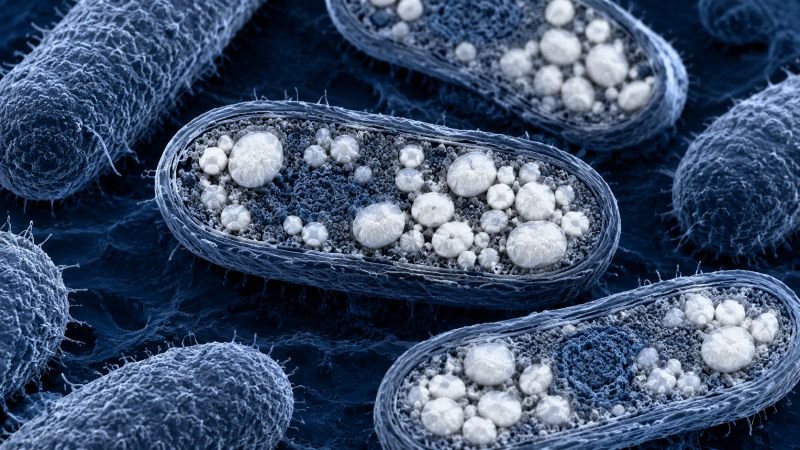
Bacteria such as Cupriavidus necator accumulate PHA granules as an intracellular energy storage mechanism, in the same biological logic that drives fat accumulation in animals. Feed the bacteria a carbon source, restrict their nitrogen supply, and they divert metabolic energy into polymer synthesis. PHA granules build up inside the cells at concentrations reaching 80% of dry cell weight. The polymer is then extracted by disrupting the cells and separating the granules from the cellular debris.
What makes PHA genuinely distinct from PLA is the degradation profile. PLA requires industrial composting conditions to break down on any reasonable timescale. PHA degrades in soil, in marine environments, and in home compost heaps, because the same bacterial enzymes that produce it during cellular metabolism exist throughout natural ecosystems. A PHA-based fishing line lost at sea will break down. A PLA line will not.
The tradeoff is cost. Bacterial fermentation at the purity level required for commercial PHA production currently costs roughly three to five times more per tonne than conventional polypropylene. The feedstock is more expensive, the fermentation is slower, and the extraction step consumes significant energy. Several pilot-scale PHA facilities have operated since the early 2000s. Industrial scale remains constrained by economics rather than by any gap in the chemistry.
The Physical Properties That Determine What Bioplastics Can Replace
Can bioplastics substitute for conventional polymers? The answer depends entirely on the specific polymer and the specific application. The performance differences between bioplastic types are measurable and material-specific, not general.
| Bioplastic | Primary Feedstock | Degradation Conditions | Heat Limit (Tg) | Main Constraint |
|---|---|---|---|---|
| PLA | Corn starch, sugarcane | Industrial compost only | 57-60°C | Fails in hot-fill and automotive |
| PHA | Sugars and oils (bacterial) | Soil, marine, home compost | 5-10°C (PHBV variant) | High production cost |
| TPS | Potato and corn starch | Home compost and soil | 60-90°C (plasticizer-dependent) | Absorbs moisture, weakens rapidly |
| Bio-PET | Sugarcane (30% bio-content) | Not biodegradable | 75-80°C (amorphous) | Only partially bio-based |
| PBS | Bio-succinic acid | Industrial compost | -30°C (flexible at room temperature) | Low stiffness for structural use |
The glass transition temperature (Tg) of a polymer defines the boundary between rigid and softened behavior. Below Tg, the polymer behaves as a structural solid. Above it, molecular chains gain mobility and the material loses mechanical integrity. PLA’s Tg sits at 57 to 60°C. Fill a PLA cup with coffee at 85°C and it deforms within seconds. A conventional polypropylene cup withstands 100°C without change.
For cold-chain food packaging, PLA performs adequately and the cost premium over conventional plastic is commercially defensible. For hot-fill applications, it does not work without modification.
The Biodegradation Reality in Bioplastics
“Biodegradable” on packaging contains accurate information delivered in a misleading frame. PLA does biodegrade. The conditions required are specific enough that most disposal scenarios common in developed countries are not among them.
Industrial composting facilities maintain sustained temperatures between 55 and 65°C, active microbial communities, and controlled humidity over 12-week processing cycles. Under those conditions, amorphous PLA degrades in 3 to 6 months. Crystalline PLA takes 12 to 24 months. Neither figure represents a problem for a properly managed composting operation that accepts certified compostable packaging.
What happens chemically? PLA degrades through hydrolysis: water molecules penetrate the polymer matrix and break the ester bonds between lactic acid repeat units. The rate of hydrolysis depends on temperature, water activity, and crystallinity. At ambient temperature and moderate humidity, the reaction proceeds so slowly that a PLA container remains structurally intact for years. Home compost heaps rarely sustain 58°C. Most municipal waste streams have no industrial compost infrastructure at all.
Does PLA biodegrade in the ocean if it escapes the waste stream? Seawater averages 15 to 17°C globally, well below the threshold for meaningful hydrolysis. A PLA container entering the ocean persists for years alongside its petroleum-based counterparts. PLA does not generate the persistent microplastic fraction that photodegraded polyolefins produce, but it does not solve the ocean plastic problem either.
The bioplastics that degrade reliably outside of industrial facilities are PHA and thermoplastic starch. TPS absorbs moisture, which weakens it mechanically but also enables genuine soil degradation because the starch matrix is enzymatically accessible to common soil microbes. PHA’s degradation is driven by the same bacterial enzymes that synthesized it in the first place, and those enzymes are present in virtually every biologically active environment on earth.
What Stops Bioplastics From Replacing Conventional Plastic at Scale
The chemistry of bioplastics is not the bottleneck. Three specific engineering and systems gaps explain the gap between the chemistry and the market.
Heat resistance is the most immediate material constraint. Stereocomplexed PLA, where left-handed and right-handed PLA chains are mixed to create a denser crystal structure, raises the melting point from 175°C to around 220°C and the effective use temperature to above 100°C. The improvement is real and well-documented at lab scale. The production process adds complexity and cost that have not been eliminated at commercial scale, and the market for premium-priced heat-resistant bioplastic has developed slowly.
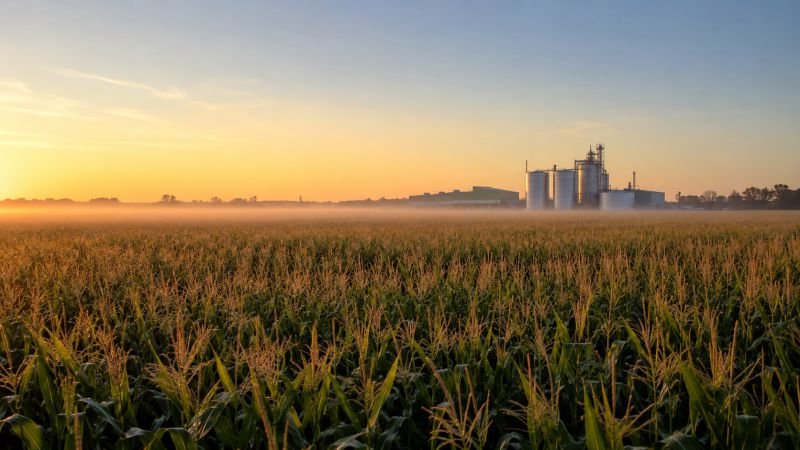
Land use becomes the constraint that scale creates. Growing enough corn or sugarcane to supply a meaningful fraction of global plastic production requires agricultural land. Global plastic production totaled 400 million tonnes in 2023 against 2.2 million tonnes of bioplastics. Closing even a quarter of that gap through current crop-based fermentation routes would require roughly 16 million hectares of dedicated crops, an area approximately equal to Uruguay. Second-generation feedstocks based on agricultural residues, forestry waste, and non-food crops address this partially, but industrial conversion routes for lignocellulosic biomass remain more expensive and less efficient than starch-based routes.
Contamination in recycling streams is the third gap. PLA has a melt temperature of 175°C and conventional PET has a melt temperature of 265°C. A single PLA container entering a PET recycling batch contaminates the entire melt, degrading the mechanical properties of the recycled PET. Until optical sorting infrastructure can reliably separate bioplastics from conventional polymers at the materials recovery facility level, mixing the two streams creates a problem that undermines both material recoveries.
Technologies Bioplastics Are Pointing Toward
Several categories of future devices depend on bioplastics chemistry reaching commercial maturity. The capacity to engineer specific degradation timescales, tune mechanical properties through polymer architecture, and substitute bio-based carbon for fossil carbon in structural materials are capabilities with clear applications.
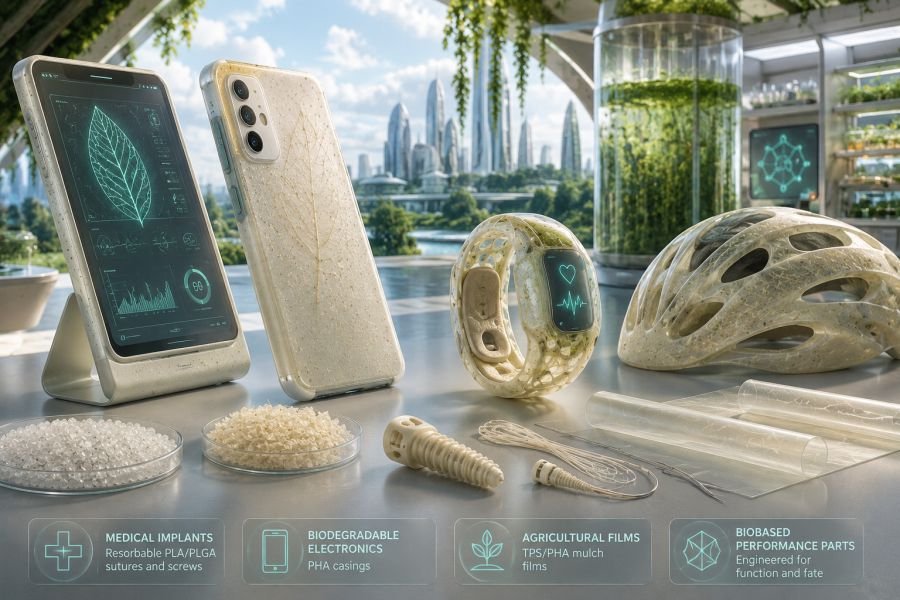
Biomedical resorbable implants represent the most mature branch. PLA and PLGA (polylactic-co-glycolic acid) sutures, bone screws, and drug-delivery matrices are standard surgical materials today. The same ester bond chemistry that degrades a PLA food container through hydrolysis degrades a bone screw over a controlled 3 to 6 month period as the surrounding tissue heals. In this application, the degradation behavior that makes PLA problematic as packaging becomes the reason for its use.
Fully bio-based electronics casings represent a more speculative direction: a smartphone housing that degrades within a defined timeframe after its useful life, without leaving toxic residue. PHA’s combination of mechanical stiffness and genuine biodegradability makes it the candidate material. The economics of the enclosure remain unfavorable, but the polymer architecture already exists.
Agricultural mulch films made from TPS and PHA blends address a specific problem: conventional polyethylene mulch film is used on hundreds of millions of hectares annually and must be collected and disposed of after harvest, at significant labor and contamination cost. Biodegradable film that can be plowed into the soil eliminates the collection step entirely. Commercial products in this category are already in use across parts of Europe and Asia, making agricultural film the furthest-advanced application of bioplastics at meaningful scale outside of food packaging.
The View From NoSuchDevice
I find bioplastics genuinely interesting and consistently misrepresented, which is an unusual combination for a materials category that has been commercially available for over twenty years.
The chemistry is real. The degradation mechanisms are understood at the molecular level. PHA’s ability to break down in marine environments is not a marketing claim; it is enzyme kinetics operating exactly as the biology predicts. The problems are not in the chemistry. They are in the infrastructure, the economics, and the specific honesty required when talking to consumers about what “biodegradable” actually means in practice.
My honest reading is that bioplastics in their current form are not a general replacement for conventional plastics. They are a materials toolkit with specific slots where their properties justify the cost premium: medical devices that must dissolve in tissue, packaging supported by certified industrial composting infrastructure, and agricultural applications where the degradation behavior eliminates a real collection and disposal cost. Outside those slots, the value case is weaker than the labeling suggests.
The constraint worth watching is not PLA’s heat resistance or PHA’s production cost, both of which are engineering problems with known solutions. The constraint is feedstock. A future in which bioplastics replace a substantial fraction of global plastic production requires either a dramatic expansion of non-food agricultural land, a viable industrial route from lignocellulosic biomass, or a carbon capture pathway that does not depend on photosynthesis at all. The polymer is ready. The system around it is not.
Technologies Related to This Concept
| Technology | Concept |
|---|---|
| Bio-Programmable Polymers | Concept: Materials that biodegrade at programmed times or conditions, controlled at the molecular level. |
| Biodegradable Packaging from Food Waste | Concept: Packaging materials made from processed food waste that decompose naturally after use. |
| Bioengineered Plastic-Eating Organisms | Concept: Genetically modified organisms that consume plastic waste and excrete useful compounds. |
| Compostable Smart Textiles | Concept: Wearable fabrics that biodegrade naturally after their usable life. |
| Marine-Biodegradable Packaging Films | Concept: Packaging films designed to break down safely in marine environments. |
You read the whole thing.
That is rarer than it should be, and it is the exact kind of attention I built this archive for. I make every piece alone, with no ads and no investor deciding what gets written. If you want the next machine taken apart like this one, you can help me make it.
A coffee a month is enough to keep it free for everyone.
Prefer crypto or a one time gift? Other ways to give →