






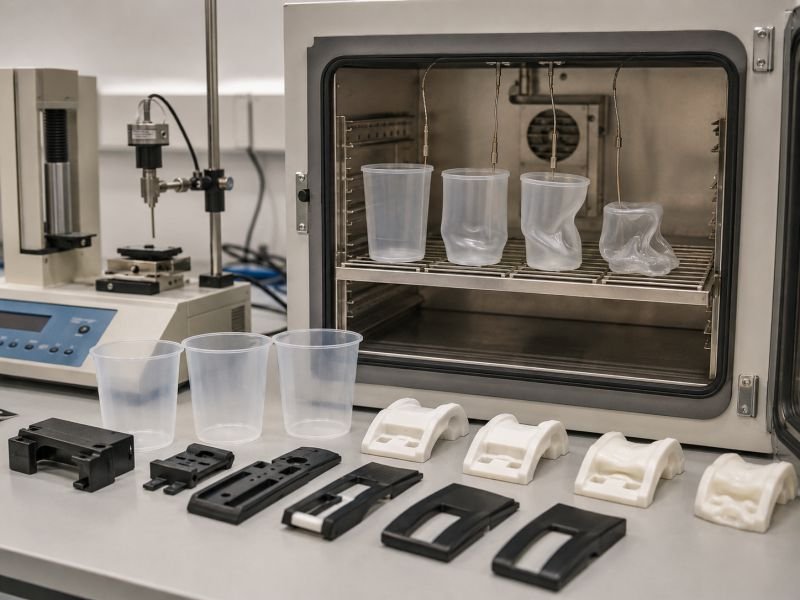
What Is Glass transition temperature?
Glass transition temperature, abbreviated Tg, is the temperature range where an amorphous polymer changes from a hard, glassy state to a softer, more mobile state. It is not a true melting point, but a mobility threshold tied to segmental chain motion. A simple operating relation is T_use < Tg for rigid behavior, while T_use > Tg leads to softening and reduced dimensional stability.
In real products, Tg controls whether a polymer stays stiff in storage, transport, and service or begins to deform under modest heat. Plasticizers, chain flexibility, crystallinity, and moisture content can all shift the transition. Used in devices include food containers, medical trays, electronics housings, flexible films, and automotive interior parts where heat exposure changes performance. The threshold is especially important in temperature-limited bioplastic design where a material may work well in cold service yet distort quickly in hot-fill or sun-heated conditions.
The concept matters because many polymer failures are not caused by chemical breakdown at all. They happen when a material simply crosses the mobility range where its chains can move enough to lose stiffness, shape retention, or impact resistance.
Engineers usually measure Tg by differential scanning calorimetry or dynamic mechanical analysis, then compare the result with the highest realistic service temperature rather than relying only on room-temperature feel.
Example:
A PLA cup that holds chilled food can warp within seconds when filled with a liquid well above its glass transition range.
Related Terms:
NoSuchDevice is a free archive of machines that do not exist yet but already have a shadow in physics. I research and write every entry alone, with no ads. Take a look around the archive, or help keep it free.