




What Is MHETase?
MHETase is an enzyme that hydrolyzes mono(2-hydroxyethyl) terephthalate, or MHET, into terephthalic acid and ethylene glycol during biological PET deconstruction. It functions downstream of PETase, completing a second bond-cleavage step that moves the process from intermediates toward reusable monomers. Like many enzymes, its rate can be described by v = Vmax[S] / (Km + [S]) under simplified reaction conditions.
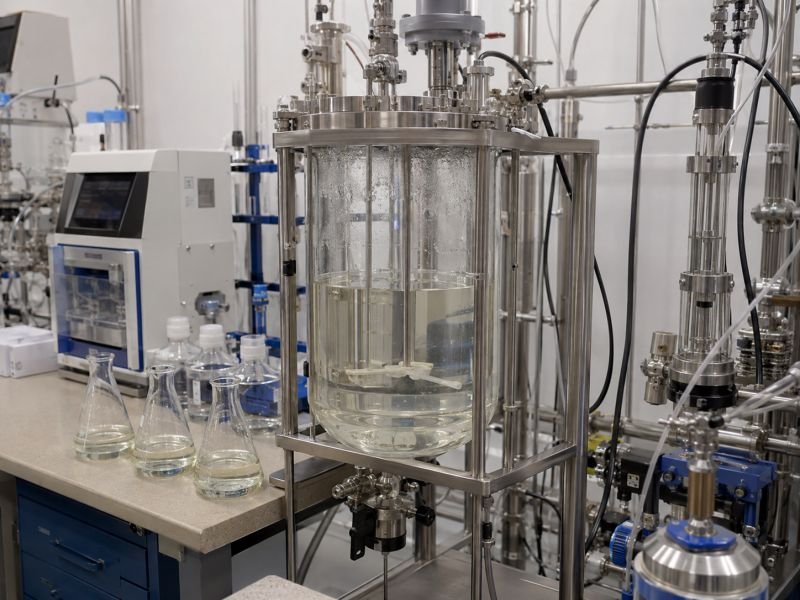
In real systems, MHETase activity depends on substrate availability, enzyme expression level, pH, reactor temperature, and whether upstream PET hydrolysis is producing intermediates fast enough to keep the pathway supplied. Used in devices include enzyme cascade reactors, microbial PET depolymerization vessels, metabolite sampling systems, and purification trains designed to recover monomers from aqueous streams. It becomes especially important in closed-loop PET bioprocessing systems where incomplete conversion would leave valuable carbon trapped in partially degraded products.
The enzyme matters because it improves product purity and pathway completeness. Without an effective second-stage catalyst, PET breakdown can stall at intermediates that still require additional treatment, reducing the advantage of a biological recycling route.
Engineers therefore tune PETase and MHETase together, since the useful output of the full process depends on balanced flux through both steps rather than maximum activity from either enzyme alone.
Example:
An enzyme mixture acting on PET hydrolysate can convert dissolved MHET into terephthalic acid and ethylene glycol for downstream separation.
Related Terms:
NoSuchDevice is a free archive of machines that do not exist yet but already have a shadow in physics. I research and write every entry alone, with no ads. Take a look around the archive, or help keep it free.