





What Is Terephthalic Acid?
Terephthalic acid is an aromatic dicarboxylic acid used as a primary monomer for producing polyethylene terephthalate, or PET, and related polyesters. Its two carboxyl groups allow it to react with diols to form long repeating chains through esterification. In PET recovery calculations, a useful relation is m_TPA = (166 / 192) x m_PET, estimating the theoretical mass of terephthalic acid released from depolymerized PET.
In real systems, terephthalic acid appears as a solid chemical feedstock whose purity affects repolymerization quality, catalyst behavior, and downstream separation cost. Used in devices include polyester resin plants, monomer purification columns, PET depolymerization reactors, and crystallization systems that recover aromatic solids from aqueous mixtures. It is also a key output in enzyme-based polyester recovery, where biological or chemical hydrolysis routes aim to return the original building block rather than a mixed fuel product.
The compound matters because recovering a monomer is more useful than merely destroying a polymer. High-purity terephthalic acid can re-enter manufacturing chains, supporting material circularity without abandoning the physical properties that made PET valuable in the first place.
Process design therefore focuses on contamination control, filtration, and separation conditions, since dyes, additives, and residual intermediates can lower recovery value even when the hydrolysis step itself is effective.
Example:
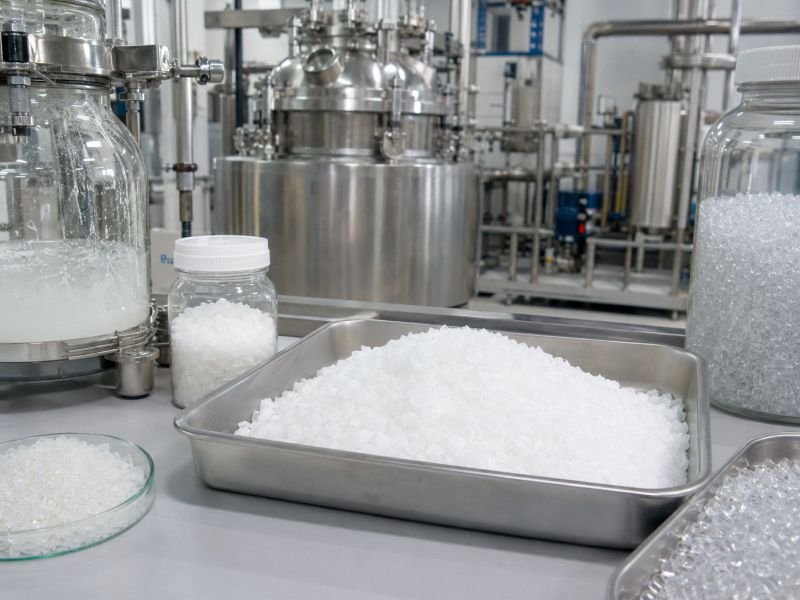
After PET depolymerization, cooled process liquor can yield terephthalic acid crystals that are washed and dried for reuse.
Related Terms:
NoSuchDevice is a free archive of machines that do not exist yet but already have a shadow in physics. I research and write every entry alone, with no ads. Take a look around the archive, or help keep it free.