



What Is Photolysis?
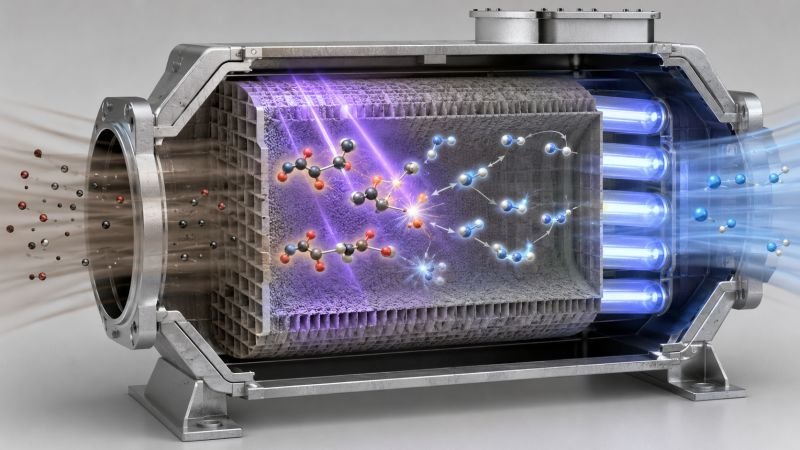
Photolysis is the breaking or rearrangement of chemical bonds after a molecule absorbs a photon with enough energy to reach an excited state. The basic energy relation is E = hc / lambda, so shorter wavelengths carry more energy and can drive stronger bond-cleavage pathways. In atmospheric and surface chemistry, photolysis often initiates reaction chains that convert stable molecules into radicals, ions, or other reactive intermediates.
In real systems, its rate depends on light intensity, wavelength distribution, absorption cross-section, and how long reactants remain illuminated. It is widely applied in photocatalytic pollution control where light activates chemical breakdown pathways on engineered surfaces or in reactive air volumes. Used in devices include UV reactors, photocatalytic facade panels, water sterilization units, and atmospheric simulation chambers built to track light-driven chemistry.
The concept matters because light can trigger transformations without requiring high thermal input, making photolysis central to atmospheric modeling, environmental remediation, and analytical chemistry. It helps explain ozone formation, pollutant decay, radical generation, and the performance limits of catalysts that rely on sunlight or artificial illumination. Designers therefore treat spectral access and residence time as core parts of any photolytic system rather than secondary details.
Example:
Sunlit nitrogen dioxide in urban air can photolyze and begin a reaction sequence that contributes to ground-level ozone formation.
Related Terms:
NoSuchDevice is a free archive of machines that do not exist yet but already have a shadow in physics. I research and write every entry alone, with no ads. Take a look around the archive, or help keep it free.