







The air above a busy urban intersection on a weekday morning contains roughly 80 micrograms of nitrogen dioxide per cubic meter. That number is invisible, odorless at that concentration, and about 60% above the threshold the World Health Organization considers safe for prolonged exposure. The exhaust that produced it has already dispersed into the wider atmosphere. The chemistry it left behind has not.
The short version: An atmospheric pollution dissolver is a concept device that applies photolytic chemistry to break pollutant molecules – primarily NOx and volatile organic compounds – into harmless compounds before they accumulate. A photocatalytic surface, energized by UV or near-visible light, generates reactive oxygen species that oxidize pollutants at the molecular level and leave behind inert byproducts. A building-integrated version with 2,000 m² of active surface running in average urban sunlight could neutralize roughly 240 grams of NOx equivalent per day. What follows here is the machine designed to close the gap the natural system cannot.
Key Takeaways
- Photolysis can break chemical bonds in pollution molecules – the atmospheric version of this already happens naturally, but far too slowly for urban concentrations
- The concept device uses a photocatalytic surface energized by UV or near-visible light to produce reactive radicals that oxidize pollutants into inert compounds
- Physical form is the core engineering challenge: how air reaches the catalytic surface determines whether the device performs or merely decorates
- A single building-scale unit contributes modestly; the case for this device rests entirely on network-scale deployment across a city
- The comparison with trees, filters, and plasma reveals a device occupying a gap that none of them address well
Table of Contents
The Atmosphere Already Has a Cleaning System – It Just Cannot Keep Up With Cities
Something often skipped in discussions about air pollution is how much the atmosphere already does to clean itself. Hydroxyl radicals – formed when UV radiation interacts with water vapor at altitude – attack NOx and volatile organic compounds, gradually oxidizing them into less reactive compounds. Ozone cycles contribute. Photolysis happens continuously in the upper atmosphere without any human engineering involved.
The rate is where it breaks down for cities. Natural atmospheric chemistry operates on timescales of hours to days and performs adequately when pollutant inputs are modest and spread across large areas. A city center is a different situation. NOx concentrations near busy arterial roads routinely exceed 100 micrograms per cubic meter, sometimes reaching 200 or higher during peak hours. The natural system is processing the load – just not quickly enough to prevent accumulation at the scale and location where people actually live and breathe.

The atmospheric pollution dissolver is designed to amplify the same chemistry the atmosphere already uses, but at the specific locations where the natural system is overwhelmed. The mechanism is not invented from scratch. It is borrowed from the sky and re-applied at street level with engineering precision.
How Light Breaks What Exhaust Built
Photolysis is the disruption of a chemical bond by a photon. A molecule absorbs light of sufficient energy and one of its internal bonds breaks. The energy source is the photon. The result is molecular fragmentation or rearrangement into something less harmful, or more reactive in ways that lead to something less harmful. The concept device puts this to work on demand, at a surface engineered specifically for the purpose.
TiO2 and the Chemistry of Reactive Radicals
Titanium dioxide (TiO2) is a photocatalyst – a material that accelerates chemical reactions under light without being consumed in the process. Under UV illumination, TiO2 generates electron-hole pairs at its surface. Those pairs react with water vapor and oxygen in the passing air to produce hydroxyl radicals (OH-) and superoxide ions (O2-). Both are among the most reactive oxidizing agents in chemistry. A hydroxyl radical does not negotiate with a pollutant molecule – it strips electrons and dismantles the structure.
NOx is oxidized to nitrate, which deposits on the device surface or washes away in rain. SO2 becomes sulfate. Volatile organic compounds – benzene, toluene, formaldehyde – break down into CO2 and water. What enters the device as pollution exits as compounds either already present in the atmosphere at harmless concentrations, or as surface deposits manageable through a maintenance cycle. No residual waste stream. No collection tank.
The Light Spectrum Problem That Defines the Device
Standard TiO2 responds to UV wavelengths below roughly 385 nanometers – a fraction that accounts for about 5% of natural sunlight reaching the surface. Modified variants, doped with nitrogen, carbon, or built as composite nanostructures, shift the activation threshold into the visible range and raise the usable fraction of solar energy to 40-50%. The atmospheric pollution dissolver described here assumes a catalytic surface operating in this broader activation window. Lab results already support this shift. Consistent, scalable production at architectural dimensions has not yet delivered it – which is precisely what makes this a concept device worth examining rather than a product worth buying.
How an Atmospheric Pollution Dissolver Could Actually Work
At the molecular level, the chemistry is clear enough. What needs to be specified is the physical architecture – how the machine is shaped, how air moves through it, how photons reach the catalytic surface, and how that surface is maintained across years of continuous operation.
The Geometry That Determines Whether the Device Is Useful
A flat photocatalytic panel facing a street captures some passing polluted air through turbulence and diffusion. The contact time is short, the surface-to-volume ratio is poor, and the fraction of passing air that actually reaches the reactive surface is small. A device built on that geometry is a coating, not a machine.
The atmospheric pollution dissolver folds its reactive surface into a three-dimensional structure: parallel channels, honeycombed geometry, accordion-folded sheets of catalytic material. The goal is to maximize the area of photocatalytic surface that any given cubic meter of polluted air contacts as it passes through. Air enters either passively – driven by wind pressure and thermal convection – or actively, drawn through by low-energy fans embedded in the intake. Inside, air moves through the folded catalytic matrix at low velocity. Slow enough for the photolytic reaction to complete during transit. Fast enough that throughput justifies the device’s footprint.
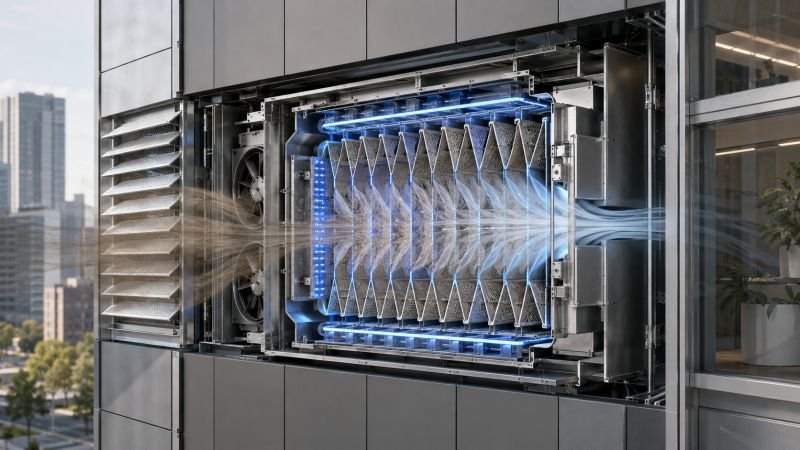
Light reaches the catalytic surface through a distribution system built into the matrix structure. UV or near-UV LEDs are embedded throughout the folded channels, or concentrated sunlight is channeled via optical waveguides from a collector on the building exterior. The catalytic surface is illuminated from within, not from outside.
Neutralize on Contact or Capture the Breakdown Products
Two design philosophies exist for the atmospheric pollution dissolver. The first neutralizes pollutants on contact: air passes through the catalytic matrix, radicals break the pollutant molecules down, clean air exits. No collection tank, no waste stream requiring disposal. Nitrate and sulfate deposits that form on the catalytic surface wash away with rain or are flushed periodically. Open neutralization suits outdoor and facade-integrated deployments.
The capture model contains the breakdown products internally for controlled disposal. Complexity and maintenance requirements increase substantially, but the device can operate in enclosed environments where even the harmless breakdown products need to be managed before the air re-enters a ventilated space. Road tunnels are the obvious case. A complete infrastructure ecosystem of atmospheric pollution dissolvers probably needs both variants – the choice of model is a deployment context decision, not a chemistry one.
Where Photolytic Pollution Dissolvers Could Be Deployed
The concept scales across environments in ways that are not immediately obvious from the core mechanism alone. Building facades, road tunnels, industrial zone boundaries, mobile transport, and indoor commercial spaces each offer different constraints and different opportunities. The engineering problem is not the same in each context, and pretending otherwise produces devices that underperform in three out of five situations.
| Deployment Context | Active Surface Scale | Primary Pollutant Target | Primary Engineering Challenge |
|---|---|---|---|
| Building facade | 500-5,000 m² | NOx from street traffic | Surface-to-air-volume ratio |
| Road tunnel | Wall-integrated, variable | NOx, CO, particulates | Forced airflow required, no natural UV |
| Industrial zone boundary | Modular, site-specific | SO2, VOCs | High-concentration catalyst saturation |
| Mobile – ships and trains | Hull or stack-adjacent | SOx, NOx | Vibration, corrosion, weight limits |
| Indoor – commercial spaces | 50-500 m² per installation | VOCs, NO2 | Air recirculation and byproduct management |
The building facade context is where the concept first becomes architecturally plausible. A large commercial building in a high-traffic district has 2,000 to 10,000 m² of exterior surface. If that area is replaced with or overlaid by an active photolytic system, the building stops being a passive object in a polluted street and starts being part of the solution to the pollution surrounding it. Urban planning rarely offers clean solutions. A facade that processes the air adjacent to it is about as clean as the logic gets.
Road tunnels present a harder engineering problem but a more acute air quality one. Pollutant concentrations inside tunnels run several times higher than open-air urban averages. Existing ventilation systems already move large volumes of air – they exhaust the problem to the atmosphere above the portal. A photolytic system integrated into the ventilation architecture does not exhaust the problem. It processes it before the air moves anywhere.
The mobile deployment case – ships, container vessels, trains – targets point sources at the moment of emission, before pollutants disperse into the wider atmosphere. A photolytic system on the exhaust pathway of a container ship processes a highly concentrated stream, which is chemically more efficient than treating diluted ambient air. Vibration, salt corrosion, weight constraints, and spatial restrictions make this the most demanding engineering context of the five. The concentration advantage is real. It has to be earned through materials engineering that does not yet exist for this specific application.
Everything here is free. Readers are the reason it stays that way.
I make all of it alone, with no ads. If it is worth a coffee a month to you, that keeps the next one coming.
Keep it alive →The Arithmetic That Resets Expectations
A building-integrated atmospheric pollution dissolver with 2,000 m² of active catalytic surface, operating under average urban sunlight conditions, degrades pollutants according to:
M = S × R × F
Where M is the daily mass of pollutant decomposed (grams), S is the active surface area (m²), R is the photolytic decomposition rate for an enhanced photocatalytic surface in grams per m² per day, and F is the light availability factor – a dimensionless number between 0 and 1 that accounts for night hours, cloud cover, and seasonal angle of incidence.
At S = 2,000 m², R = 0.2 g/m²/day (a realistic figure for a visible-light-activated composite surface operating in partial UV conditions), and F = 0.6 (annual average for a mid-latitude European city):
M = 2,000 × 0.2 × 0.6 = 240 g/day
Two hundred and forty grams of NOx equivalent per building per day. A major European city produces roughly 50,000 kilograms of NOx from traffic and industry combined each day. Dividing those numbers: approximately 200,000 building-scale dissolvers to address the full daily load. Would a single building-integrated dissolver make a measurable difference to city air quality? No. That is not a pessimistic reading. That is arithmetic.
Two hundred thousand building-scale units is infrastructure – the kind that gets embedded into cities over 30 to 50 years, the way water treatment and electrical distribution did. The scale is sobering. It is also the kind of scale that urban infrastructure routinely reaches when the alternative costs more in public health than the installation costs in budget.

The evolutionary arc of the atmospheric pollution dissolver does not start at city scale. It starts with individual units demonstrating measurable, local effect – a tunnel, a road junction, a district with monitored air quality improvement. From that evidence, the device becomes what sewage treatment became: something a city cannot justify being without, once residents understand what the absence actually costs.
What Could Go Wrong – Byproducts, Degradation, and the Concentration Curve
When the Chemistry Produces the Wrong Compound
Photocatalytic oxidation of NOx does not always terminate cleanly at nitrate. At low light intensity, or when pollutant concentration is very high, the reaction can produce ozone as an intermediate rather than completing the full oxidation pathway. Ground-level ozone is itself a regulated pollutant and a contributor to photochemical smog. A device that converts one harmful compound into another has not solved the problem – it has renamed it.
Known in photocatalytic research for decades, the ozone pathway is not an unsolvable problem. Catalyst formulation, residence time design, and controlled operating conditions can suppress it significantly. The implication is that the simplest possible version of the atmospheric pollution dissolver – a TiO2 surface with a UV lamp aimed at it – is not the version that works cleanly in practice. The device needs to be specified, not just assembled from available materials.
High Concentration Changes the Math – and Degradation Changes the Device
At low pollutant concentrations, the reaction rate scales roughly with how often a pollutant molecule contacts the catalytic surface – higher concentration means higher throughput per unit area. At high concentrations, a different effect appears. The catalyst surface saturates. Additional pollutant molecules compete for the same reactive sites, and efficiency per unit mass of pollutant treated drops. Near industrial point sources, where concentrations can run an order of magnitude above typical urban air, the device needs a different operating envelope: slower air transit, higher surface area per treated volume, or a catalyst formulation with higher saturation tolerance.
Photocatalytic surfaces also degrade over time. Deposits accumulate, surface structure changes, and some fraction of the catalyst is gradually consumed by side reactions. A facade-integrated dissolver with no maintenance protocol slowly becomes an expensive architectural panel with no active function. Meaningful deployment requires periodic flushing, surface regeneration, or module replacement on a defined cycle. Low sunlight conditions – nights, overcast winters, north-facing facades – reduce daily output rather than causing failure, but over a year those reductions compound against the city-scale arithmetic established earlier.
Not a Filter, Not a Forest – Where the Photolytic Dissolver Actually Fits
Trees remove air pollutants. A mature urban tree sequesters a few kilograms of particulate matter per year and absorbs some NOx through its leaf stomata. Urban tree planting is valuable and its benefits extend well beyond air chemistry – cooling, biodiversity, mental health effects on urban populations. A city would need tens of millions of mature trees distributed precisely in traffic corridors to approach the NOx removal the atmospheric pollution dissolver targets. Urban tree planting and photolytic dissolvers are not competing for the same job. They address different scales, different mechanisms, and different timescales of the same broad problem.

Filtration systems – HEPA units, electrostatic precipitators, activated carbon modules – remove particulate matter from air with high efficiency. They do not break down gaseous pollutants. An oxidized NOx molecule leaves no waste filter to handle. A captured NOx molecule in a filter matrix is still there, concentrated in a material now requiring controlled disposal. For gaseous pollutants specifically, the photolytic approach is mechanistically cleaner. The two technologies solve different halves of the air quality problem and are most useful in combination rather than in competition.
Plasma-based air treatment passes polluted air through an ionized field to break molecular bonds – chemistry similar in result to photolysis. The energy cost per unit of air treated is substantially higher than a photocatalytic system using ambient or concentrated solar light, which pushes plasma treatment toward enclosed industrial applications with very high pollutant concentrations and dedicated power budgets. Open-air city-scale deployment on plasma power does not close economically.
The atmospheric pollution dissolver occupies a specific gap: gaseous pollutants, outdoor or semi-enclosed environments, low-power operation, and deployment at architectural scale. Comparing it to filters, trees, and plasma systems reveals a device doing something different from all three, in conditions none of them handle well. Whether that gap is large enough to justify the infrastructure investment is the honest question. The 200,000-unit arithmetic from the earlier section is the honest starting point for answering it.
The View From NoSuchDevice
I find this concept more honest than most atmospheric cleanup proposals, and considerably harder.
The photolytic mechanism is real. The chemistry is established. Seed technology already exists – TiO2 coatings that function in laboratories, photocatalytic paints with measurable NOx reduction in field tests, modified catalyst formulations that respond to visible light rather than UV alone. The gap between those proofs of concept and a working atmospheric pollution dissolver at architectural scale is primarily an engineering and materials problem, not a physics one. That distinction matters. It keeps the device inside the feasible zone, where engineering can eventually reach it, rather than in the zone where only optimism operates.
What I find less certain is not the chemistry. It is the deployment model. The arithmetic makes clear that individual devices contribute modestly. The concept only becomes meaningful as infrastructure – embedded into cities over decades, the way electrical grids or water treatment systems got embedded. City-scale infrastructure requires governance, investment cycles, maintenance contracts, and political patience measured in generations. Air quality has rarely attracted that kind of commitment, even when the cost of inaction is measured in premature deaths per year and not in abstract future risk.
The indoor variant is the most near-term application I can see functioning. A commercial building with an air quality problem has a defined incentive, a controlled environment, a building services budget, and a purchasable solution. I expect the first real atmospheric pollution dissolvers to appear inside office towers and transit hubs, not on city-wide facade networks. The indoor version solves a contained problem with a contained device. The business model is cleaner than the air.
The outdoor network is where the concept becomes genuinely important. A city that embeds photolytic dissolvers into building facades, tunnel ventilation, and transport corridors is a city actively managing its own atmospheric chemistry. I think that city is physically possible. I am less certain it arrives on the timetable that the health data actually requires.
You read the whole thing.
That is rarer than it should be, and it is the exact kind of attention I built this archive for. I make every piece alone, with no ads and no investor deciding what gets written. If you want the next machine taken apart like this one, you can help me make it.
A coffee a month is enough to keep it free for everyone.
Prefer crypto or a one time gift? Other ways to give →