





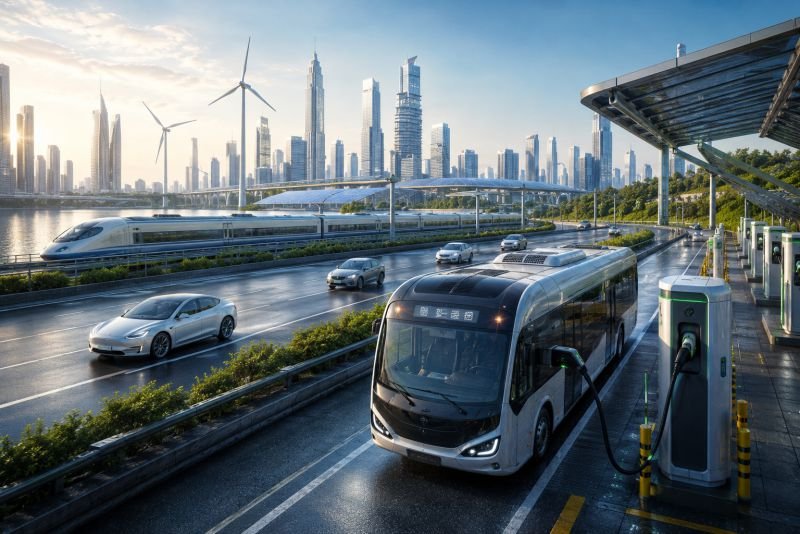
In 2018, the city of Shenzhen finished something no city had managed before. Its public bus fleet, all 16,359 vehicles, had completed a full transition to electric power. Every bus leaving the Longhua depot each morning did so without a combustion event. The fleet covered roughly 1.2 billion kilometres annually and had previously been one of the largest sources of particulate pollution in southern China.
The part worth pausing on is that the physics behind this was not new. Every principle involved had been understood for well over a century. Shenzhen did not wait for a scientific breakthrough. It deployed physics that already existed at a scale that made the economics work.
That gap between what physics permits and what gets built is where sustainable transportation lives.
The short version: Transportation currently accounts for roughly 23% of global energy use and generates around 16% of all CO2 emissions, almost entirely from burning fossil fuels in heat engines that convert 20 to 40% of their fuel into motion and discard the rest as heat. Sustainable transportation works by replacing inefficient energy conversion with more direct pathways, then powering those pathways from sources that do not emit carbon. The physics involved is well understood. The engineering is most of the way there. A few sectors remain genuinely unsolved.
Table of Contents
Why Sustainable Transportation Starts With Thermodynamics, Not Engineering
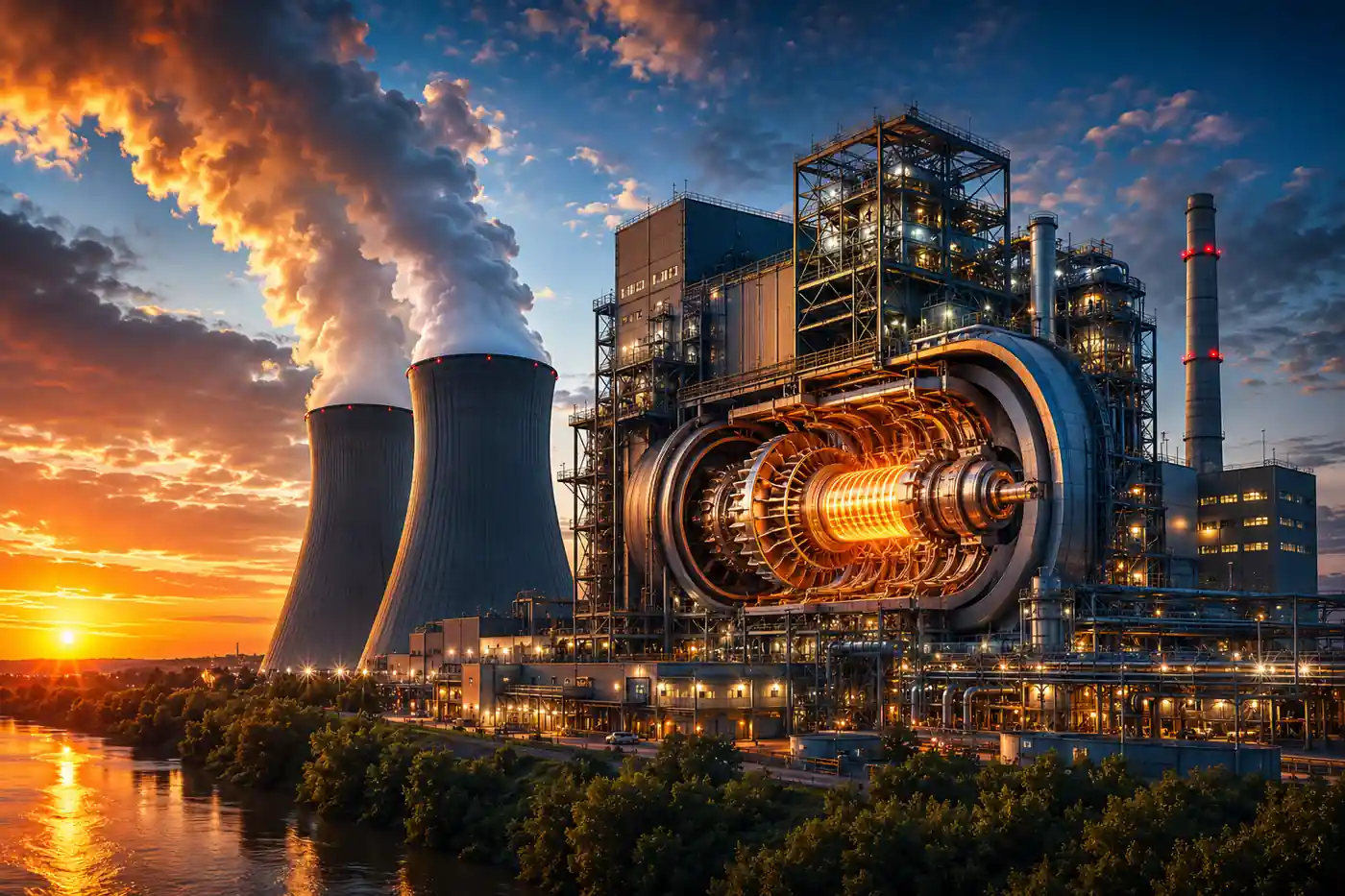
There is something people tend to overlook when talking about greener vehicles. The problem with combustion is not the carbon. The carbon is a consequence. The underlying problem is that burning fuel to produce motion is a remarkably roundabout way to accomplish the task, and physics placed a ceiling on how efficient it could ever be before the first petrol engine was built.
In the 1820s, the French physicist Sadi Carnot proved that no heat engine can convert all of a fuel’s thermal energy into work. Heat moves from hot to cold. Some of it always escapes. The fraction that can actually be captured as useful output depends on the temperature difference between combustion and exhaust, and nothing about building a better engine changes this.
The Carnot efficiency formula states this precisely:
η = 1 – (T_cold / T_hot)
Here η is the maximum possible efficiency expressed as a fraction, T_cold is the temperature of the exhaust in Kelvin, and T_hot is the peak temperature of the burning gases in Kelvin. A modern petrol engine reaches peak combustion temperatures around 2,200 K. Exhaust leaves at roughly 700 K. Substituting those numbers:
η = 1 – (700 / 2200) = 1 – 0.318 = 0.682
That theoretical ceiling of 68.2% is never reached. Real-world friction, incomplete combustion, and thermal losses through cylinder walls reduce actual petrol engine efficiency to 25 to 35%. Diesel engines do better, reaching 40 to 45% under optimal conditions, which is why heavy transport defaulted to diesel for over a century.
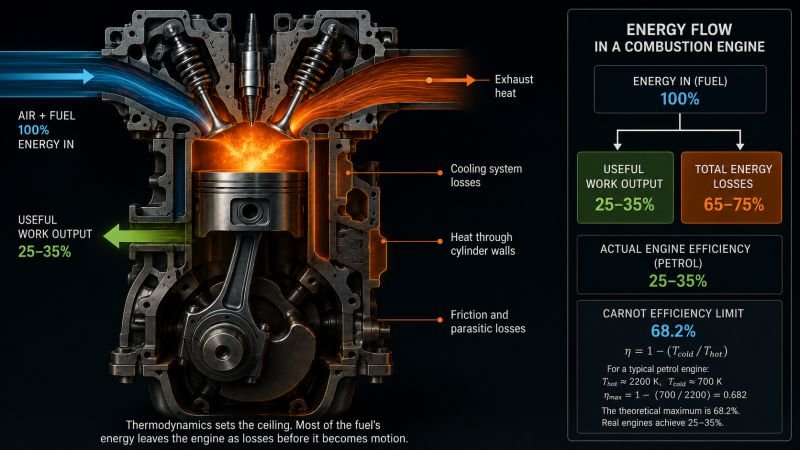
The verdict from physics is blunt. Before a single litre of fuel is burned, thermodynamics has already decided that most of its energy will leave as heat. No redesign of the cylinder head or fuel injector changes this. The only path around the Carnot limit is to stop using heat as the conversion step entirely.
That turns out to be the single most important idea in sustainable transportation.
How Motion Resistance Shapes Sustainable Transportation’s Energy Budget
Setting aside the power source entirely, every vehicle that moves through the world faces two forces that consume energy regardless of where that energy came from. Understanding these forces matters because they define the minimum cost of any trip, and they favor certain kinds of transport over others before the drivetrain question is even raised.
Rolling resistance scales with vehicle weight and the quality of road and tyre contact. It is manageable at low speeds and on well-maintained surfaces. On rough roads with heavy loads, it becomes significant, which is one reason freight trains on steel rails are orders of magnitude more efficient per tonne-kilometre than trucks on asphalt.
Aerodynamic drag is a more severe constraint. The force required to push through air scales with the square of velocity. The power required scales with the cube. This is not a small difference.
| Speed (km/h) | Aerodynamic Drag Force | Power Required |
|---|---|---|
| 60 | 1x (reference) | 1x (reference) |
| 90 | 2.25x | 3.4x |
| 120 | 4x | 8x |
| 150 | 6.25x | 15.6x |
At 120 km/h, a vehicle needs eight times the power to overcome aerodynamic drag that it needs at 60 km/h. Not twice. Eight times. This is one of the cleaner insights in sustainable transportation, and it is usually ignored entirely in conversations about vehicle efficiency. Speed is not a free variable. It is one of the most expensive choices a transport system makes.
The consequence for system design is worth stating plainly. A bus carrying 60 passengers at 80 km/h on a planned route is physically a very different problem from 60 individual cars travelling at 120 km/h. The difference in aerodynamic resistance per passenger, combined with weight-sharing and fewer powertrains, changes the energy arithmetic dramatically. Mass transit at moderate speeds starts with a smaller energy problem before the drivetrain question is even raised.
How much smaller? Studies on passenger-kilometre energy consumption consistently place urban bus transit at 0.2 to 0.5 MJ per passenger-kilometre. The average single-occupant car in Europe consumes closer to 2.5 MJ. The gap is not primarily about the car’s engine. It is about how the physics of motion resistance behaves per person when the people are consolidated.
The Energy Density Problem That Makes Sustainable Transportation Technically Difficult
Here is where the honest accounting gets uncomfortable.
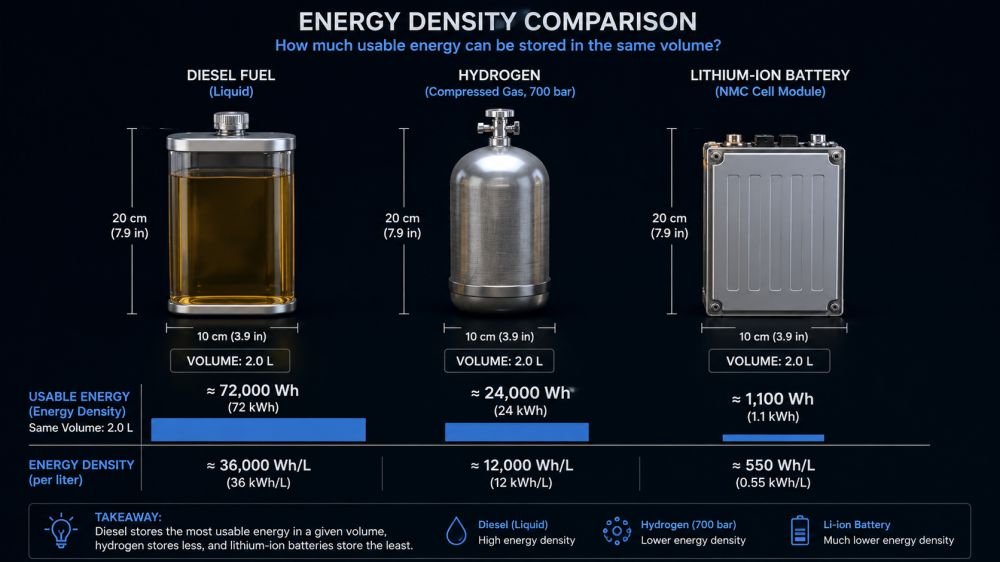
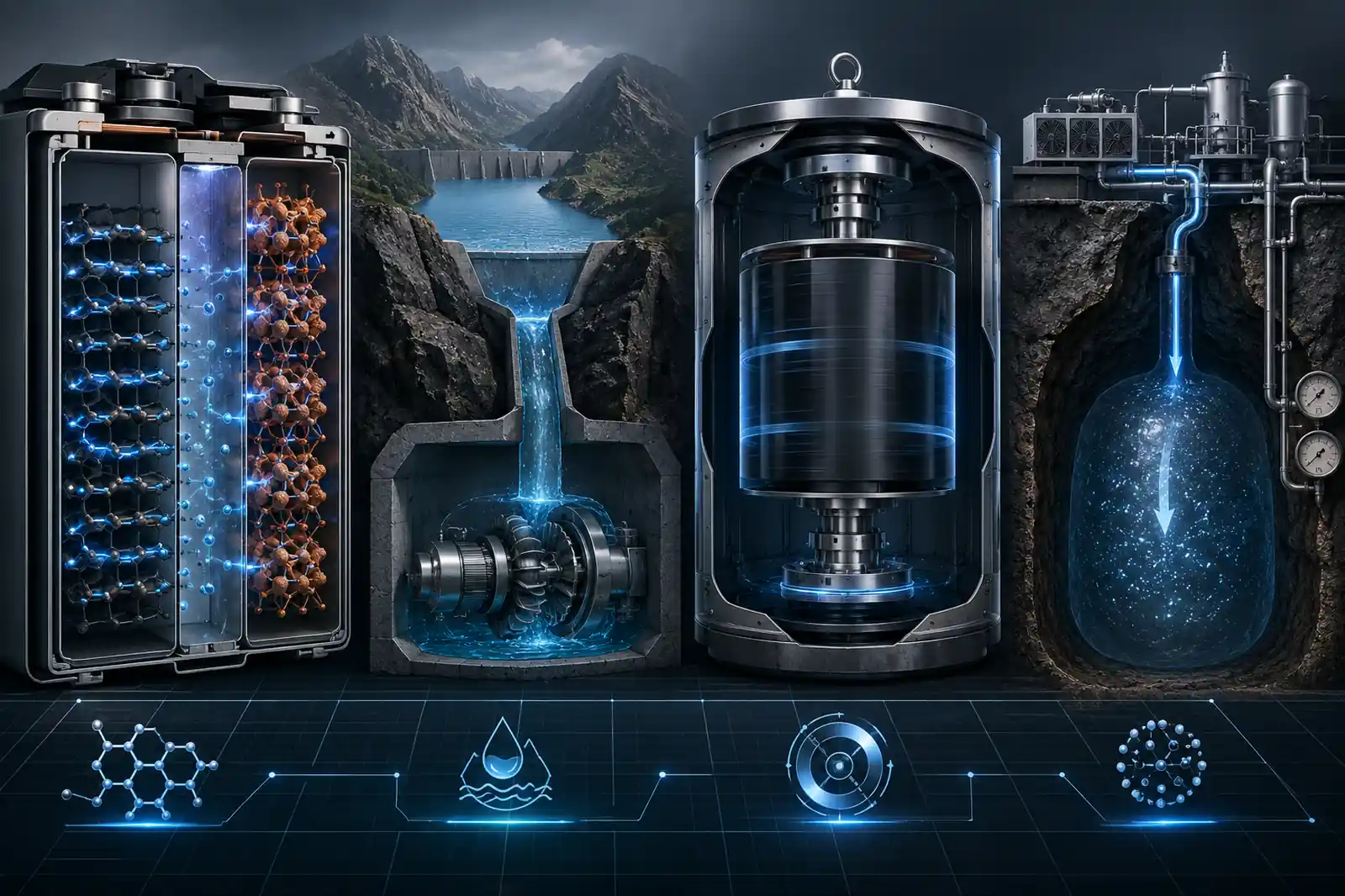
A litre of diesel holds approximately 35 megajoules of chemical energy. A lithium-ion battery pack of equal mass holds around 0.9 megajoules. The ratio is roughly 40 to 1. That gap did not emerge because the battery industry has been underperforming. It reflects a fundamental property of how chemical energy is stored. Liquid hydrocarbons are extraordinarily dense repositories of energy. Electrochemical batteries are not, and the electrode materials that carry the charge have mass that does not get discarded after use the way combustion products leave through the exhaust.
This is the central physical tension in sustainable transportation, and it does not have a clean solution.
What makes electrification viable despite the gap is the efficiency advantage on the other side of the equation. An electric motor converts 85 to 95% of its input energy into motion. A petrol engine converts 25 to 35%. The effective energy cost per kilometre is what matters, not the raw energy stored in the tank or pack.
Working through the numbers: a petrol car with a 50-litre tank carries approximately 1,750 megajoules of chemical energy. At 28% conversion efficiency, it delivers roughly 490 megajoules as useful motion. A 75 kWh battery pack holds about 270 megajoules and delivers approximately 240 megajoules as useful motion at 90% efficiency. The battery vehicle starts with eight times less stored energy and ends up delivering roughly half the effective range. That is the honest version of the energy density problem in sustainable transportation. For passenger cars and urban buses, it is manageable. For long-haul freight, deep-sea shipping, and long-range aviation, it is not yet solved.
Everything here is free. Readers are the reason it stays that way.
I make all of it alone, with no ads. If it is worth a coffee a month to you, that keeps the next one coming.
Keep it alive →How Electric Drivetrains Change the Physics of Sustainable Transportation
An electric motor is not simply a cleaner combustion engine. The two devices work on different physical principles, and those differences produce performance characteristics that combustion cannot replicate regardless of fuel source.
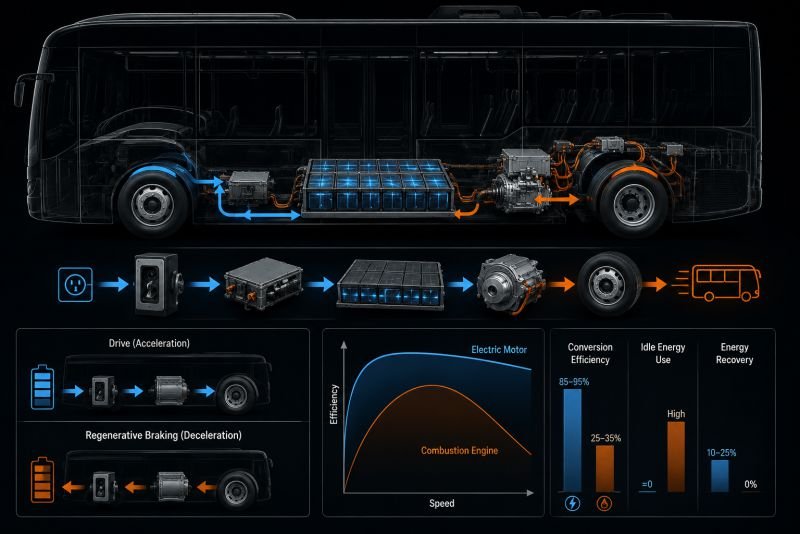
A combustion engine requires continuous burning to produce torque. At idle, it consumes fuel while producing no useful work. At low speeds and light loads, its efficiency falls significantly below the peak values measured on controlled test cycles. The engine must also operate within a narrow speed range to stay near its efficiency peak, which is why vehicles need multi-speed transmissions in the first place.
An electric motor produces maximum torque from zero rotational speed. It operates efficiently across a wide speed range without gear changes. At a red light, consumption drops to nearly zero.
What about the energy a vehicle throws away every time it slows down? In a conventional vehicle, that kinetic energy becomes heat in the brake pads. In an electric vehicle, the motor runs in reverse during deceleration, converting the vehicle’s momentum back into electrical current that recharges the battery. This is regenerative braking. In a city bus making 40 stops per hour, it recovers between 10 and 25% of the energy that would otherwise be lost to friction. Over a full operating day, the cumulative recovery is substantial.
These are not marginal improvements. They are structural differences in how energy moves through the system. They are also precisely why Shenzhen’s electric bus fleet became economically viable. Each bus costs more to purchase than its diesel counterpart. But lower energy costs and significantly reduced maintenance on a drivetrain with far fewer moving parts close the gap over the vehicle’s operating lifetime, often completely.
The real efficiency advantage of sustainable transportation built on electric drivetrains does not come from one source. It comes from the combination of high conversion efficiency, near-zero idle consumption, and systematic energy recovery at every stop.
The Life-Cycle Emissions Sustainable Transportation Cannot Ignore
Counting tailpipe emissions alone gives an incomplete picture, and the industry has been guilty of leaning on that incomplete picture more than it should.
Battery manufacturing is energy-intensive. A comparison of manufacturing emissions for a mid-sized battery electric vehicle versus a petrol equivalent typically finds the electric vehicle produces 30 to 70% more CO2 during production, primarily because of battery pack fabrication. Lithium, cobalt, nickel, and manganese mining carries environmental and social costs that are geographically concentrated in specific regions of the Democratic Republic of Congo, Chile, and Indonesia. This manufacturing deficit is real and should not be dismissed.
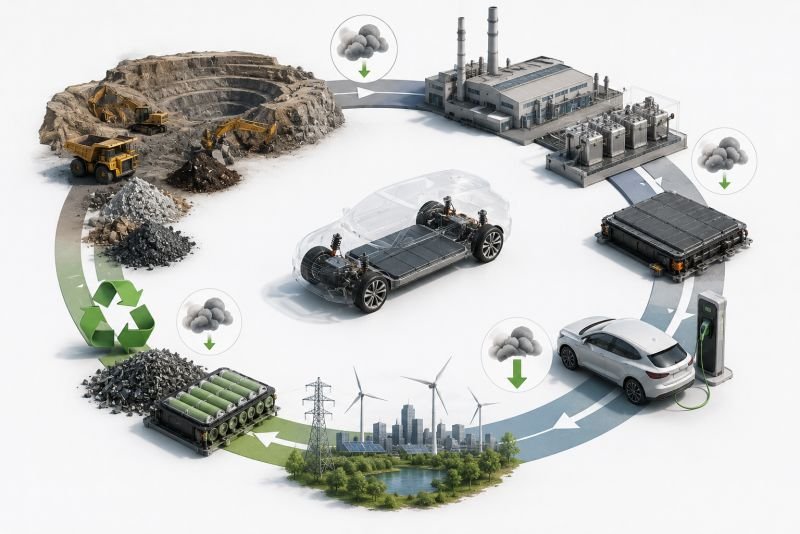
Over 150,000 to 200,000 kilometres of operation, however, the lower operational emissions of the electric vehicle recoup the manufacturing difference in most electricity grids. Research from the International Energy Agency places life-cycle emissions for battery electric vehicles in Europe at 50 to 70% below petrol equivalents under current grid conditions. In countries with high-carbon grids the advantage is smaller. In countries with high renewable penetration, it is larger.
The conclusion is not that sustainable transportation through electrification is clean in an absolute sense. It is that the drivetrain efficiency advantage is large enough that, across a realistic operating lifetime, the total emissions balance favors electrification under current grid conditions, and the advantage grows as grids decarbonise. The numbers move in the right direction without requiring any optimism about technology that does not yet exist.
Where Physics Sets the Hard Limits for Sustainable Transportation
Understanding sustainable transportation seriously requires being honest about where the physics does not cooperate.
Long-haul aviation is the clearest problem. Aircraft require extreme energy density in their fuel because the weight of the storage system directly subtracts from payload and range. A battery pack capable of matching the energy content of a full fuel load for a transatlantic flight would exceed the aircraft’s structural weight limit by a significant margin. Hydrogen offers higher energy density by mass than any current battery chemistry, but must be stored at cryogenic temperature or extreme pressure. The structural and safety engineering complications this introduces at commercial scale remain unsolved.
Ocean shipping faces a version of the same problem at larger scale. A large container ship crossing the Pacific burns fuel measured in thousands of tonnes. No currently available battery technology approaches the energy content required for that range without impossible weight penalties.
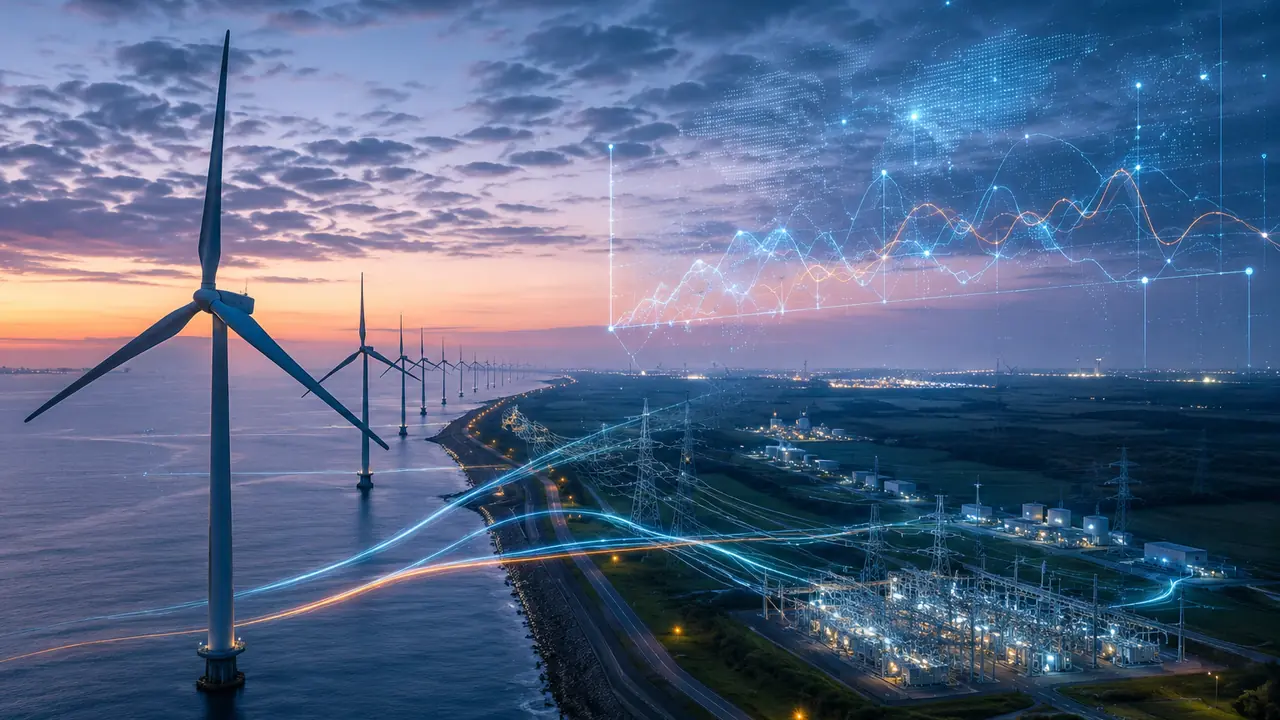
Rail and short-to-medium road transport are the easy cases. Trains on fixed routes draw power directly from overhead wires, removing the energy storage problem from the equation. Urban road transport has been proven at scale. Long-haul trucking sits between the solved and unsolved categories, with battery solutions becoming viable for routes under 400 kilometres and hydrogen fuel cell trucks being deployed in test fleets across Europe, Japan, and California.
Sustainable transportation at full scale will not be a single technology extended everywhere. It will be a layered system in which electrification covers the high-frequency, moderate-range movement that constitutes the majority of transport’s energy consumption, while hydrogen, synthetic fuels, or storage technologies that do not yet fully exist address the hard cases at the margins.
The hard cases are genuinely hard. Glossing over them makes the easier wins look less impressive than they are.
The View From NoSuchDevice
I find sustainable transportation interesting for a reason that has nothing to do with climate optimism or the green transition narrative. The physics here is genuinely strange. A combustion engine – the dominant technology in global mobility for 130 years – is, at its core, a device that uses controlled burning to produce expansion to push pistons to turn a crankshaft to rotate wheels. The inefficiency is not an accident. It is baked into the mechanism at the molecular level. Carnot told us this in 1824. Humanity spent the next 200 years building the entire infrastructure of modern civilization around a process that physics had already declared wasteful.
The electric drivetrain does not fix climate change by itself. It replaces a particularly convoluted mechanism for converting stored energy into rotation with a much more direct one. That the more direct mechanism happens to be compatible with carbon-free electricity is convenient. The efficiency advantage would exist regardless.
What I think is underappreciated is how much of the hard work is already done. Urban transport, rail, and most short-haul road freight can be electrified with existing technology and existing grid infrastructure. The genuinely interesting physics problems are in long-haul aviation, deep-sea shipping, and heavy freight. Those sectors are also, by total share of transport emissions, significantly smaller fractions of the overall problem. Solving the easy part first and buying time for the hard part to catch up is not a compromise. It is a reasonable engineering sequence.
Whether the deployment happens fast enough to matter is, at this point, not a physics question.
Technologies Related to This Concept
| Technology | Concept |
|---|---|
| Quantum Levitation Vehicles | Concept: Cars that use quantum levitation to hover above surfaces, eliminating friction and reducing energy consumption. |
| Hyperloop Maglev Trains | Concept: Combining hyperloop concepts with magnetic levitation for ultra-fast, zero-emission travel. |
| Nano-Structured Hydrogen Storage | Concept: Safe, efficient hydrogen storage at the nano level for fuel cell vehicles. |
| Bio-Synthetic Fuel Production | Concept: Creating fuels through bio-synthesis that are carbon-neutral. |
| Solar-Hydrogen Hybrid Engines | Concept: Engines that switch between solar and hydrogen power for maximum efficiency. |
| Kinetic Energy Harvesting from Vehicle Traffic: The Road as a Generator | Concept: Roads equipped with devices that capture kinetic energy from moving vehicles. |
You read the whole thing.
That is rarer than it should be, and it is the exact kind of attention I built this archive for. I make every piece alone, with no ads and no investor deciding what gets written. If you want the next machine taken apart like this one, you can help me make it.
A coffee a month is enough to keep it free for everyone.
Prefer crypto or a one time gift? Other ways to give →