



A banana peel contains roughly the same chemical energy as a small AA battery. It sits in the bin for a week, then goes to landfill, where bacteria spend the next several months doing what a microbial fuel cell would do in days – breaking organic molecules apart and releasing the energy stored inside them. The difference is that in a landfill, the electrons produced in that process scatter as heat. A home MFC would put an electrode in their path.
The concept is not exotic. Bioelectrochemical systems that harvest electricity from organic material through bacterial metabolism are among the most studied phenomena in applied microbiology. The design challenge is exactly this: compact, sealed, thermally stable, operated by someone who is not a microbiologist. The kitchen does not look different. The bin simply has a second destination.
The short version: A microbial fuel cell uses live bacteria to oxidize organic waste at an electrode called the anode, releasing electrons that travel through an external circuit as usable electricity. A home device processing 500 grams of kitchen scraps per day could theoretically deliver between 3 and 7 watts of continuous power. That will not run a refrigerator. It will run a sensor network, charge small devices, or sustain LED lighting across an apartment – and it would do so from material currently being thrown away. The constraint is not the chemistry. The constraint is the engineering around it.
Key Takeaways
- A family of four’s daily food scraps contain enough chemical energy to power a laptop for several hours – the device challenge is capturing even 15% of it reliably
- The electroactive bacteria at the core of the device are real and well-characterized; the engineering architecture around them at kitchen scale is where the difficulty lives
- Temperature is the variable most people overlook: below 20°C, bacterial output falls sharply, which means device placement in a cold utility room is not the same as placement in a warm kitchen
- A properly designed home MFC would produce electricity and biogas simultaneously from a single waste input
- Scaled to a city block, interconnected bioelectrochemical reactors represent something qualitatively different from a collection of kitchen appliances
Table of Contents
The Bacteria That Build Current in a Microbial Fuel Cell (MFC)
An MFC does not burn anything. No combustion, no heat engine, no turbine. The energy extraction is biological: a specific group of bacteria called exoelectrogens oxidize organic molecules and transfer the electrons produced in that process to a solid electrode surface. Those electrons then move through a wire. The bacteria follow their natural metabolic pathway – the device just gives the electrons a more useful place to go.
The Reaction at the Anode
At the anode, electroactive bacteria break down organic molecules through extracellular electron transfer. For glucose, the half-reaction at the anode side is:
C6H12O6 + 6H2O → 6CO2 + 24H+ + 24e-
Glucose is oxidized, carbon dioxide is released, protons pass into the surrounding electrolyte, and 24 electrons move to the electrode surface. Those electrons are what the device is after. Everything else is chemistry that the architecture needs to manage carefully.
The bacteria do not accidentally transfer electrons to the electrode. Electroactive species like Geobacter sulfurreducens have evolved specific molecular structures for exactly this purpose – networks of conductive protein filaments that extend from the cell body to the electrode surface, routing electrons outward. The bacteria are, in a functional sense, wired to the anode.
How the Circuit Closes
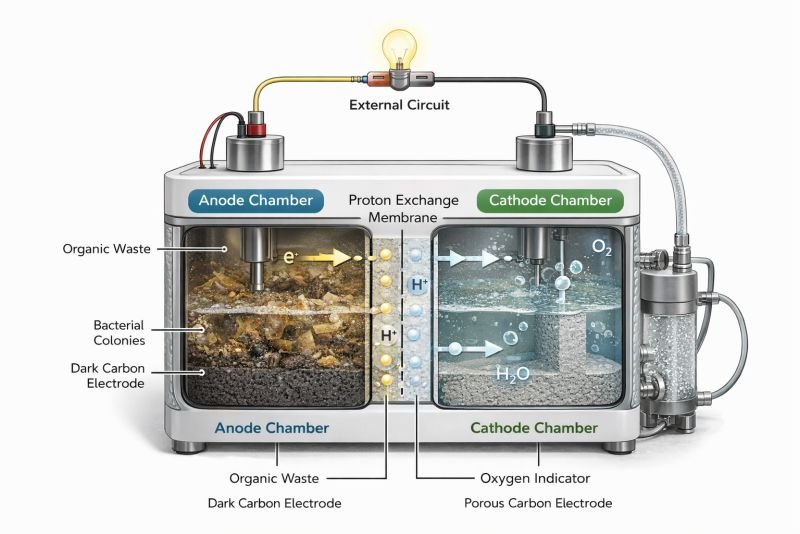
The electrons that reach the anode travel through an external circuit to the cathode, closing the electrical loop. At the cathode, those electrons combine with oxygen and the protons that have migrated through the proton exchange membrane separating the two chambers:
O2 + 4H+ + 4e- → 2H2O
The proton exchange membrane does two jobs at once: it lets protons pass through to the cathode while keeping oxygen out of the anode chamber. The bacteria require strictly anaerobic conditions. Any oxygen leak into the anode chamber poisons the exoelectrogens and stops current production. Getting this balance right across years of continuous operation, with a membrane exposed to a biologically active environment, is one of the harder engineering problems a home device would need to solve before it belongs in a kitchen.
What a Home Microbial Fuel Cell Could Actually Process
Not all kitchen waste performs equally. Exoelectrogens prefer simple, soluble organic molecules. Glucose, acetate, lactate – these are processed quickly and produce high electron transfer rates. Complex substrates like cellulose, intact starch, proteins, and lipids require longer residence times, often because they need hydrolysis into simpler molecules before the bacteria can access them. A home device that accepts the full variety of kitchen output would need either a pre-treatment step or a multi-zone architecture that handles different substrates at different processing rates.
The Kitchen’s Energy Content by Waste Type
| Waste Type | COD (g/kg) | Processing Speed | Notes |
|---|---|---|---|
| Fruit scraps (sugars, acids) | 500-800 | Fast | Highest electron yield per gram |
| Cooked grains (starch) | 300-500 | Moderate | Consistent output, predictable |
| Vegetable peelings | 100-300 | Moderate | High water content dilutes effective COD |
| Meat scraps (protein) | 250-400 | Slow | Elevated H2S risk from sulfur compounds |
| Fats and oils | 700-1100 | Very slow | High energy density; requires specialized microbial communities |
Fats carry the most energy per gram by a significant margin. They are also the most difficult substrate for typical exoelectrogens to process at rates that produce useful power densities. A device optimized for the bulk of most kitchen output – cooked starches, vegetable waste, and fruit scraps – would perform more predictably than one attempting to handle fats and proteins at the same throughput.
Temperature and the Bacterial Threshold
Mesophilic exoelectrogens operate efficiently between 30 and 37 degrees Celsius. Below 20°C, metabolic activity falls sharply. Below 15°C, most electroactive species slow to near-zero current output. This is not a minor caveat – it is a constraint that shapes where a home device can be placed and how it must be built.
A home MFC in a well-heated kitchen would perform adequately year-round. The same device in an unheated basement utility space during winter would need its own low-power heating element to maintain bacterial activity. That heating element consumes electrical energy – which partially offsets the output being generated. Device placement, thermal insulation around the anode chamber, and thermal management become design requirements from the first iteration, not corrections added later.
How the Device Could Operate
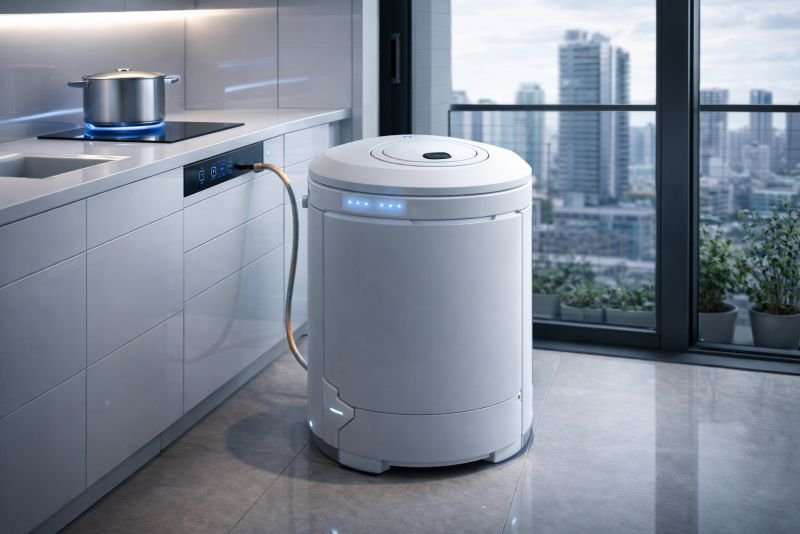
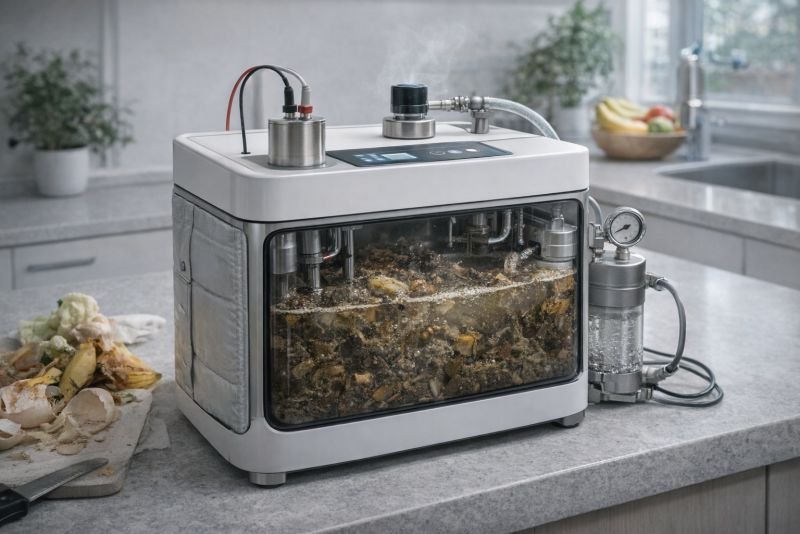
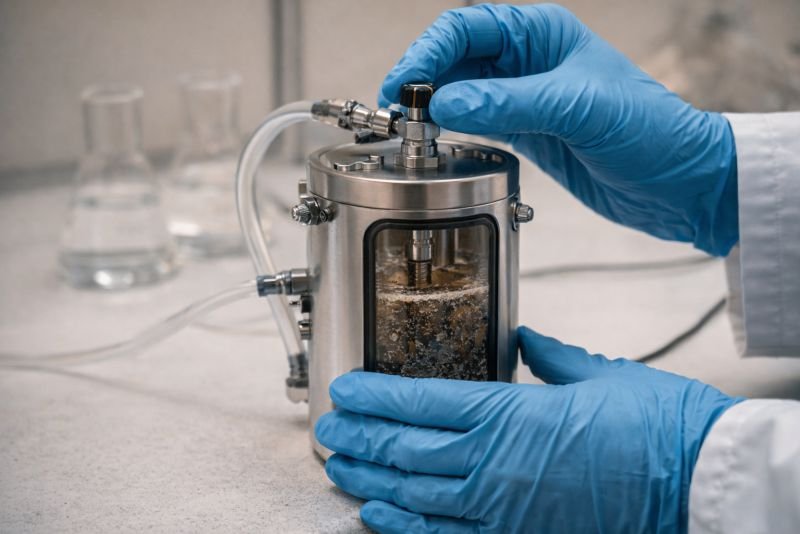
A home MFC would occupy roughly the footprint of a large countertop appliance. The anode chamber takes most of the interior – a thermally insulated, sealed, anaerobic space where bacterial colonies establish themselves on a high-surface-area carbon electrode. Organic waste enters through a sealed intake port, mixed with a small volume of electrolyte solution that maintains ion conductivity through the liquid phase. A proton exchange membrane lines one interior wall, dividing the anode space from a thin cathode zone. The cathode faces ambient air through a gas-permeable outer layer. An external circuit connects the two electrodes through a power conditioning unit that stabilizes the variable voltage before passing it to a battery buffer.
Inside the Anode Chamber
Electrode surface area determines power output. A flat carbon plate offers relatively little. A compressed mass of carbon fiber, graphene-enhanced carbon felt, or high-porosity biochar granules offers orders of magnitude more contact area per unit volume – and therefore far more surface for bacterial colonization. Exoelectrogens build biofilms across every accessible surface during the first weeks of operation, which means a home MFC would not reach stable output immediately. It would require an establishment period, likely two to four weeks, before the bacterial community stabilizes and current production reaches its operating level.
A well-designed anode chamber would also capture biogas. Anaerobic bacterial communities produce methane alongside carbon dioxide during organic degradation, and that methane represents a second energy stream from the same waste input. A device with a gas collection port and small storage capacity would deliver both electricity and combustible gas from a single load of kitchen scraps. The additional mechanical complexity is real. So is the improvement in overall energy recovery.
The Smell Problem and Its Solution
Anaerobic digestion of organic material produces hydrogen sulfide. Bacterial processing of protein-containing waste amplifies this. A home MFC that is not hermetically sealed, with controlled gas exit through appropriate filtration, will smell – and the smell will be noticed immediately in a living space. This is not a speculative concern derived from theoretical chemistry. It is a basic consequence of operating an anaerobic biological system at room temperature with variable inputs.
The engineering response is a sealed anode chamber with all gas exit routed through activated carbon filtration, combined with a one-way valve intake system designed to prevent backflow during waste loading. Odor containment must be a primary design requirement from the first prototype iteration. Any architecture that defers this problem to the final product stage will encounter it at the worst possible time.
Everything here is free. Readers are the reason it stays that way.
I make all of it alone, with no ads. If it is worth a coffee a month to you, that keeps the next one coming.
Keep it alive →The Numbers Behind One Kitchen Reactor
A household of four generates approximately 500 to 700 grams of organic kitchen waste per day. Assuming an average chemical oxygen demand of 200 grams per kilogram of mixed waste – reasonable for a diet that includes cooked grains, vegetable scraps, and fruit – the total daily COD available to the reactor is:
m_COD = 0.6 kg/day x 200 g COD/kg = 120 g COD/day
The theoretical energy content of organic matter at standard biochemical oxidation is approximately 3.86 watt-hours per gram of COD. The available energy per day is therefore:
E_theoretical = 120 g x 3.86 Wh/g = 463 Wh/day
That is the ceiling. A home MFC operating at 20% electrical conversion efficiency – a plausible target for a mature compact device with well-established bacterial communities – would yield:
E_electrical = 463 x 0.20 = 93 Wh/day, or roughly 3.9 watts continuous
At 35% efficiency, achievable with improved electrode architecture and optimized microbial community composition:
E_electrical = 463 x 0.35 = 162 Wh/day, or 6.8 watts continuous
Seven watts is not a number that changes anyone’s energy bill. What it does change is the energy accounting of a specific waste stream. At 6.8 watts, a home MFC can sustain a full apartment’s LED lighting load, run a low-power WiFi router and sensor network indefinitely, or continuously charge small devices. The device is not a primary energy source. It is a waste-stream recovery system that generates electricity as a byproduct – which is why the numbers are interesting even when they are modest.
From Counter to Grid – The Evolutionary Arc of Home Bioelectrochemical Systems

A single countertop device producing 4 to 7 watts is an appliance. Ten of them in an apartment building, networked through shared organic waste collection, constitute a waste processing system that generates distributed power as a secondary output. A thousand of them across a neighborhood – handling kitchen waste, restaurant scraps, and organic material from urban food production – begins to resemble distributed baseload infrastructure.
First-generation home MFCs would be standalone, batch-fed devices requiring manual waste loading and periodic maintenance. Bacterial communities would need initial inoculation and occasional monitoring. Output would vary with waste composition and seasonal temperature. These are the constraints of early adoption, not permanent limits.
Second-generation devices would integrate with kitchen plumbing, with organic-rich wastewater from dishwashing and food preparation feeding directly into the anode chamber alongside solid waste. Continuous flow replaces batch loading. Remote monitoring through a home energy management system replaces manual inspection. The device becomes a background system, not an appliance that demands attention.
Smart home integration arrives naturally at this stage. A home MFC generates continuous data – bacterial metabolic rate, substrate composition inferred from output voltage patterns, gas production volume, electrolyte conductivity. That data, passed to a building management system, enables the device to signal feeding status, flag bacterial community decline before output drops, and optimize waste routing between composting and electrical recovery based on substrate type. The bioreactor becomes a sensor node as well as a generator.
Third-generation systems emerge at building or block scale. Organic waste aggregated from multiple households feeds large anode chambers with significantly higher electrode surface area. Biogas recovery feeds building heating systems. Electrical output contributes to a local microgrid. At this scale, the value proposition shifts from individual energy recovery to community waste processing with power and heat as co-products. A city that routes a meaningful fraction of its food waste through bioelectrochemical infrastructure rather than landfill is not harvesting electricity from trash – it is closing a metabolic loop that urban civilization has left open since industrialization.
Open Questions for Future Developers
The chemistry behind an MFC is not contested. What remains genuinely open is the engineering translation from a well-understood laboratory phenomenon to a household device that survives years of use.
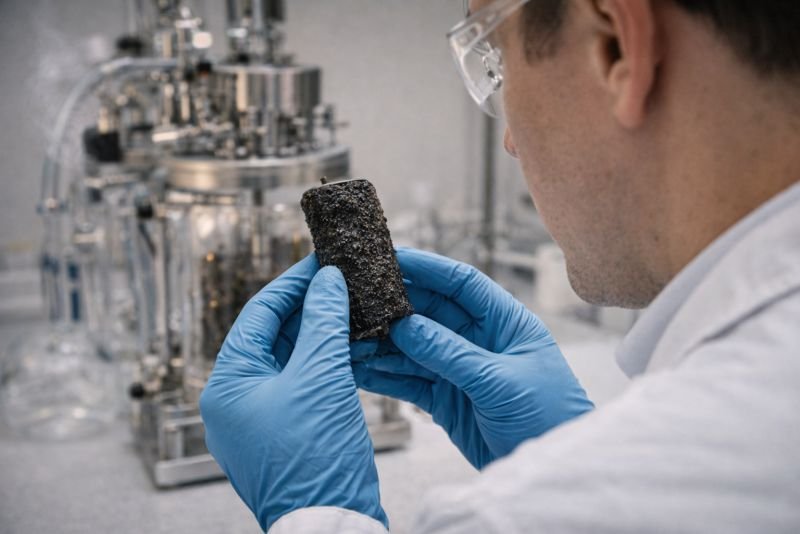
Electrode longevity under continuous exposure to mixed organic waste inputs has not been demonstrated at household timescales. Bacterial biofilms that improve conductivity during establishment phases thicken over time and eventually become resistive barriers. Whether this can be managed through electrode geometry, periodic electrochemical cleaning cycles, or controlled biofilm thinning protocols is a real design question without a settled answer.
The proton exchange membrane presents a parallel durability challenge. Standard PEM materials perform well under controlled laboratory conditions, but continuous exposure to biologically active, chemically variable inputs accelerates degradation in ways that multi-year household performance data would need to characterize.
Bacterial community stability under variable household waste inputs is the least understood operational variable. A microbial community enriched on one household’s predominantly starch-based waste might respond differently to a sudden shift toward protein-heavy inputs than a community adapted to a varied diet. Whether home devices would need periodic community refresh from a standardized inoculum, or whether stable self-selecting communities would emerge naturally from consistent waste exposure, shapes the entire maintenance model for the device.
The dual-output design – electricity plus methane – adds engineering complexity that household product development has not yet had to address. Methane collection and routing in a residential setting raises safety, regulatory, and infrastructure questions that laboratory MFC research operates well upstream of. Solving the electrical output problem first and treating gas recovery as a second-generation feature is probably the practical sequencing, but it leaves significant value on the table during the period that matters most for adoption.
The View From NoSuchDevice
I find the home MFC concept compelling for a reason that has nothing to do with the electricity output. Seven watts from a kitchen is not exciting. What is interesting is the structural position the device occupies: it converts a waste stream into useful energy without combustion, without a grid connection, and without asking anyone to change behavior. The user throws food scraps into a different bin. Everything else happens below the counter.
The engineering problems are not trivial and should not be presented as if they are. Membrane longevity, electrode fouling, odor containment, temperature sensitivity – any single one of these can make the device impractical if it is not properly solved. A kitchen appliance that requires biological maintenance expertise from its user is not a kitchen appliance. It is a laboratory experiment with a product design problem.
The more honest version of this technology’s case is the building-scale and neighborhood-scale arc. A single home device is an interesting proof of concept with modest output. A block-scale bioelectrochemical system that processes organic waste from a hundred households, generates meaningful electrical output for local consumption, and eliminates the energy cost and emissions of landfilling that organic material – that is a genuinely useful infrastructure technology. The home device is the seed. The infrastructure is the actual destination.
I do not expect the kitchen version to arrive before the neighborhood version is operational at scale. The engineering discipline required to make a home MFC reliable enough to sell to ordinary households is substantial – and the commercial justification for that investment is stronger at building scale, where the energy numbers are large enough to matter to building operators. When city-scale bioelectrochemical systems become normal infrastructure for organic waste processing, the kitchen device will follow as a natural product extension.
The physics is patient. The engineering will catch up.
You read the whole thing.
That is rarer than it should be, and it is the exact kind of attention I built this archive for. I make every piece alone, with no ads and no investor deciding what gets written. If you want the next machine taken apart like this one, you can help me make it.
A coffee a month is enough to keep it free for everyone.
Prefer crypto or a one time gift? Other ways to give →