



Every week, a typical urban household carries out roughly 3 to 5 kilograms of organic waste. Vegetable peels, coffee grounds, leftover rice, bread that went stale on Tuesday. It travels downstairs, joins a bin on the street, and disappears into the logistics of municipal collection. Somewhere far from the kitchen, usually, it either rots in a landfill or gets processed in an industrial biogas plant the size of an aircraft hangar.
The industrial plant works. The problem is the distance between it and the kitchen.
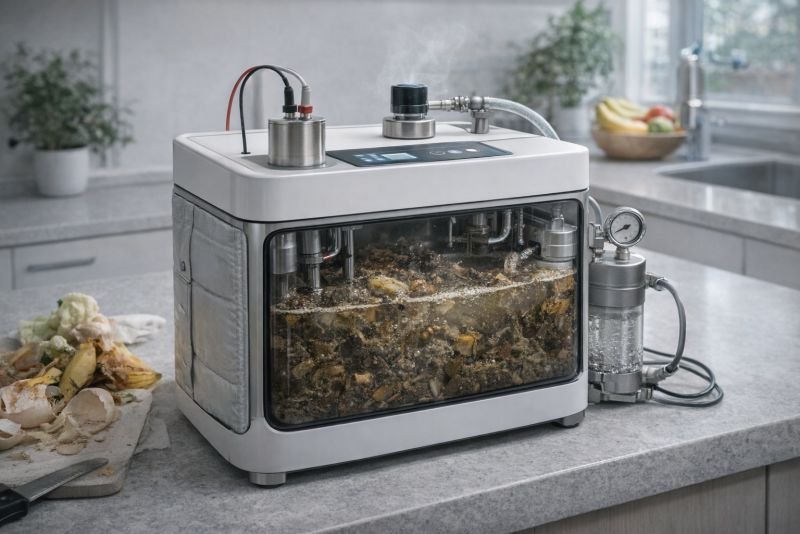
The short version: A portable bio-reactor for urban apartments would use anaerobic bacteria to break down kitchen food scraps and produce usable cooking gas on site. A 40-liter device running in thermophilic mode could realistically supply 40 to 60 percent of a household’s daily cooking energy from waste that currently goes to landfill. The engineering barriers are genuine – gas pressure management, CO2 removal, hydrogen sulfide handling, and the stubborn physics of small-scale fermentation – but none of them violate known chemistry.
Key Takeaways
- Anaerobic bacteria convert food waste into methane – the same gas in a kitchen stove – without combustion, without electricity input beyond heating, and without much intervention once the colony is stable
- The scale problem is biological, not just mechanical: small reactors lose efficiency faster than their volume shrinks, and this is the central engineering problem the device has to solve
- A 40-liter thermophilic reactor processing 800g of food scraps per day could produce roughly 2.5 kWh of usable gas – enough to cover about half a household’s cooking energy needs
- Raw biogas contains 35 to 45 percent CO2 and traces of hydrogen sulfide; both must be removed before the gas reaches a burner, and the device must do this silently inside a kitchen
- The apartment bio-reactor is the seed form of a more persuasive idea: when every unit in a building feeds a shared basement reactor, the physics stops being marginal and starts being genuinely useful
Table of Contents
Why Fermentation Gets Worse as You Shrink It
There is a law operating quietly inside every biogas plant, and it is not kind to the idea of apartment-scale digestion.
Large anaerobic reactors maintain stable internal conditions almost by inertia. The bacterial populations have room to specialize and reach equilibrium. Temperature drifts slowly. pH swings that would poison a small system get buffered across thousands of liters. Feedstock variation – a day with more fat, a day with more starch – gets absorbed into a large biological mass that does not notice. Scale is a stabilizer.
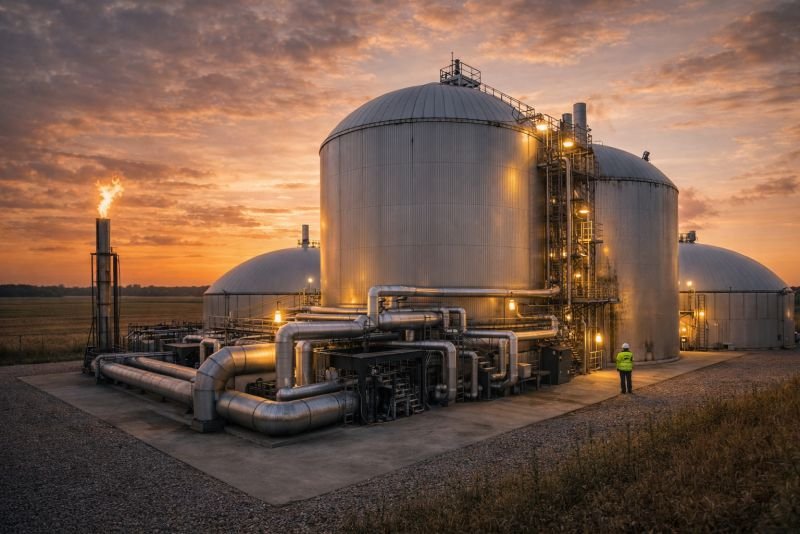
Shrink the vessel by a factor of twenty and the math changes direction. Surface-to-volume ratio increases sharply, which means heat loss per liter of reactor volume climbs. pH fluctuations become more severe with the same input variation. A feedstock mistake that a large reactor absorbs can swing a small one enough to stall methanogenesis entirely. The bacteria that produce methane – the methanogens – are slow-growing, chemically sensitive organisms that require conditions a large system maintains passively and a small one has to engineer deliberately.
This is not a problem that clever materials or a better app can dissolve. The physics of small-scale anaerobic digestion is structurally less favorable than at industrial scale. A portable bio-reactor for urban apartments is not trying to replicate the plant – it is trying to find the operating window where small-scale fermentation becomes good enough to justify the device’s existence in a kitchen.
That window is narrow. It exists. And it requires making two foundational decisions before any engineering happens.
Two Choices That Define the Reactor
Every design decision in a portable bio-reactor flows from two upstream choices. Get either wrong and no amount of refinement downstream will fix the result.
Wet or Dry Fermentation
Conventional anaerobic digestion runs wet – organic material diluted in water to roughly 5 to 10 percent total solids content, producing a pumpable slurry that mixes uniformly and feeds bacteria evenly. Wet digestion is well-understood and reliable. For an apartment device, it creates a straightforward problem: volume. A wet-process reactor handling 500g of food waste daily requires several liters of added water per cycle and must manage that liquid continuously. Over a 20-day retention period, the device is essentially a 40-liter tank of warm bacterial soup, and the water in that soup has to go somewhere.
Solid-state anaerobic digestion operates at 20 to 35 percent total solids – far less water, smaller effective volume, higher concentration of degradable material per liter of reactor space. The tradeoff is reduced mixing efficiency and greater sensitivity to feedstock composition. For an apartment device, the volume argument outweighs those tradeoffs. A 40-liter solid-state reactor processes the same organic load as a wet reactor two to three times larger.
Mesophilic or Thermophilic Operation
The other choice is temperature, and it matters more than most people expect.
| Parameter | Mesophilic (35-38°C) | Thermophilic (52-58°C) |
|---|---|---|
| Retention time | 20-30 days | 10-15 days |
| Methane content in raw biogas | 55-65% | 60-70% |
| Pathogen destruction | Partial | Near-complete |
| Temperature tolerance | ±5°C acceptable | ±2°C required |
| Heating energy demand | Lower | Higher, but justified |
Thermophilic bacteria work faster. At 55°C, a 40-liter reactor achieves the throughput that mesophilic operation would need 80 to 100 liters to match. The cost is tighter temperature control – the device must maintain 55°C with precision, which requires insulation and a regulated heating element. The energy cost of that heating is modest relative to the gas output, but it cannot be ignored.
For a device trying to fit a meaningful fermentation capacity into an under-counter cabinet, thermophilic solid-state digestion is the combination that makes the numbers defensible.
How a Portable Bio-Reactor Could Operate
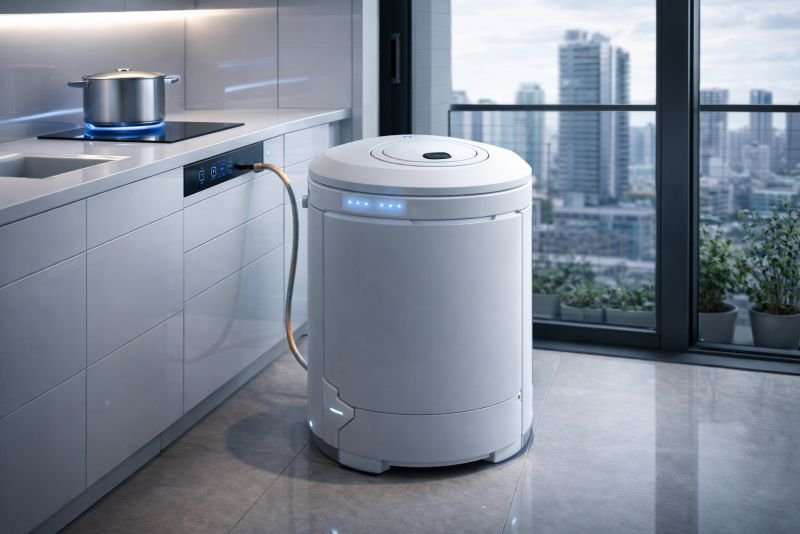
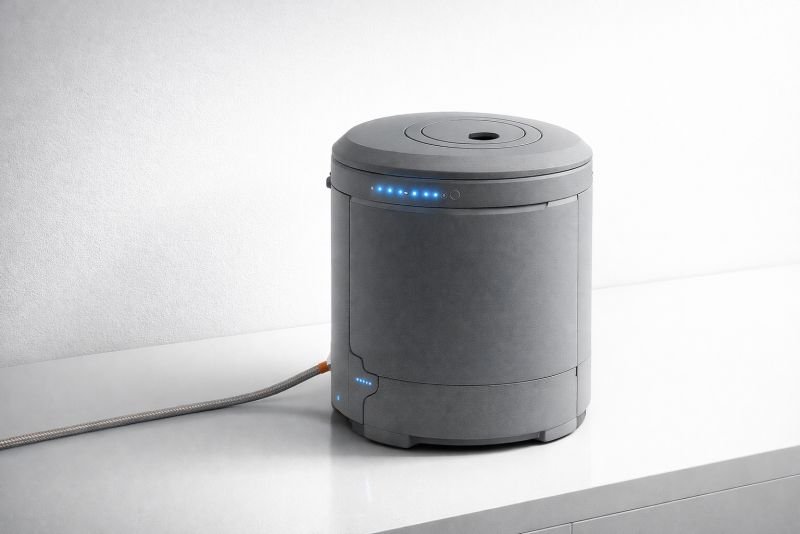
Picture the device in physical terms. A cylinder roughly 60 centimeters tall and 35 centimeters in diameter – the dimensions of a large catering stockpot but taller. Total active volume: 40 liters. Outer shell: insulated composite, matte finish, no visible vents. A control panel on the front displays temperature and gas level. A thin hose exits near the base and runs along the wall to the stove.
Loading and Maintaining the Bacterial Environment
Food scraps enter through a sealed top port, shredded first by a small integrated grinder – smaller particle size accelerates bacterial breakdown because it increases surface area available to the first-stage bacteria. The feeding mechanism uses a double-valve sequence: the inner chamber is never directly exposed to air when the port is open. Methanogens, the archaea responsible for actual methane production, die on contact with oxygen. The entire loading sequence takes about 30 seconds.
Temperature inside is maintained at 55°C by a resistive heating element controlled by a precision thermostat. The fermentation process itself releases some heat – exothermic at the margin – so the external heating requirement is lower than the target temperature implies, particularly in a warm kitchen.
The bacterial community is inoculated once at initial setup, from digestate taken from an active system. After that, it self-sustains as long as feeding is regular and the temperature holds. Irregularity – missed feedings, sudden temperature swings – can stress the community. The device monitors internal pH and gas production rate, alerting the user when conditions drift outside operating range before the situation becomes unrecoverable.
Gas Pressure and Why It Cannot Be Left to Chance
Biogas accumulates in a flexible internal bladder above the solid mass, expanding as the bacteria produce it. As the bladder fills, a small compressor transfers gas into a sealed 3-liter metal buffer tank at 0.3 to 0.5 bar – low pressure, comparable to LPG in a camping cylinder, far below the pressures in a natural gas distribution network.
From the buffer tank, a regulator steps pressure down to the burner’s operating requirement and a flow meter records consumption. A pressure relief valve set to 0.8 bar vents to outside through a wall penetration the diameter of a dryer duct. Nothing in the system operates at high pressure inside the living space. The only pressurized component sits inside a sealed metal housing, not exposed to the kitchen air.
The fire risk in any biogas system is gas accumulation in a confined space. The design eliminates the accumulation point by keeping gas either inside the sealed reactor, inside the sealed buffer vessel, or moving through the hose to the burner. There is no intermediate storage in the kitchen atmosphere.
Cleaning the Gas Before It Reaches a Burner
Raw biogas from food waste contains roughly 55 to 65 percent methane, 35 to 45 percent carbon dioxide, traces of hydrogen sulfide, and water vapor. The CO2 does not burn. Running raw biogas through a stove calibrated for natural gas or LPG produces a weaker, yellower flame – inefficient combustion and potentially incomplete, depending on burner geometry.
The device routes biogas through a water-scrubbing column before the buffer tank. Gas bubbles upward through 2 liters of water; CO2 dissolves into the water preferentially while methane passes through. One pass through this column at near-atmospheric pressure removes 70 to 80 percent of the CO2, raising methane concentration to 80 to 85 percent. A standard gas burner runs cleanly on this, with a minor orifice adjustment to account for the different energy density compared to natural gas.
The CO2-saturated water that exits the scrubber is a secondary output. Warming it or aerating it releases CO2 gas at usable concentrations – enough to supply an aquarium plant system or a small home carbonation setup. Small, but not zero.
Hydrogen sulfide is present in biogas at 200 to 2000 parts per million depending on feedstock composition. At those concentrations it corrodes copper fittings, smells strongly at single-digit ppm, and becomes toxic above 10 ppm in an enclosed space. Before the CO2 scrubber, biogas passes through a small iron oxide bed that binds H2S through a simple chemical reaction. The bed regenerates periodically by exposure to air and needs full replacement every few months – a consumable roughly the size and cost of a water filter cartridge.
Digestate
The residue of anaerobic digestion – digestate – accumulates inside the reactor and must be removed on schedule. A 40-liter thermophilic device processing 800g of food waste per day generates roughly 60 to 90 grams of digestate daily. After 12 to 15 days, a cleaning cycle drains 1 to 1.5 liters of dense, nutrient-rich material through a sealed port at the base into a collection bag.
Digestate is an excellent fertilizer. Urban apartment residents without gardens have limited use for it in that form. The collection bag goes into the waste stream as a concentrated organic package, which is a better outcome than raw food waste but not a complete solution. Building-level deployments, discussed later, offer a more coherent answer to where digestate goes.
Everything here is free. Readers are the reason it stays that way.
I make all of it alone, with no ads. If it is worth a coffee a month to you, that keeps the next one coming.
Keep it alive →What the Household Arithmetic Actually Shows
A three-person household generates roughly 1.5 to 2 kilograms of organic kitchen waste per day. Whether a 40-liter thermophilic device can meaningfully process that, and what comes out, is a calculation worth doing explicitly.
At 25 percent total solids content and a 12-day thermophilic retention time, the device accepts approximately 3.3 liters of prepared feedstock per day. At 25 percent TS concentration, that corresponds to 825 grams of total solids. Volatile solids – the fraction bacteria actually degrade – represent roughly 85 percent of total solids:
Daily volatile solids input = 825 g × 0.85 = 700 g VS
Biogas yield from mixed food waste runs between 400 and 550 liters per kilogram of volatile solids. Using a conservative 450 L/kg:
Daily biogas output = 0.70 kg VS × 450 L/kg = 315 liters
After CO2 scrubbing, methane concentration reaches approximately 82 percent. Usable methane per day: 258 liters, or 0.258 cubic meters.
Methane energy content: 35.8 MJ/m³.
Daily energy output = 0.258 m³ × 35.8 MJ/m³ ≈ 9.2 MJ ≈ 2.6 kWh
A European three-person household uses between 3 and 6 kWh per day for cooking, depending on diet and habits. The device covers 43 to 87 percent of that, with the realistic middle landing around half.
Half a household’s cooking energy from material that currently goes to landfill. That number passes the straight-face test – not by a large margin, but it passes.
Connecting the Reactor to the Kitchen
A bio-reactor that produces methane is not useful until that methane reaches an appliance. The connection is not technically difficult, but it is not trivial either.
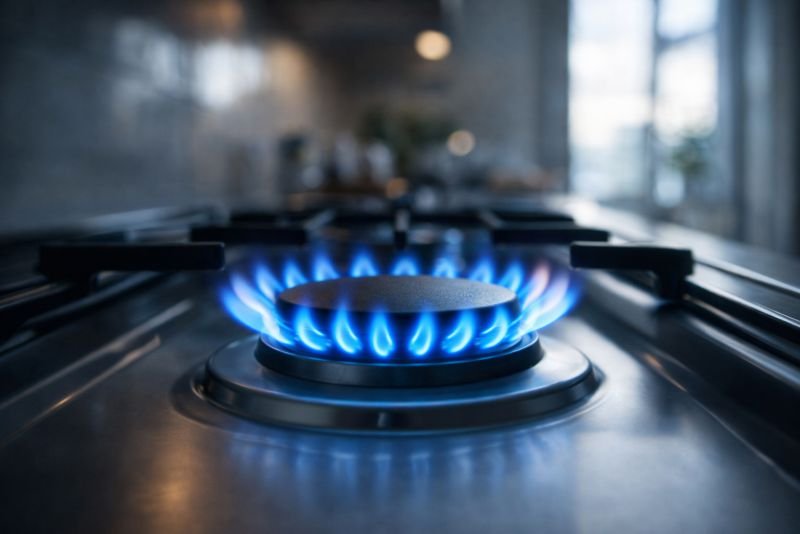
The simplest integration is a direct low-pressure hose from the buffer tank to a dedicated single-burner gas hob mounted near the device, or to an existing gas range through a compatible fitting. Gas pressure from the device after regulation sits at 20 to 30 mbar – comparable to low-pressure natural gas distribution in European residential networks. The difference in gas composition from standard natural gas requires a calibrated burner orifice, which determines the gas-to-air ratio at the burner face. This is a well-understood adjustment; burners are already rated and certified for different gas families.
A more integrated design routes gas to a combi boiler or water heater in buildings where cooking gas and hot water share a single gas supply. This extends the device’s impact beyond the stove. Small methane fuel cells – capable of converting gas to electricity at 40 to 55 percent efficiency – represent a third connection option for buildings without gas infrastructure, though the efficiency penalty makes this the weakest choice energetically.
What does not yet exist is a standardized low-pressure adapter for domestic appliances that assumes an on-site biogas source. The device concept imagines a simple connector – analogous to a garden hose fitting – that plugs into certified appliances with a local pressure regulator. The engineering of that connector is straightforward. The certification pathway for it is the harder problem, and that problem belongs to the next section.
The Regulatory Gap Between Physics and an Installation Certificate
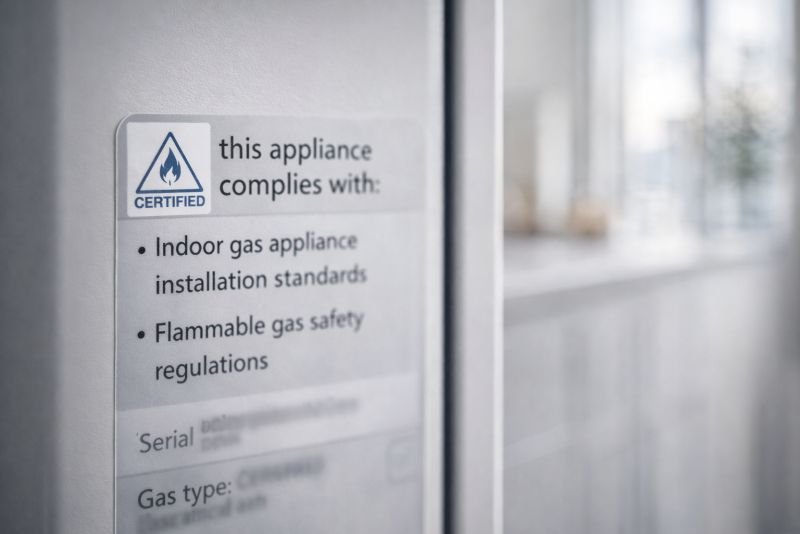
A device that produces and stores flammable gas inside a residential apartment is something building codes examine carefully. That is not an objection to the concept – it is a structural challenge with a navigable path.
The certification gap is real. Gas appliance safety standards, residential installation codes, and fire regulations in most jurisdictions were written for natural gas and LPG at fixed pressures from known sources. A domestic device producing variable-composition methane at low pressure from biological feedstock sits outside every existing product category. There is no certification pathway because there is no category.
What does exist is precedent in neighboring categories. Indoor LPG appliances are permitted under specific installation standards in dozens of countries. Residential fuel cells running on natural gas have been certified in Japan and parts of Germany and Italy. Sealed composting units with internal gas management are permitted in some residential codes. A portable bio-reactor that produces methane below 0.5 bar, stores it in a sealed metal vessel, routes it through certified connectors to a certified appliance, and exhausts to outside through a wall penetration is not categorically more dangerous than any of these.
The regulatory path is jurisdiction-specific, uncertain, and will require purpose-built standards for this device class. In some markets, the device may need to be classified as a gas appliance and certified accordingly. In others, it may fall under composting equipment with gas recovery. Getting a device from physics to certification takes longer than building the device. That is the honest assessment. It is also not permanent.
From One Apartment to a Building
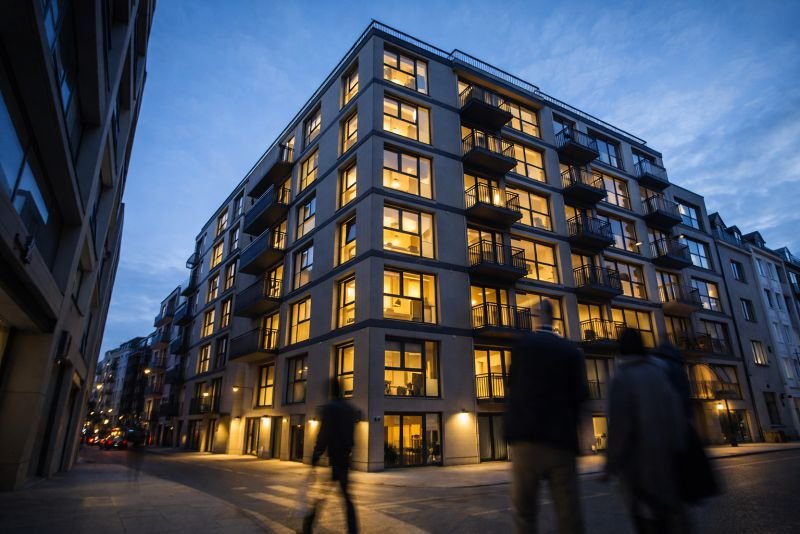
A single apartment bio-reactor is an interesting device. A building where every kitchen connects to a shared gas riser fed by a basement digester is something different in kind.
The apartment device proves the concept and handles the retrofit case – buildings where central infrastructure cannot be changed. It demonstrates that urban organic waste has energy value at the point of generation, and it shows what the bacterial process needs to stay stable in a confined space.
At building scale, the physics becomes more persuasive. A 20-unit residential building generates 30 to 50 kilograms of organic waste per day. A single basement reactor of 800 to 1200 liters fed by this waste operates in a fundamentally more favorable regime – the bacterial population reaches genuine equilibrium, temperature management becomes efficient across a large thermal mass, and gas output stabilizes into a usable and predictable flow. Digestate at building scale has obvious destination: a collection point for municipal organic waste services or on-site composting for shared green spaces.
Urban building typologies suggest different adoption paths. Dense residential towers in Japan and South Korea – buildings with active management associations and shared infrastructure maintenance – are natural first environments for centralized building-level systems. European apartment blocks with more individual kitchen space but less coordinated management might adopt the individual device first, demonstrating the economics before a building committee votes on a shared system. Both paths lead toward the same infrastructure idea: organic waste as a local energy source rather than a logistics problem.
The apartment device and the building reactor are not competing concepts. One is the seed. The other is what grows from it when the scale conditions favor it.
The View From NoSuchDevice
I find the honest version of this device more interesting than the optimistic one.
The optimistic version says: turn kitchen waste into cooking gas, close the urban energy loop, empower city dwellers. That framing has circulated in appropriate technology and sustainability circles for decades, and it has not produced a certified apartment product. The reason is not lack of interest.
The honest version is that fermentation at small scale carries a biological efficiency penalty that engineering can reduce but cannot eliminate. You close the gap with thermophilic solid-state digestion, and the numbers become defensible – 2.5 kWh per day from kitchen waste is real energy, not rounding error. But the digestate problem has no elegant solution in a 40-square-meter apartment, the regulatory path is genuinely difficult, and maintaining a living bacterial colony through holidays and irregular feeding schedules is a maintenance burden most people will underestimate until the colony crashes.
Where I think this makes sense is as a building infrastructure choice, not a consumer appliance. The apartment device earns its place as a demonstration and a retrofit tool. The basement reactor of a 20-unit building is where the economics actually work and the operational complexity becomes manageable by a single building maintenance contract. I would find it more useful for urban planning to require on-site organic waste processing in new residential construction than to imagine a thousand individual reactors in a thousand individual kitchens.
That said: the physics here is honest. Nothing in this device asks nature to do something unusual. It asks nature to do what it does in landfills and marshes and compost heaps – just in a smaller, warmer, more controlled environment, with the gas captured before it leaves. That is not a radical idea. It is delayed engineering, which is exactly the kind worth examining.
You read the whole thing.
That is rarer than it should be, and it is the exact kind of attention I built this archive for. I make every piece alone, with no ads and no investor deciding what gets written. If you want the next machine taken apart like this one, you can help me make it.
A coffee a month is enough to keep it free for everyone.
Prefer crypto or a one time gift? Other ways to give →